
Is This Invention That Supports the Burden of Modern Camping Really Necessary?
While camping starts with the desire to be one with nature, the search for comfort has significantly inflated equipment lists today. The paths that used to be traversed with just a backpack are now filled with foldable chairs, inflatable mattresses, large cooler boxes, and kitchen sets. At this point, foldable wagons come into play, allowing you to transport all this weight to your campsite in one go. These vehicles ensure that you save your physical energy for enjoying the camp rather than carrying items, and they have become a basic necessity for modern campers who do not want to be crushed under heavy loads. Owning a wagon means freeing yourself from back pain and professionalizing the logistics process.
Does Wheel Width Really Make a Difference on Sandy Beaches?
The performance of a cart largely lies in the points where its wheels make contact with the ground. Standard thin-wheeled models perform excellently on hard surfaces and asphalt, but they can fail when it comes to sandy beaches or soft soils. Wide-profile, off-road wheels increase the surface area, ensuring that the weight is distributed more evenly on the ground and preventing the vehicle from sinking into the sand. If your camping routes often consist of coastal or loose terrain, opting for a model with wide wheels will halve the effort you need to exert to pull the cart. Trying to pull a wagon with thin wheels on sand can quickly turn into a physical torture and may also damage the wheel mechanism.
Steel Frame or Aluminum Body: Which Lasts Longer?
Material quality is the most critical factor determining both the durability and total weight of the wagon. Steel frames generally have a higher carrying capacity (100 kg and above) and are incredibly resistant to impacts; however, they have disadvantages such as the risk of rust and being heavy. Aluminum-bodied models, on the other hand, have a natural resistance to rust and are quite lightweight, making them much easier to load into your vehicle. In terms of longevity, quality steel frames coated with powder paint can serve for decades, while if your priority is lightness and avoiding coastal corrosion, aluminum is the right choice. In both cases, paying attention to whether the joints are plastic or metal will be the main determining factor for longevity.
Are Folding Dimensions Critical for Vehicles with Limited Trunk Space?
The biggest paradox of a camping cart is that while it offers a massive area for carrying items, it also takes up space in the trunk itself. The detail that users often overlook during the purchasing phase is the final form the wagon takes when folded. Some models only fold in half, while more advanced designs can fold accordion-style to fit into the size of a suitcase. If you have a small city car or your trunk is already packed with camping gear, models with "ultra-compact" folding features are crucial. A poorly chosen wagon that remains bulky even when folded can lead you to leave other essential camping gear (like a tent or sleeping bag) at home, which contradicts the very purpose of having a wagon.
How Does a Telescopic Handle Design Affect Your Waist Health?
The mechanics of your body while pulling a cart are directly related to the length and angle of the handle. Fixed-length handles can create ergonomic issues for users who are taller or shorter than average; this can invite back and shoulder pain during long-distance pulls. Telescopic (extendable and retractable) handles allow the user to adjust the height of the grip according to their own height, helping to keep the spine upright while pulling the load. Additionally, the flexibility of the point where the handle connects to the body reduces the load on the wrist during sudden maneuvers. An ergonomic grip not only means comfort but also control capability; therefore, lockable and adjustable handle mechanisms are essential for a quality wagon.
Is Denier Value of the Fabric the Only Criterion Determining Tear Resistance?
The fabric that makes up the body of wagons is generally referred to as "Oxford Polyester" and its durability is measured in "Denier" (D) units. A value of 600D or higher indicates that the fabric is quite thick and resistant to tearing. However, denier value is not the only criterion; the fabric's resistance to UV rays, the stitching being double-layered, and the way it attaches to the frame (whether it is Velcro or stitched) are equally important. Cheap fabrics that remain under the sun for long periods can become brittle over time and tear at the slightest load. Therefore, fabrics that are coated with polyurethane, have water-repellent properties, and can be easily removed and washed from the frame should be preferred for hygiene and long-term use.
Are Waterproof Covers a Necessity in Rainy Weather?
Camping life is not always about sunny and clear weather; an unexpected downpour can leave all your equipment soaked. Specially designed waterproof covers to protect the items inside the wagon are a critical shield for the safety of your gear. They not only protect against rain but also prevent your items from getting dirty on dusty and muddy roads. While some high-end models come with their own waterproof tarps, it is wise to acquire an external protective cover for standard models. Remember that a wet sleeping bag or camping kitchen equipment can completely ruin the comfort of your camping night; therefore, equipping your wagon with a "protective shield" is always a wise investment.
Do Wagons Serve as a Portable Crib for Families with Children?
Camping can sometimes turn into a logistical nightmare for families with small children. However, a safe, deep, and seat-belted wagon not only carries items but also transforms into a mobile space where children can rest when they get tired or even take a nap. Choosing models with canopies to protect children from the sun and supporting the interior with a soft mat maximizes comfort. Of course, safety is the most important element here; models designed for carrying children have much more advanced braking systems and anti-tip features compared to standard load wagons. With the right choice, your children can enjoy exploring the surroundings inside the wagon instead of getting tired on nature walks.
Is It Safe to Exceed the Maximum Carrying Capacity?
Every cart has a "static" and "dynamic" carrying capacity specified by the manufacturer. These values, which generally range from 80 kg to 150 kg, determine the safe operational limits of the vehicle. Exceeding or pushing these limits can lead to the frame breaking, wheel bearings failing, or the folding mechanism getting stuck. It is especially important to remember that the load becomes dynamic on uneven terrain, meaning the weight increases with jolts. If you load exactly 100 kg onto a cart with a 100 kg capacity and enter a bumpy path, the first dip can put excessive weight on the frame. Therefore, it is always safest to choose a model with a capacity slightly higher than what you need and to distribute the load evenly inside the cart.
How Does the Quality of Wheel Bearings Determine Riding Comfort?
How easily a wagon "rolls" is directly related to the bearing technology inside its wheels. Cheap models often use plastic bushings, while quality models prefer stainless steel ball bearings. Ball bearings minimize friction, allowing the cart to move fluidly enough to be pulled with just a fingertip even under heavy loads. Additionally, sealed bearing systems that prevent dust and mud ingress help avoid squeaks and wheel lock-ups that can develop over time. Trying out a wagon in the store when it’s empty is easy; however, the real difference will be determined when you load it with 50 kg and start going uphill. A quiet and fluid ride is also important to maintain the peaceful atmosphere of camping.
Can a Complex Folding Mechanism Lead to Time Loss?
Setting up and packing up camp is already a time-consuming process; therefore, your equipment should be "user-friendly." Some wagons can fold in seconds with a single pull of a central cord, while others require the wheels to be removed or the frame to be folded in a specific order. Complex mechanisms not only waste time but also have a higher potential for malfunction. "One-pull folding" systems make your job incredibly easier when you’re tired at the end of camping. Additionally, having a locking buckle to prevent the folded wagon from opening while placing it in the trunk prevents it from hitting anything. Simplicity is always synonymous with durability and speed in camping equipment.
Are Side Pockets and Cup Holders a Solution for the Organized?
Small details can sometimes make a big difference. Mesh compartments or cup holders on the exterior of the wagon are not just decorative. They prevent essential items like water bottles, sunscreen, phones, or maps from getting lost among the main load while you’re carrying them. Especially when using on the beach, using these special pockets instead of tossing your phone among sandy towels helps protect your device. Internal pockets found in some models ensure that valuable items like keys or wallets are stored securely. If you like to stay organized and don’t want to waste time searching for your items, multi-pocket models will serve as a great organizer for you.
How Broad Are the Usage Areas from Picnic Areas to Festivals?
Foldable carts are not just limited to camping areas; their usage areas are limited only by your imagination. At a picnic you’ll have on a city park over the weekend, they are ideal for transporting everything from your cooler bag to cushions from the parking lot to your table. At large music festivals, they become your biggest helper while transporting all your camping gear from distant parking lots to the campsite. Additionally, you can use these carts to bring heavy groceries from the farmers' market home, transfer small boxes while moving into an apartment, or carry soil and pots in your garden. Their versatility transforms the wagon from just a "once-a-year camping gear" into an indispensable helper equipment for the home.
Do Aluminum Alloy Models Compromise Durability for Lightness?
Lightness does not always mean weakness; thanks to modern metallurgy, aluminum alloys have reached incredible strength-to-weight ratios. Wagons made from aluminum profiles used in the aircraft industry can be both lightweight and safely carry loads of up to 80-90 kilograms. The critical point here is the flexibility of aluminum. While steel is stiffer, aluminum can bend a bit; this flexibility can actually serve as a suspension that prevents the frame from breaking on uneven terrain. However, the joints and plastic hinges of aluminum models should be chosen more carefully than steel models. If you plan to load the wagon by yourself and have health issues like a herni, a quality aluminum model that stands out for its lightness is definitely the preferred choice.
Is It Possible to Camp Safely Without a Brake Lock Mechanism?
Camping areas do not always provide a flat surface; often, you need to stay on uneven terrain. A wagon with a 50-kilogram load can pose a significant danger to both surrounding people and your equipment if it moves on its own. Foot brakes on the front wheels allow you to secure your cart at the desired point. Especially if you are carrying children or pets, a braking mechanism is not an option but an absolute necessity. Additionally, these locks provide great convenience to prevent the wagon from sliding while loading or unloading your items. A wagon lacking safety equipment can turn into an uncontrolled mass in nature; therefore, you should ensure that at least two of the wheels have a solid locking mechanism.
Is Extra Cushioning Necessary for the Comfort of Pets?
For campers who take their dogs on nature trips, wagons provide a great bed for their furry friends. However, the bottom of the wagon is usually covered with hard plastic or thin fabric, and the support rods underneath can be felt. If your dog will spend a long time inside the wagon or you plan to carry it here when it gets tired, placing a thick cushion or an old blanket on the bottom will protect its joints. Some brands offer removable and washable soft-bottomed models in their pet transport-focused designs. Putting a cushion that contains the scents your dog is accustomed to will make the camping experience much more peaceful for both sides.
Is It Practical to Turn a Cart into a Kitchen Counter?
For creative campers, wagons are not just a transport vehicle but also a multifunctional piece of furniture. Roll-up wooden or aluminum boards sold on the market or prepared with DIY methods can be placed on top of the wagon, instantly transforming it into a sturdy camping table or food preparation counter. This way, you won’t need to carry an extra camping table, saving space in the trunk. The depth of the wagon allows you to use the space under the table as a closed storage area (pantry); you will protect your food from direct sunlight or ground pests. Getting two different functions from a single piece of equipment is one of the smartest strategies of minimalist camping.
Does Warranty Period and Availability of Spare Parts Increase Investment Value?
When purchasing a camping wagon, you should not only look at the current price of the product but also the after-sales support offered by the brand. The wheels of these vehicles used on rough terrain can break, the fabric can tear, or the locking mechanism can fail. Products from well-known and reliable brands usually come with a warranty period of 2 years or longer, and most importantly, parts like "spare wheels" can be easily obtained. If you buy an unbranded, cheap model, you may have to throw the entire cart away due to a small part breaking. Therefore, when viewed as a long-term investment, choosing a brand with spare parts support will protect both your budget and nature (by preventing unnecessary waste).
Which Brands Maintain Their Value in the Second-Hand Market?
Camping equipment, when well-maintained, can be products that find buyers quickly in the second-hand market. If you plan to upgrade your wagon in the future or stop camping, the brand of the product you purchased will determine your selling speed and price. Brands like Coleman, Timber Ridge, Mac Sports, or Decathlon (Quechua), which are common in the Turkish market, maintain their second-hand value quite well due to their proven quality. When buying or selling a second-hand wagon, attention is paid to the rust condition on the frame, the ease of wheel rotation, and stains on the fabric. Buying a quality product means that even if you pay more at the beginning, you can recover a significant portion of your money when your usage period ends.
Is It Logical to Use It as a Shopping Cart in the City?
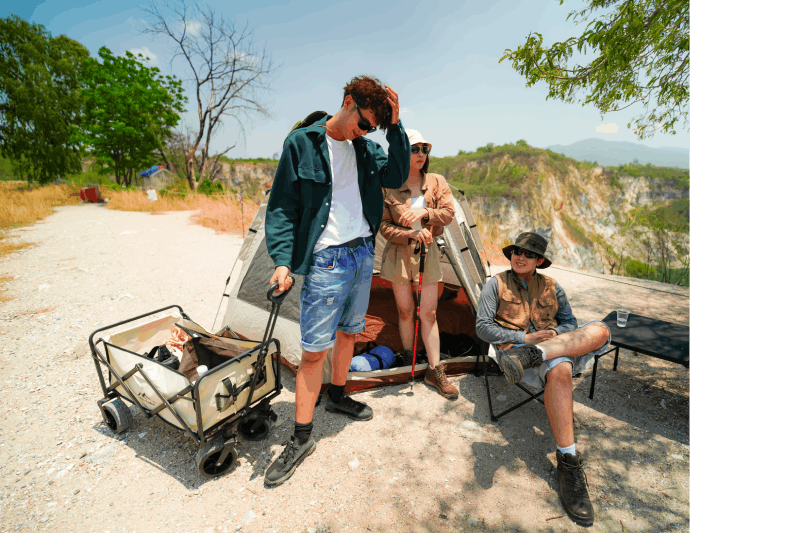
With the increasing popularity of wagons, they have started to be seen not only in forests but also in city centers. Especially for those living in buildings with elevators, carrying bags from the parking lot to home after grocery shopping can be a big hassle. A foldable wagon can be pulled out of the trunk and opened in seconds, allowing you to carry all the bags to the elevator in one go. Similarly, it provides great convenience when picking up heavy cargo packages from PTT or cargo branches. In urban use, it is important that the cart has high maneuverability and that its wheels are made of rubber material that does not make noise to avoid disturbing your neighbors. These multifunctional vehicles are a great solution to the logistical challenges of modern life.
Does Wheel Cleaning Become a Nightmare on Muddy Grounds?
After a rainy camping trip, the biggest hassle is cleaning the equipment that has gotten stuck in the mud. Especially mud that gets stuck between the deep-tread off-road wheels can dirty the cart's trunk if not cleaned before drying and can strain the mechanism during the next use. To overcome this problem, it is wise to choose wheel designs that are "self-cleaning" or have "mud drainage channels." Additionally, before leaving the campsite, rinsing the wheels with some water and then wiping them with a cloth will make your job easier. Some models allow the wheels to be completely removable, enabling you to wash them in the bathroom at home or place them in a separate bag in the trunk, which is invaluable for those who are particular about cleanliness.
How Do Depth and Width Ratios Affect Loading Ergonomics?
The interior volume of wagons should be evaluated not only in terms of "liters" but also in terms of "geometry." Very deep but narrow models require you to stack items on top of each other, making it difficult to reach the materials at the bottom. Wider and broader models allow items to be arranged side by side, which increases stability and speeds up the loading-unloading process. Additionally, in very deep models, constantly bending down to remove items can strain your back. An ideal wagon should be of a length suitable for a standard camping chair and a width that can accommodate a cooler box. When loading, placing heavy items towards the wheels and lighter, bulkier items (like sleeping bags) on top will improve the dynamics of the load.
Do Reflective Details Save Lives for Night Visibility?
Moving around in camping areas or along roads at night can be risky due to low visibility. Some wagon models have reflective (reflective) strips on the edges of the fabric or on the wheel rims. These strips light up when hit by a vehicle's headlights or a headlamp, helping to identify your location. If your wagon does not have this feature, you can enhance your safety by attaching reflective tape or a small bicycle light from the outside. Especially when moving along dark paths or crowded camping areas, this small detail can be crucial in preventing others from bumping into you or your cart. Being visible is an integral part of a safe camping experience.
Is Using a Wagon a Paradox for Minimalist Campers?
The philosophy of minimalist camping is based on the principle of "less gear, more peace." For someone with this perspective, carrying a large wagon may seem contradictory at first glance. However, a minimalist camper may sometimes need a helper to carry 20-liter water jugs when staying far from a water source. Or they may want to transfer very light but bulky equipment (like a giant sleeping bag for winter) in one go. The issue here is not how much gear you can fit into the wagon, but how effectively you manage the transportation process. "Mini wagon" models, which take up almost no space when folded, are specially designed to solve this paradox for minimalists.
Do Inflatable Tires Require Less Maintenance Than Solid Tires?
There are two main technologies for wagon wheels: inflatable (pneumatic) tires and solid (rubber/plastic) tires. Inflatable tires, like bicycle tires, are inflated with air and provide excellent shock absorption on uneven terrain, offering a smooth ride. However, they carry the risk of punctures from thorns or sharp stones and require regular inflation. Solid tires never puncture, require no maintenance, and are always ready for use; however, they can be bumpier on hard surfaces. Most campers prefer solid-tired models to avoid dealing with tire repairs in nature. If comfort is your top priority, inflatable tires are the best choice; if hassle-free operation is your priority, solid tires are the most logical option.
Can You Use Your Wagon as a Solar Panel Station?
With the integration of technology into camping life, wagons can now also turn into mobile energy stations. By placing a flexible solar panel on top of the wagon and a power station inside, you can charge your devices throughout the camping trip. Being able to easily rotate the wagon according to the sun's angle helps you get maximum efficiency from the panel. Additionally, you can completely change the ambiance of your campsite with a sound system or lighting pole that can be placed inside the wagon. These creative uses prove that a wagon is not just a "box for carrying items" but can also be a technological platform that enhances your camping comfort.
How to Manage Odor Issues When Carrying Fishing Equipment?
For fishermen, wagons are indispensable for carrying fishing rods, buckets, bait, and chairs over long distances. However, fish odors and wet equipment can seep into the wagon's fabric. To prevent this issue, it is essential to use a plastic "cargo pool" or a waterproof liner that can fit inside the wagon. Wiping the fabric with vinegar water and airing it out after each fishing trip will help prevent odors from penetrating the fabric. Additionally, rinsing the wheels with fresh water after each fishing trip to prevent them from rusting due to saltwater will extend the life of the bearings. In specific hobbies like fishing, the cleanability and corrosion resistance of the wagon should be at the top of your purchasing criteria.
Can Wheel Changes Be Made According to Different Terrain Types?
Some professional wagon models offer users the option to change wheels. For example, you can install quieter and thinner wheels when using in the city, and switch to wide balloon tires when heading to the beach on the weekend. This feature ensures that the wagon adapts perfectly to any terrain. The ability to remove and install wheels without tools thanks to "quick-release" pins is a significant advantage. If you want to achieve the highest performance on snow, sand, and asphalt with a single wagon, you should look for models with a modular wheel structure. Although these models may be more expensive initially, their flexibility eliminates the need to purchase separate vehicles for different needs.
Why Is It Important for Models to Stand Upright When Folded?
When you fold the wagon, it is a great convenience for it not to tip over until you put it in the trunk or store it at home. While some models lose their balance and fall over when folded, others can stand upright on their own thanks to special feet or wheel locks. This feature saves space, especially in narrow garages, apartment spaces, or when the wagon is not in use at the campsite. Additionally, models that can stand upright can be pulled like a suitcase when folded; this means you won’t have to carry it in your arms while transporting it from the parking lot to your home. These small engineering details that enhance user experience are the fundamental differences that distinguish a quality design from an ordinary one.
How to Prevent Arm Fatigue on Long Journeys with a Wagon?
Pulling a wagon, especially with heavy loads and over long distances, can tire your arm and shoulder muscles. To reduce this fatigue, models with a "push bar" can be preferred. Just like a baby stroller, pushing the cart from the front allows you to use your body weight and requires less energy than pulling. Some hybrid models have both a pull handle and a push bar; this way, you can change positions when you get tired. Additionally, distributing the load evenly inside the wagon, keeping the center of gravity low, and ensuring the wheels are well-lubricated will minimize the effort you expend. Remember, with the right technique and proper equipment, you can carry even a 100-kilogram load for miles without strain.
Are There Special Devices to Secure Beach Umbrellas?
Transporting and securing beach umbrellas on sandy beaches is always a hassle. Some wagon models come with special side slots or pipe sockets to secure umbrellas, fishing rods, or long camping table legs. With these devices, your long items won’t take up space inside the wagon and can be safely hung outside. In fact, some creative models allow the wagon itself to serve as a weight (base) for the umbrella; by mounting the umbrella to the wagon, you can prevent it from flying away. These types of attachments make your beach day much more organized and hassle-free. If such devices are not readily available, you can easily create your own securing solutions using simple "bungie" cords (elastic hooks).
Do Aesthetic Concerns and Color Options Reflect the Spirit of Camping?
When choosing camping equipment, aesthetics is as important as functionality for many users. Earth tones, olive green, or camouflage patterned models blend well with nature; while vibrant red, orange, or blue models help you easily find your wagon in crowded beaches or festivals. Additionally, light-colored fabrics heat up less under the sun, while dark colors hide dirt and stains better. Aesthetics is not only about color but also relates to the texture of the material used and the quality of stitching. A stylishly designed wagon will serve as a beautiful detail in your camping photos while reflecting your camping style and personality. Ultimately, using equipment that you love and enjoy looking at is always more motivating.
Are Base Plates Necessary to Prevent the Load from Sliding Inside the Wagon?
The bottom of the wagon is usually fabric, and a flat surface is created with hard plates placed underneath. In some cheap models, these plates may be too thin or flimsy; this can cause the bottom to sag and rub against the wheels when you place a heavy item. Quality wagons come standard with foldable, sturdy, and sometimes non-slip textured base plates. These plates distribute the weight evenly on the frame and prevent items from tipping over during sudden turns. If the bottom of your wagon is not sturdy enough, you can solve this problem by cutting a thin plywood or hard plastic sheet according to the measurements. A solid base is essential for you to truly utilize the wagon's load-carrying capacity.
What Are the Ways to Secure a Wagon Against Theft?
A quality camping wagon is a serious investment and can be a target for thieves in crowded camping areas or beaches. Using a simple bicycle lock to protect your wagon is the most effective method. You can lock the cart to a fixed tree, a utility pole, or your vehicle's tow hitch. Additionally, placing an AirTag or similar tracking device inside the wagon while it is folded can help you locate it in case of loss. The safest way is to fold the wagon and place it inside your tent or vehicle while you sleep at night. However, if you need to leave it outside while loaded, covering it with a tarp and keeping it locked will increase its deterrent effect. Protecting your valuable equipment is essential for maintaining your camping peace.
Can It Be Used as an Alternative for Baggage Handling at Airports?
Especially for those traveling with children or carrying a lot of sports equipment, foldable wagons can be lifesavers at airports. Airport carts can sometimes be charged or may not be available at every point. You can use your wagon inside the terminal and check it at the boarding gate just like a baby stroller. This way, you can effortlessly transport all your luggage and children from the parking lot to the counter. However, before boarding, you should ensure that the wagon complies with the airline's size and weight limits. Travel-focused "lite" models are much more suitable for such uses and can significantly reduce your travel stress.
Are There Ecological Wagons Made from Recycled Materials?
For nature lovers, sustainability is an important value. Nowadays, some brands use fabrics made from recycled plastics (rPET) and environmentally friendly dyeing techniques in line with the "green camping" trend. Additionally, the use of recycled aluminum or steel in the production of the frame is also becoming common. Choosing an ecological wagon means taking a step not only to carry nature but also to protect it. These products may be slightly more expensive than standard models; however, they do not compromise on durability and functionality. If you are an environmentally conscious consumer, checking the production certifications of the product you are purchasing and the brand's sustainability policies will help ease your conscience and pay off your debt to nature.
Do Wagons Attract Attention in Social Settings?
Wagons are still considered "new" and "interesting" equipment for many people. When you open your wagon at a beach or campsite and effortlessly transport your items, you can feel the curious gazes and questions of those around you. You may frequently encounter questions like "Where did you get it?" or "How much weight does it carry?" This situation is actually a great icebreaker for meeting new people and sharing camping experiences. Your wagon not only makes your life easier but can also inspire those around you to enhance their camping comfort. If you are a social camper, having such an attractive and useful piece of equipment is a perfect excuse to start a conversation.
How Is the Performance of Progressing on Snowy Grounds in Winter Camping?
Using a wagon on snow requires a special experience, just like on sand. Thin wheels can sink into the snow, making progress impossible, while wide and treaded wheels act like a "snow paddle." In fact, some extreme models even have "skate/ski" attachments that can be fitted instead of wheels. When using a wagon in winter camping, it is important to use insulated covers to prevent the load from freezing and getting wet. Additionally, since touching the bare metal frame in cold weather can be uncomfortable, having the handle covered with neoprene or sponge provides a significant advantage. If you are a serious winter camper, you should ensure that your wagon is made from materials resistant to freezing temperatures and corrosion.
Which Features Should Be Sacrificed When Establishing Price-Performance Balance?
Not everyone’s budget may allow for the purchase of top-segment models. In this case, it is necessary to know which features are "must-haves" and which are in the "nice to have" category. A sturdy frame and quality wheel bearings are fundamental features that should never be compromised. However, if waterproof tarps, cup holders, special color options, or ultra-compact folding features strain your budget, these features can be sacrificed. A standard steel frame and 600D fabric are sufficient for most amateur campers. Analyzing your needs correctly; that is, determining how often and on which terrains you will use it, will prevent you from spending money on unnecessary features and help you establish the most accurate price-performance balance.
Will We See Wagons with Electric Motor Support in the Future?
Technology is not standing still, and the era of "smart camping" is slowly beginning. Some start-up projects abroad are working on prototypes of wagons that contain electric motors and sensors, which can follow the user from a certain distance (self-following) or provide push assistance when going uphill. These types of vehicles will make nature much more accessible, especially for elderly campers or individuals with physical disabilities. Additionally, these electric wagons can meet all the energy needs of the camp with their batteries and can serve as an entertainment center with integrated Bluetooth speakers. They may seem a bit utopian or expensive today; however, in the near future, "motorized camping wagons" could become the new standard in campsites.
Will There Really Be Space Left in the Trunk or Should I Leave the Spare Tire at Home?
The biggest fear before purchasing a camping cart is that it will completely take over the already limited trunk space. Most users focus on the massive carrying capacity of the product in its open state, but the volume it takes up when folded is often overlooked. In a standard passenger car trunk, a camp cart occupies an average of 20% to 35% of the space. If you are also carrying an inflatable boat, a large tent, and a cooler, the car can turn into a logistical nightmare rather than a lifesaver. Before purchasing, you should definitely compare the folded dimensions with the depth of your trunk and plan whether you will stack it vertically or horizontally.
Do Thin-Wheeled Models Get Stuck in Soft Sand?
The biggest disappointment for camping carts designed for beach use is that thin-wheeled models can turn into a trap in dry sand. According to the laws of physics, a narrow surface area sinks into the sand, and instead of turning, the wheels start to slide in the sand. This situation causes you to expend more energy than carrying the load. If your priority is beach use, you should prefer models with "balloon wheels" or paddle-type wheels that are wider than 10 cm. Thin wheels only perform well on concrete, asphalt, or hard dirt surfaces; otherwise, your vacation can turn into a weightlifting workout.
If I Exceed the Carrying Capacity, Will the Metal Parts Bend?
Manufacturers usually promise a carrying capacity between 80 kg and 120 kg, but these figures are for "static" loads. This means the cart can carry this weight while stationary. However, on uneven terrain, the dynamic forces created while passing over a bump can double the load on the weak points of the metal frame, especially at the joints. Wagons made from cheap alloy metals will inevitably develop bending at the cutting points or cracks at the welding spots when loads close to capacity are applied. If you plan to carry a heavy camping kitchen and full coolers, choosing models with steel profiles and double-layered floor support will protect your budget in the long run.
Will Sand from the Beach Ruin the Inside of the Cart?
The biggest hidden hygiene issue of a camping cart is that all the dirt and sand from outside directly transfers into your cart's trunk. Especially wet sand and mud can get stuck between the wheel treads and can contaminate the fabric during folding. This situation can lead to unpleasant odors and stains that are impossible to clean inside your cart over time. As a solution, it is essential to prefer models with a special carrying cover that completely encloses the wheels or to keep a waterproof mat in the trunk. Otherwise, after every enjoyable camping trip, you may find yourself facing hours of cleaning rituals.
Can the Fabric Part Be Removed and Washed in the Machine, or Will It Leave Stains?
Many camping cart models come with fabric that is either stitched to the metal frame or secured with complex screws. This means you may face fruit juice spills, meat juices, or mud stains. For users who are particular about hygiene or want a clean appearance, the "removable textile" feature is vital. Thanks to systems that allow for quick removal, you can easily take the fabric off in seconds and wash it in the machine, which also prevents bacteria formation and extends the product's lifespan. When purchasing, it is critical to check whether the fabric is made of durable material like Oxford 600D and has water-repellent properties for your long-term satisfaction.
Is It a Safety Risk Not to Have a Brake Mechanism When Going Downhill?
A loaded camping cart is one of the most challenging pieces of equipment to control on uneven terrain. A cart filled with 100 kg of load without a braking system can easily lose control with a small distraction and crash into someone or damage your vehicle. Especially on parking ramps or uneven camping grounds, having a locking system (brake) on the front wheels is not an optional luxury but a necessary safety requirement. Even a simple foot-operated latch system can prevent the cart from sliding while loading and unloading, thus avoiding potential accidents. Leaving your safety to chance is one of the biggest mistakes you can make to cut costs.
Is There a Risk of Tipping Over When I Put My Kids Inside?
While many parents use camping carts as child strollers, the center of gravity of these products is very different from that of strollers. Sudden movements by children or leaning to the side can cause high-profile carts to tip over suddenly. Additionally, camping carts usually do not have seat belts, and the metal profiles inside can cause injuries upon impact. If you intend to transport children, you should choose models certified as "stroller wagons" that have anti-tip wide axle spacing and padded interiors. Standard wagons do not meet the necessary engineering standards for child safety.
Do Cheap Market Models Break Down on the First Bumpy Road?
Economical models sold in supermarket chains are generally designed with thin profiles and hard plastic wheels for flat surfaces. While these carts may visually resemble professional models, the material quality may be insufficient for outdoor conditions. Especially hard plastic wheels can cause excessive jolting on stony roads, leading to spills or breakage of the plastic rim. Additionally, the folding hinges of these models are usually made of plastic parts and are not durable. If you only go on a picnic once a year, these models may work for you, but if you are a serious camper, you are likely to face a skeleton left in your hands on the first bumpy path.
Does the Folding Mechanism Rust Over Time and Cause Jamming?
The heart of camping carts is the folding mechanism, which involves complex engineering. This mechanism usually consists of dozens of moving parts and hinges. Salt particles in the air during beachside camping or joints exposed to rain can corrode over time, causing the system to jam. A rusted mechanism can lead to the cart not opening fully or, worse, not folding properly in the middle of the trunk. To avoid this issue, you should prefer frames coated with powder paint and periodically maintain the moving points with silicone-based lubricants. The quality of the equipment is the most fundamental factor determining the lifespan of the product.
Will I Have to Pay Extra for Accessories?
Many brands offer the basic cart at an affordable price; however, parts like sunshades, table tops, mesh pockets, or cooler bags are sold separately under the name "accessories." This can suddenly double your initially reasonable budget. Especially in models that do not close at the top, it is inevitable that your items will be affected by dust and sunlight. When choosing a product, you should carefully examine what is included in the package. Some premium models come with built-in sunshades, while others can transform into a camping table with a wooden top that attaches to the cart. Making a decision without calculating the total cost of ownership can create unexpected holes in your budget.
Will It Get Wet and Ruin If I Leave It Outside at Night?
Although the fabrics of camping carts are usually made from synthetic fibers, the threads used at the seams and the metal parts inside can be sensitive to moisture. If water cannot drain from inside the cart after a night of camping or an unexpected rain, it can create a breeding ground for mold and odors in the fabric. Additionally, in models without drainage holes, accumulated water can lead to rusting of the metal from the inside. If you plan to leave your cart outside, you should cover it with a waterproof cover or position it in a way that allows water to drain. Long-term moisture is the enemy of even the highest quality equipment.
Is Maneuvering on Narrow Paths a Nightmare?
The maneuverability of carts depends on the turning radius of the front wheels and the design of the handle. In some models, the handle length is fixed, while in others, it can be telescopic. On very narrow paths, if the turning radius of the cart is large, you may have to constantly go back and forth. Additionally, if the angle of the handle's separation from the cart is limited, it can bump into your heels while going uphill. An ideal camping cart should be able to turn easily around its axis and have a handle that can be adjusted according to the user's height to provide an ergonomic pulling angle. A cart that is difficult to maneuver can be a significant source of stress, especially in crowded camping areas.
Will I Be Able to Find a Distributor When I Need Spare Parts?
Camping carts are prone to breakdowns such as wheel punctures, fabric tears, or broken plastic joints with frequent use. In products imported from abroad or unbranded ones, you may have to throw the entire cart away due to a small broken part. Inquiring whether the brand you purchased has a local service or spare parts support is the best way to protect your investment. Especially the availability of spare parts for the most worn-out components like wheels ensures that your cart will serve you for years. Opting for brands with strong after-sales support is the most logical move to avoid the "use-and-throw" culture.
Does Pulling Heavy Loads Trigger the Risk of Herni?
Ergonomics is one of the most neglected issues in camping equipment. Pulling a cart loaded with 100 kg in an improper position can lead to serious strains in your back and shoulder muscles. If the pull handle is too short, you will have to constantly bend over to walk; this destabilizes the weight on your spine. You should prefer models with adjustable heights and ergonomic grips in T or D shapes. Additionally, sometimes "pushing" may also be necessary. Models that can be used in both directions (having both a push and pull bar) help protect your body mechanics in different terrain conditions.
Do Plastic Parts Left Under the Sun Emit Odors?
Plastic parts made from cheap polymers and low-quality fabric dyes can emit volatile organic compounds (VOCs) under high temperatures. This can lead to an unpleasant plastic smell around the cart, especially on hot summer days. If you are carrying food inside the cart or putting your children in it, these odors can be not only annoying but also harmful to health. Quality brands use UV-resistant and odorless recyclable plastics. If the product you just bought emits a strong chemical smell, it indicates that the material's stability is low and it will deform quickly under the sun.
Will It Stay Stable on Uneven Ground Without a Wheel Lock System?
In camping areas with uneven terrain, your cart will start to slide as soon as you leave it free. If you do not want your valuable items (like an expensive camera bag or glass dishes) to get damaged, a reliable locking system is essential. In some models, only the front wheels are locked, while in professional models, all four wheels can be secured. Using primitive methods like placing stones under a cart without a locking system is neither practical nor provides a safe solution. The comfort of camping life lies in these small but critical functional details.
Will It Take Half an Hour to Set Up Alone?
When you arrive at the campsite, you want to rest as soon as possible. A cart with a complex setup process or one that requires excessive force to open can dampen your spirits. The best models can be opened in seconds with a single pull thanks to the "accordion" system and can be folded with a single motion. If you have to remove the wheels every time or use special tools to stretch the fabric, this will become a burden over time. The "one-hand fold" feature is a technology that truly simplifies your life when you don’t have another helper with you.
How to Transport Long Items in Models Without an Open Back?
Standard camping carts are shaped like a "pool" with four closed sides. However, long items like camping chairs, beach umbrellas, or fishing rods cannot fit inside this pool and can hang out awkwardly. To overcome this problem, models with the "foldable tail" feature have been developed. This allows you to safely carry items longer than the cart's length horizontally. If you are carrying standard-length equipment alongside, closed box models will create a significant limitation for you. You need to optimize the functionality according to the sizes of the items you will be carrying.
Will It Be Accepted as Baggage on Airport Transfers?
If you prefer air travel for overseas or long-distance camping, you should check whether your camping cart will be classified as "sports equipment" or "baby stroller." Generally, camping carts quickly fill your standard baggage allowance due to their sizes and weights. However, models that become very slim (ultra-slim) when folded may be accepted by some airlines. If you are considering travel-focused use, you should ensure that the cart's own weight is below 10 kg and that it fits into a suitcase form when folded. Otherwise, you may have to pay high "overweight" fees at the airport.
Will the Wheels Get Completely Blocked in Muddy Ground During Winter Camping?
Winter camping, unlike summer, means dealing with sticky and heavy mud. In models with protective mudguards on the wheels, mud can accumulate between the wheel and the body, completely preventing the wheel from turning. For such situations, it is advisable to choose models with wide wheel wells and self-cleaning tread designs. Additionally, the risk of plastic parts breaking due to cold is also a concern. Products made from high-quality plastic that maintain their flexibility in low temperatures or those with entirely metal joints will not leave you stranded in the harsh conditions of winter camping.