Why is Map Knowledge Necessary to Overcome the Fear of Getting Lost in Nature?
Spending time in nature can be very peaceful, but the thought of losing your way is one of the biggest sources of stress for many campers. Map reading skills are not just about getting from one place to another; they also involve understanding the language of the geography you are in. When you look at a map and can see elevations, valleys, and water sources, your awareness of your surroundings increases. This awareness brings confidence. Panic is the biggest cause of mistakes made in nature; however, when you know exactly where you are, your stress level decreases, and you can make rational decisions. Therefore, map knowledge is not just a technical requirement but also a mental defense mechanism.
How Do Contour Lines on Topographic Maps Help You Visualize the Terrain in Your Mind?
The most characteristic feature of topographic maps, the contour lines, allow you to construct a three-dimensional world on a two-dimensional sheet of paper. The closeness of these lines indicates steep slopes, while their distance represents flat areas. For campers, being able to read these lines means being able to predict the difficulty level of the path ahead. For example, closely spaced lines may indicate a steep climb or a difficult wall to climb. When you can visualize these lines in your mind like a model, you can plan how to expend your physical energy. An individual who practices reading contour lines can easily determine their location based on the shape of surrounding hills, even in situations where visibility is low.
What Risks Arise from Relying Solely on Technology Without the Compatibility of Compass and Map?
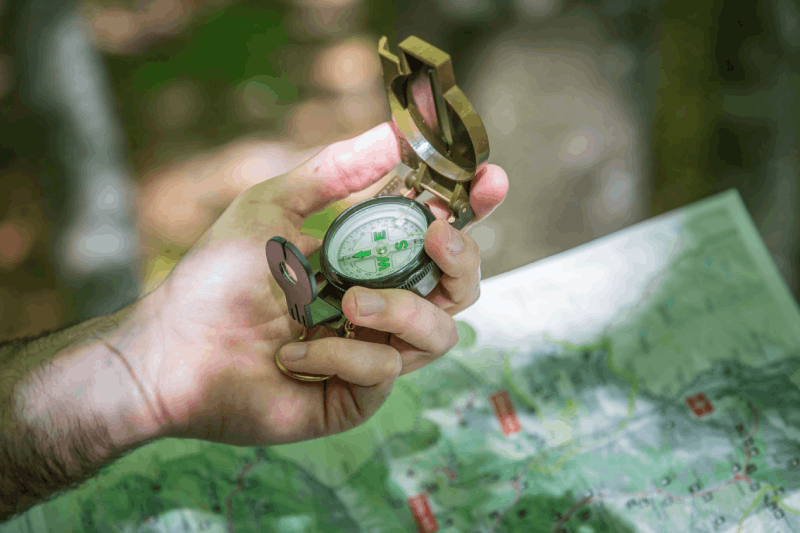
While GPS devices and smartphone applications have made navigation quite easy in the modern age, technology always carries the potential for failure. Dead batteries, rapid depletion of batteries in cold weather, the device falling into water, or losing signal under dense tree cover can leave campers vulnerable. A camper who relies solely on digital data will be completely "blind" if their device fails. However, a map and compass require no charging and do not search for signals. The ability to use these traditional tools is your most reliable insurance in nature. A person who knows how to navigate using analog methods can determine their route even when digital systems fail and can safely reach their campsite or evacuation point.
What Are the Navigation Errors Made Without Calculating the Magnetic Deviation Value?
Maps are drawn according to true (geographic) north, while compasses point to magnetic north. The angular difference between these two norths is called magnetic deviation (declination). If a camper applies an angle on the map directly to their compass without accounting for the deviation value of the area they are in, they can be off by hundreds of meters over a route that spans kilometers. Especially in long-distance hikes, this small angular difference can cause you to completely miss the water source or campsite you need to reach. This error can pose life-threatening risks during foggy weather or night hikes. Adjusting for declination as a niche skill is an integral part of a professional camper's navigation discipline.
How Are the Positions of Stars and Navigation Techniques Used During Night Hikes?
After the sun sets, nature takes on a completely different identity, and familiar landmarks disappear. In this situation, the sky becomes your greatest navigation tool. Finding the North Star (Polaris) in the Northern Hemisphere is the oldest method of determining north. However, simply looking at the North Star is not enough; you need to fix your route on the map according to the positions of the stars, which means "taking a bearing." By choosing a specific star as a reference point while hiking, you must remember that the stars shift due to the rotation of the Earth. This technique provides you with a silent and endless guide when your flashlight fails or when you need to conserve battery. Night navigation is one of the most advanced levels of map reading skills.
How Can You Maintain Your Sense of Direction When Visibility Is Reduced in Foggy Weather?
Fog is the most insidious obstacle in nature because it eliminates depth perception and makes every direction look similar. In such situations, the technique of "dead reckoning" comes into play. This technique allows you to estimate your current position by recording which direction you have traveled, at what speed, and for how long from your last known location. When combined with methods like counting steps or timing on the map, it allows you to continue making progress even when visibility is near zero. Additionally, you should continuously take micro-bearings with your compass to ensure you are moving in a straight line. Navigating in fog requires trusting the symbols on the map and the compass needle without panicking.
Why Is Reading the Structure of Valleys and Slopes Essential for Finding Water Sources?
Finding water in the wild is the first rule of survival, and maps provide you with hidden clues in this regard. The contour lines shaped like a "V" on topographic maps often indicate a valley or streambed. If the tip of this "V" points to a high elevation, the likelihood of water flowing down that valley is high. Campers can analyze which valleys may be dry and which may hold water year-round by combining vegetation cover and elevation data while reading the map. Instead of wandering randomly to reach water, following the drainage basins on the map saves energy and helps strategically determine the campsite.
How Is the Analysis of Wind Direction and Geographic Barriers Conducted in Selecting a Campsite?
A good campsite is not just a flat ground; it is also a shelter against natural events. By analyzing the prevailing wind direction on the map, you can identify areas that are sheltered behind a hill or wooded area (downwind). Points where valleys narrow can accelerate the wind (Venturi effect), so you should avoid such narrow passes on the map. Additionally, you should check how high you are above riverbeds by looking at the water levels on the map to assess the risk of sudden flooding. Map reading is an analytical tool that tells you in advance whether the place where you will set up your camp will remain safe and comfortable throughout the night.
What Is the Critical Impact of Seasonal Changes on Navigation Strategies?
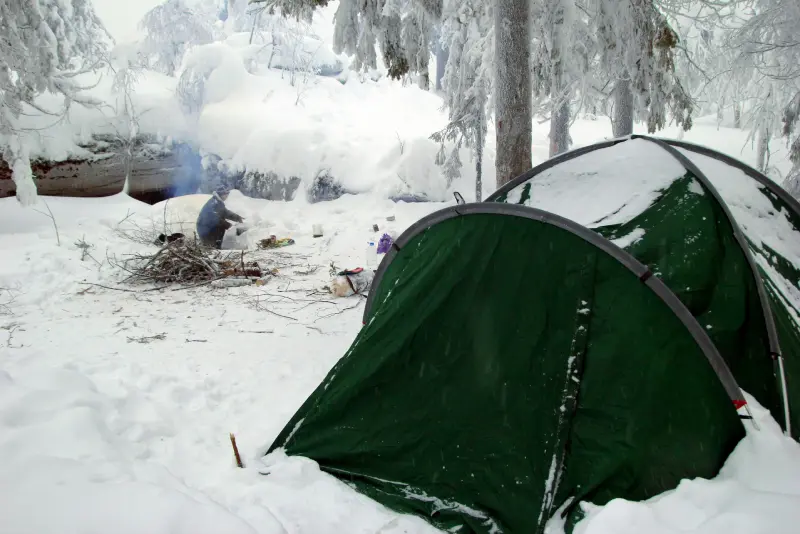
Paths that are obvious in summer can completely disappear under snow in winter, or fallen leaves in autumn can hide ground markers. Map reading skills teach you to focus on "landforms" that remain unchanged despite these variable conditions. Even if a streambed is covered in snow, the valley structure on the map is still there. The changing angle of sunlight according to the seasons is also critical for navigation; in winter, the sun rises and sets further south, affecting shadow lengths and directions. Campers should interpret their maps with seasonal data (snow depth, frost risk, vegetation density). This niche perspective allows you to move with the same competence in nature in every season.
How Is the Integration of Self-Tracking and Natural Indicators with Map Data Achieved?
Nature itself is a complete system of indicators; the mossy sides of trees, the rate of snowmelt, or the nests of ants provide general directional information. However, these natural indicators are not always 100% reliable and can be affected by local conditions. True professionalism lies in combining these natural indicators with the big picture on the map. For example, observing tilted trees due to prevailing wind direction and correlating this with the ridge structure on the map ensures your location. Map data organizes the scattered information from nature and minimizes your margin of error. This integration is the deepest form of dialogue a camper has with their surroundings.
What Is the Role of Navigation Skills in Group Psychology in Team Leadership?
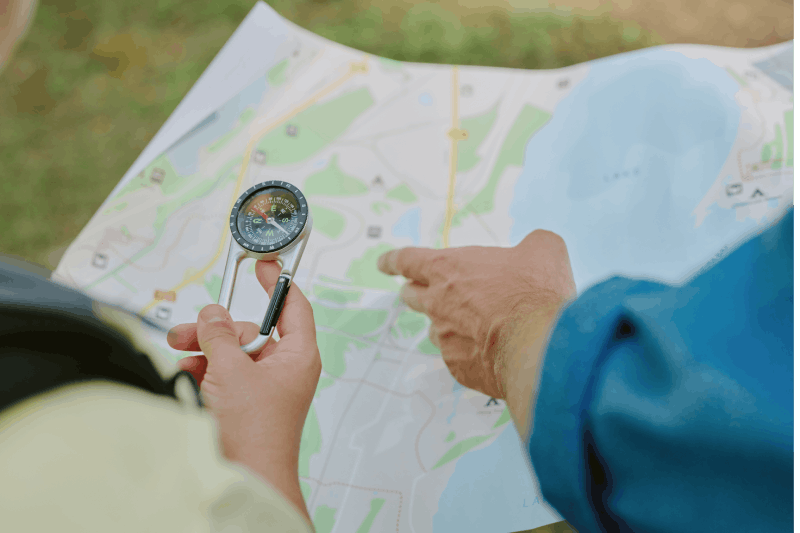
In group camping, the competence of the person determining the route and knowing the direction affects the morale of the entire group. If the leader does not know where they are or hesitates in reading the map, unrest and insecurity begin within the group. Conversely, a leader who is proficient with the map and anticipates obstacles (blocked paths, excessively steep slopes) while offering alternatives keeps the group's motivation high. Navigation is not just a technique; it is also a management skill. While ensuring the safety of the group, you must also convey your control over the map to manage the members' anxieties. This will enhance the enjoyment your camping friends derive from nature.
Why Is Map Reading Practice Important When Preparing an Emergency Evacuation Plan?
In the event of an accident or sudden illness, knowing the fastest way to the nearest settlement or a point where rescue teams can reach can save lives. Map reading is not just about moving forward; it is also about knowing the "escape routes." Emergency evacuation routes should be determined on the map before setting up camp. Which valley descent is easier? Which ridge line is suitable for helicopter landing? Where is the nearest forest road? The answers to these questions are hidden on the map. Instead of rushing in panic in an emergency, using the data on the map to follow the safest and fastest route significantly increases your chances of survival.
How Are Habitat Indicators on the Map Interpreted to Avoid Wild Life Areas?
Maps sometimes show not only physical landforms but also indirectly indicate ecosystems. For example, wetlands, dense forest cover, or steep cliffs are habitats for certain animal species. By reading the vegetation symbols on the map, you can see how far you are from riverbanks or fruiting areas where bears or other wildlife may be abundant. Similarly, when selecting your campsite, you can predict whether you are on animal migration routes based on the terrain (narrow passages, water troughs). Map reading helps you respect the inhabitants of the wild and reduces your risk of unwanted encounters with them.
What Is the Impact of Elevation Changes on Time Management and Hiking Speed Calculations?
There is a huge difference in time and energy between hiking 5 kilometers on flat ground and hiking 5 kilometers with a 1000-meter elevation gain. The "total elevation gain" calculation you will make using the contour lines on the map determines when you will arrive at camp. Simple calculations like the Naismith rule (1 hour for every 5 km + 1 hour for every 600 m of ascent) allow you to time your route on the map. This skill is critical for reaching your campsite before dark. Incorrect timing can lead to you getting stuck in difficult terrain in the dark. Analyzing the terrain difficulty on the map helps you manage your physical limits accurately.
How Are Battery and Signal Issues Overcome in the Use of Digital Maps?
Even when using digital navigation, it is essential to understand the logic of map reading. Keeping your phone in "airplane mode" and "power-saving mode" extends battery life, but this is not enough. Downloaded digital maps require you to have basic topography knowledge to correlate with physical landforms. Additionally, you need to understand the impact of screen brightness on navigation and the calibration of the compass sensor. Digital devices are aids, but it is the human mind that interprets their data. By adopting a hybrid approach, combining the convenience of digital tools with the safety nets of analog methods is the smartest way to modern camping.
What Are the Benefits of Teaching Navigation Skills to Children and Beginners for Future Camps?
Learning navigation skills at a young age or at the beginning of camping fundamentally changes one's awareness of nature. Teaching a child to use a compass is not just about giving them a tool; it is about teaching them to pay attention to the world around them. This education triggers curiosity and develops confidence. For beginners, reading a map allows them to see nature not as a random greenery but as a maze waiting to be discovered. In future camps, these individuals will be able to move more independently and safely, positively affecting group dynamics. Navigation training can lead to outdoor sports and open the door to conscious participation.
How Is the Identification of Safe Areas on the Map During Natural Disaster Moments Conducted?
In nature, one can encounter extreme situations such as floods, landslides, or forest fires at any moment. When such a moment occurs, instead of panicking and fleeing, looking at the map to identify high and open areas (for fire) or ridges away from flood plains (for floods) is vital. Identifying points on the map such as "dominant hill" or "safe plateau" gives you a target amidst the chaos. A mind that can read geography can predict the nature of the disaster and which direction to head. For example, if a flood is coming in a valley, identifying the nearest and least steep escape point on the map allows you to make decisions in seconds.
What Are the Micro-Location Determination Techniques in Flora and Fauna Observation?
Some rare plant species or animals only live within a specific elevation range, at a certain slope, and in a specific direction (relative to the sun). Map reading helps you find these niche points. North-facing slopes (in the Northern Hemisphere) are wetter and shadier, while south-facing slopes are drier and sunnier. If the plant you are looking for only grows on moist north-facing slopes, you can conduct a targeted exploration by filtering these areas on the map. This method provides invaluable time savings for nature photographers and researchers. A map is not just a roadmap; it is also an ecological guide.
Why Is It Exciting to Trace the Footprints of Ancient Roads and Old Trails on Maps?
Many modern maps still show traces of ancient caravan routes, old trails, or abandoned settlements. As your map reading skills improve, you begin to notice that the faint lines on the paper could be historical routes. These paths often traverse the most logical and least resistant points of the terrain. Following an old trail can make your camping journey more comfortable and offer you a cultural discovery opportunity. The map bridges time, connecting you with travelers of the past along the same route. This depth transforms the camping experience from a simple stay into an epic journey.
What Should Be Considered in Equipment Selection from Map Pockets to Compass Quality?
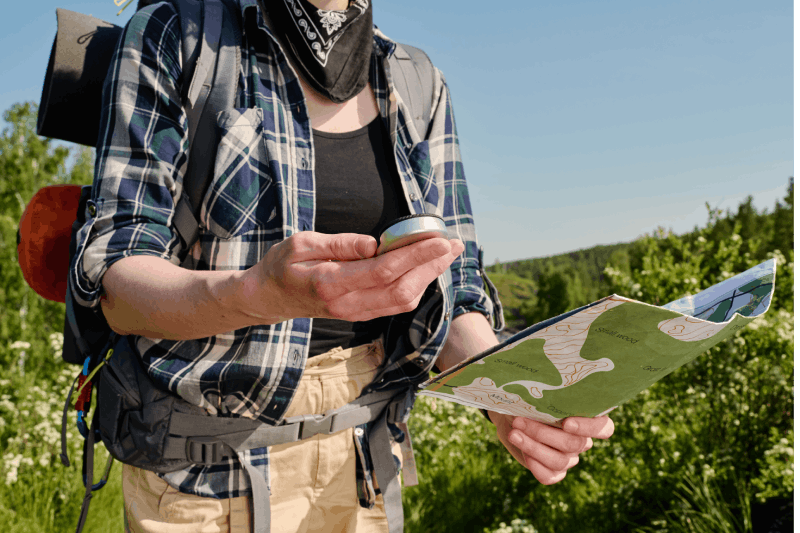
To navigate correctly, knowledge alone is not enough; quality equipment to apply that knowledge is also essential. Having a "liquid-damped" compass ensures that the needle stops quickly and reduces reading errors. Your map should be printed on waterproof paper or stored in a transparent map case to prevent it from melting away in rainy weather. Additionally, your backpack should have accessible pockets where you can reach the map and compass at any moment. The quality of the equipment supports your confidence under challenging conditions. A cheap and low-quality compass can mislead you, putting you at greater risk. Therefore, equipment selection is the first physical step in the discipline of navigation.
What Is the Impact of Micro-Topography Data on Camping Comfort?
Sometimes small dips or bumps (micro-topography) that are not visible on a general map but noticed on-site determine the quality of your sleep at night. However, someone who reads the map well can predict whether to enter under the tent based on where the general slope is heading. The structure of the ground (rocky, sandy, muddy) can provide clues with symbols on the map. For example, camping near an area marked with swamp or marsh symbols invites a mosquito invasion. Map reading is not only used to reach big goals but also serves as a tool to optimize small details and comfort in camping life.
How Are Magnetic Field Disturbances and Local Deviations Detected on the Compass?
A compass does not always point true; it can be affected by nearby metal objects, energy lines, or the concentration of iron ore in the area. A professional camper should be able to notice the "erratic" movements of the compass needle. In such cases, it is necessary to move away from objects affecting the compass or focus entirely on the landforms on the map to perform "visual navigation." Compass deviation is not only related to geographic declination but can also be associated with a local anomaly. Being able to recognize this situation is a niche area where map reading skills blend with experience. Instead of blindly trusting the device, it is safest to always verify the data with environmental conditions.
How Are the Concepts of "Handrail" and "Catching Feature" Applied in Hiking Routes?
In navigation, the techniques of "handrail" and "catching feature" are two strategies that minimize the risk of getting lost. If you are following a river, a forest path, or a distinct ridge line, this is your handrail; even if you stray from the route, you can return to it. A "catching feature" is a significant geographical landmark that will stop you if you deviate from your target. For example, being able to say, "If I cross this valley and reach the big lake, it means I have strayed 1 kilometer from my target" alerts you. Identifying these safety barriers while reading the map is like putting on a mental seatbelt. These techniques make navigation more structured and less prone to error.
How Is a Detailed Analysis of Color Codes and Symbols on the Map Conducted?
Maps are silent books, and every color, every line carries meaning. Green areas represent vegetation cover, brown lines indicate landforms, blue sections represent water, and black or red lines represent man-made structures. However, not every green area means "walkable forest"; it can sometimes indicate very dense thickets (macchia). Knowing the legend (key) of the map by heart allows you to understand its character without seeing the terrain. For a camper, a small black square on the map (a shelter or a ruined wall) can be a lifesaving refuge. A detailed analysis of symbols is the translation process that turns the data on paper into real land knowledge.
How Is Route Planning and Determining Logistics Support Points Conducted in Long-Term Camps?
In long camps lasting weeks, map reading is not just a navigation tool but also a major logistics planning center. Points where you can replenish water, the nearest settlements where you can obtain fuel or food, and emergency evacuation points should be marked on the map in advance. The distance to be covered each day should be realistically calculated according to the terrain's slope. This planning prioritizes physical endurance. Identifying "strategic camping points" on the map ensures that you spend each night as safely as possible, taking factors like wind and water into account. Good planning starts at the beginning of the map.
What Are the Reasons Why Navigation Skills Are Vital for Solo Campers?
When you go camping alone, there is no one beside you to consult or warn you when you make a mistake. In this case, the likelihood of making a navigation error is minimal. For solo campers, a map and compass are their most loyal companions. Continuously confirming your location and marking your route on your daily log or map helps maintain mental discipline. Straying off course poses a much greater risk and source of panic for someone alone. Therefore, solo campers should elevate their map reading skills to the highest level and keep their reliance on technology to a minimum. The foundation of self-sufficiency lies in knowing exactly where you are.
What Are Common Mistakes Made in Map Scale and Distance Estimations?
Not understanding the difference between a 1:25,000 scale map and a 1:100,000 scale map is one of the most common mistakes made by campers. Small-scale maps show broad areas but hide details. Large-scale maps are ideal for hiking and navigation. Quickly calculating how many meters correspond to 1 centimeter on the map allows you to accurately estimate how far you are from your target. Estimations made by eye can often be misleading; as fatigue increases, distances appear longer. Using the scale on the map or the edge of the compass provides you with objective data, eliminating these subjective errors.
How Is GPS Data Transferred to the Coordinate System on the Map (UTM, Latitude/Longitude)?
When your digital device gives you a coordinate (for example, 36S... or 40°N...), being able to mark this on a physical map is an advanced navigation skill. The UTM (Universal Transverse Mercator) grid system simplifies making metric measurements on the map, while latitude/longitude degrees provide a spherical reference. If you cannot accurately transfer this data to the map, GPS will remain just a series of meaningless numbers. Using these formats correctly when reporting your location to search and rescue teams can significantly reduce their response time. Understanding coordinate systems is about merging a local map with a universal language.
What Is the Art of Correctly Interpreting the Movements of the Compass Needle and "Swinging in Liquid"?
The biggest mistake made when using a compass is not keeping it perfectly horizontal or not allowing the needle to move freely. The purpose of the liquid in the compass housing is to slow down the needle and prevent vibrations, but in cold weather, this liquid can become viscous, causing the needle to slow down. A professional camper knows to slightly tilt the compass or check from different angles to ensure the needle is sitting correctly and pointing north. This "delicate touch" is especially critical in areas with metal interference or while on the move. Understanding the language of the device begins with knowing its technical limits.
How Can You Practice Map Reading Skills in City Life and Daily Hiking?
Navigation skills are like a muscle; they weaken when not used. You can develop this skill not only in camps you visit once a year but also in daily life. Using city maps to correlate the streets on paper with the real world keeps your sense of direction alive. Practicing taking bearings with a compass in parks or wooded areas helps you see your margin of error. Even turning off navigation apps and trying to reach an address using only the map in your mind is an excellent workout. These small exercises done before heading into nature develop the reflexes you will need in a real adventure.
Why Is Reading the Language of Nature Through Maps a Way of Life?
Navigation and map reading are not just camping techniques; they are also efforts to understand one's place in nature. An individual with this skill becomes not just a tourist but a true part of nature. Being able to read geography, elevations, and distances is like learning a universal language. This competence grants you freedom; you will not fear straying from the path, seeing every obstacle as an opportunity for discovery. The time you dedicate to maps and compasses during your camps is, in fact, an investment in your own safety and the deep connection you establish with nature. Remember, a person who knows where they are will never get lost; they will just continue to discover.