What Is the Vital Importance of Fire Safety in the Caravan Interior?
Caravans have a naturally limited living space. The furniture, insulation materials, and textiles used within this confined area are often made from composites that have flammable properties. In the event of a spark or short circuit, it only takes seconds for flames to engulf the entire interior. While homes typically have multiple exits and spacious areas to escape from a fire, in a caravan, the smoke can fill the visibility distance and consume oxygen much more quickly. Therefore, fire extinguishing tubes, which are early warning systems and immediate intervention tools, are not just an accessory but the most basic safety equipment. Analyzing every square centimeter of your caravan for fire risk and creating an appropriate layout plan is the first and most important step to protect your loved ones and your belongings.
What Should Be the Distance Between the Cooking Area's Steam and Smoke Detector?
The kitchen is considered the "hot zone" where the fire risk is highest in caravans. However, placing the smoke detector directly above or very close to the stove can cause false alarms every time you cook. Over time, this can lead the user to disable the detector, which is the greatest safety risk. For ideal placement, the detector should be mounted at least 2 to 3 meters horizontally away from the cooking unit. This distance allows for the dispersion of cooking steam and normal cooking smoke while still being close enough to detect dense smoke from an actual fire. Additionally, the detector should be fixed near the highest point of the ceiling, not in the cabinets directly below the kitchen counter, due to the upward tendency of smoke.
Why Is the Placement of Carbon Monoxide Detectors in Sleeping Areas Critical?
Carbon monoxide (CO) is known as the "silent killer"; it is odorless, colorless, and tasteless. Gas heaters, stoves, or exhaust gases that may leak from outside pose a serious threat during sleep in caravans. It is mandatory to have a CO detector in sleeping areas. The detector should be mounted at a height close to the breathing level of a person in bed (approximately 1.5 meters from the ground). This is because carbon monoxide has nearly the same weight as air and distributes homogeneously within the room. If you place the detector too high or too low, you may not accurately measure the density of the gas when it reaches your lungs. Since your senses are closed off while sleeping, it is a fundamental rule for your safety that the alarm is within a distance close enough to wake you, meaning it should be a few meters away from your head.
How Do "Dead Air" Areas Formed at the Corners of the Caravan Affect Detector Efficiency?
According to the rules of fluid dynamics, when smoke fills a room, "dead air" pockets form at the corners where the walls meet. In these areas, air circulation is at a minimum, and smoke reaches these spots last. If you mount a smoke detector very close to the exact corner of the ceiling or the line where the wall meets the ceiling, the device's ability to detect smoke can be critically delayed. In a fire situation, even seconds matter, and this delay can be fatal. For safe installation, you should place the detector at least 30 centimeters away from the side walls and at least 50 centimeters away from the corner junctions of the ceiling. This way, smoke can flow freely over the device and be detected immediately by the sensors. Considering the caravan's narrow ceiling structure, placements close to the center point always provide the highest efficiency.
What Is the Strategic Advantage of Placing a Fire Extinguisher Near the Entrance Door?
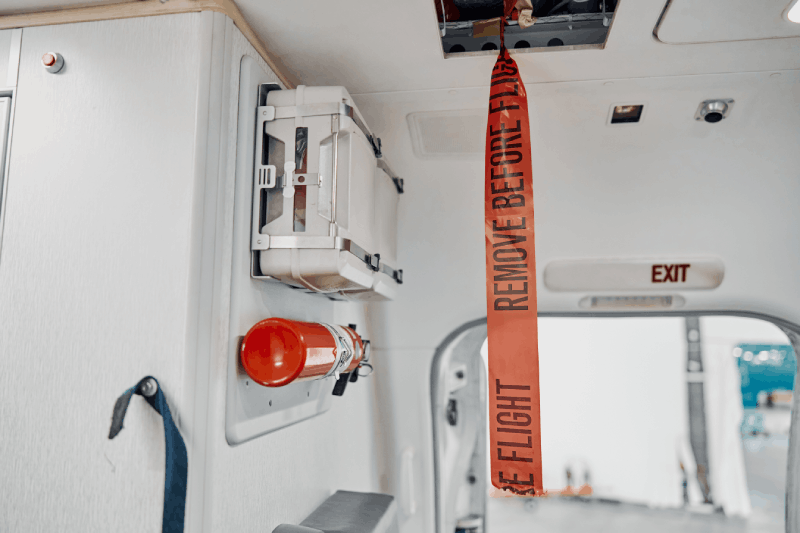
In the event of a fire, your instinctive first move is to try to get outside. Therefore, it is strategic to mount the fire extinguisher right next to the main entrance door. If the fire is inside the caravan and you are outside, you can reach the extinguisher and intervene as soon as you open the door. If you are inside and the fire is growing, you can grab the extinguisher while heading towards the door or intervene from a safe distance after exiting. Hiding the extinguisher under the bed, in cabinets, or in hard-to-reach deep compartments can lead to a loss of time in a panic situation. An extinguisher fixed next to the door ensures that both you and someone who can help from outside can see and use the device immediately. Additionally, the device should be securely mounted to the wall with a sturdy bracket that will not fall due to vibrations, which is a requirement for safety during travel.
What Extinguishing Systems Should Be Used in Areas Where Lithium Batteries and Inverters Are Located?
Modern caravans equipped with lithium batteries and high-capacity inverters also bring the risk of electrical fires. The enclosed areas where these devices are located are often prone to being airtight and overheating. In such niche areas, manual intervention is difficult, which is why the use of "automatic extinguishing tubes" or "fire extinguishing balls" is becoming increasingly common. These systems, which automatically burst or release gas when a certain temperature (for example, 68°C or 72°C) is reached, can extinguish a fire in its initial stage without you even noticing. Lithium fires are difficult to extinguish with standard extinguishers (ABC powder) as they can generate their own oxygen. Therefore, it is technically the most accurate decision to prefer clean gas systems like FM-200 or specially produced water-based extinguishers (AVD) for lithium fires in your battery compartment.
How Can the Smoke Detection Time Be Affected by Ceiling Ventilation and Fans?
Ceiling fans (like Maxxair) or standard ventilation hatches that provide air circulation in caravans can alter the direction of smoke movement. If a smoke detector is installed right next to a fan that expels air outside, smoke can be expelled before it reaches the sensor. Conversely, a detector under a fan that blows air from outside may not sense smoke due to the clean airflow. This "dilution effect" can kill the sensitivity of the detector. You should mount your detectors at least 1 meter away from ventilation openings and air conditioning units. Ideally, the detector should be placed in ceiling areas where the airflow is stagnant but where smoke will naturally rise. Conducting a small smoke test (with a smoke stick or test spray) inside the caravan before installation can help you observe which direction the air is being expelled and find the most accurate spot.
Should Sensors Be Installed Next to Heating Systems (Webasto/Truma)?
Diesel or gas-powered heaters, while performing the combustion process in a closed circuit, can still pose serious risks due to leaks in the exhaust line or fuel line. Installing a smoke or CO detector inside the cabinet or compartment where the heater's main body is located can sometimes be misleading; because the minimal heat and odors generated during the normal operation of the device can trigger the device. Instead, the detector should be placed near the hot air outlet vents of the heater but not directly in the path of the hot air. If your heater is hidden under a seat or in the storage compartment, it is more logical to place a sensor just outside this enclosed area, at the first point where smoke can escape from that area into the living space. Remember, the main goal is to prevent toxic gases that may leak from the heater from poisoning you, rather than the heater itself catching fire.
Why Is It Mandatory to Mount Gas Leak Sensors at Floor Level?
The LPG (Liquefied Petroleum Gas) used in caravans is a mixture of butane and propane. Since these gases are heavier than air, in the event of a leak, they will settle to the ground like water and begin to accumulate from floor level. Therefore, gas leak detectors should be mounted about 15-20 centimeters above the ground, not at ceiling level. If you mount the detector too high, it may not alarm even if the lower part of the caravan is completely filled with explosive gas. It is advantageous for the mounting point to be close to the cabinet where the gas cylinders are located or the main gas distribution manifold. However, the sensor must be positioned in a place protected from dust, pet hair, or liquids that could spill on it. Additionally, it should be noted that chemical sprays used during cleaning may damage the sensor or cause false alarms.
Is It a Mistake to Place a Detector Inside or Under Kitchen Cabinets?
Many users prefer to hide detectors inside kitchen cabinets or on upper shelves to avoid spoiling the visual aesthetics. This is one of the biggest mistakes that can be made from a fire safety perspective. Smoke rises upward due to its physical properties and begins to spread horizontally at the ceiling. If the detector is inside a cabinet, it may take minutes for the smoke to seep through the cabinet doors and trigger the sensor. During this time, the fire could reach an uncontrollable size. Detectors should always be visible, unobstructed, and mounted directly to the ceiling surface. "Invisible safety" is ineffective in an environment like a caravan where seconds are critical. The test button on the device should always be easily accessible, and you should be able to see the LED light indicating the operational status of the device.
What Are the Portable Extinguishing Solutions for Cooking Units Outside the Caravan?
Many caravan users prefer outdoor kitchens or portable stoves to prevent food odors from permeating inside. However, the wind factor in outdoor settings can facilitate the spread of fire to wooded areas or the exterior of the caravan. When cooking outside, there should always be at least a 1 kg dry chemical extinguisher located just inside the caravan's external service hatch or in an easily accessible external compartment. Additionally, "fire extinguishing sprays" are quite practical for outdoor use. These sprays can contain special foams designed to intervene in grease fires and are much easier to use than standard cylinders. Keeping a fire blanket right next to your outdoor cooking unit is also the cleanest and safest method to extinguish a flame that may start in a pan by cutting off its oxygen supply.
How Can Vibration and Shock Be Reduced on Caravan Fire Extinguishing Devices?
Caravans are constantly in motion, and rough roads can cause serious vibrations. The powder inside standard fire extinguishing tubes can settle at the bottom over time due to the effects of vibration and become "compact." This can result in the powder not coming out when you press the trigger of the tube in an emergency, even if gas is released. To reduce this risk, specially designed brackets for caravans that are resistant to vibrations should be used, and the tubes should be inverted and lightly shaken regularly (once a month) to loosen the powder. Additionally, the tube's manometer (pressure gauge) should be easily readable. A needle deviating from the green zone indicates that the device has lost its functionality. To prevent the tube from flying off its mount and causing injury during travel, metal clamps and locking mounting devices should be preferred; plastic holders can weaken and break over time due to sun exposure.
How Do Sloped Areas on the Caravan Roof Affect Smoke Accumulation Rate?
The roofs of caravans can sometimes be sloped or stepped for aerodynamic reasons (for example, alcove caravans). Smoke always tends to accumulate at the highest point of the ceiling. If your caravan's roof has different levels, the detector should be installed at the highest area where smoke will first be trapped, not at the lowest point. In alcove caravans (with an upper bed over the living area), smoke from a fire in the main living area will accumulate on the main ceiling before reaching the alcove section. In this case, having separate detectors in both the main living area and the alcove section is the safest scenario. When installing in sloped areas, ensure that the sensor openings of the detector are exposed to smoke from all directions. The area 15-30 cm below the highest point of the ceiling (ridge line) is generally the fastest reacting area.
How Should the Detector Placement Near the Upper Bunk of Children's Bunk Beds Be Done?
If your caravan has a bunk bed system, the child sleeping on the upper bunk is the closest person to smoke and heat. Since smoke accumulates above, a detector close to the ceiling of the upper bunk is vital. However, care should be taken to ensure that the child does not hit the detector while sleeping or tamper with the device out of curiosity. The detector should be mounted in a corner that the child cannot reach but can catch the smoke flow from the ceiling. Additionally, air circulation in narrow corridors where the bunks are located can sometimes be limited; therefore, adding a dedicated smoke alarm in this area serves as a safeguard against the possibility of the sound from the main unit not waking the sleeping child. Tests should be conducted to ensure that the alarm's sound level (decibel) is effective enough to wake the child even in an obstructed area.
Are Automatic Extinguishing Tubes Necessary for the Cable Density Inside the Electrical Panel?
The majority of caravan fires start from loose connections, overloaded wires, or inverter failures. Panels are usually located inside wooden cabinets, in narrow and enclosed spaces. For these areas, "fire extinguishing tube systems" (like Firetrace) or miniature aerosol extinguishers are excellent solutions. These systems activate automatically when they detect a temperature rise or flames inside the panel. Especially when you leave your caravan parked and step away from it (for example, while the refrigerator is running), these types of automatic systems can be the only barrier preventing your caravan from burning down completely. These devices, mounted inside or just above the panel, disrupt the fire at the point it starts. Using non-conductive extinguishing materials (CO2 or clean gases) in electrical fires also prevents damage to other healthy components in the system.
Does the Flammability Ratio of the Caravan's Interior Wall Materials Determine the Number of Detectors?
In older model caravans and some budget-friendly productions, thin plywood or plastic-based panels are used as interior cladding. These materials burn quickly and release toxic cyanide gas when burned. If your caravan has highly flammable materials, a single central detector may not be sufficient. Following the "early warning is early warning" principle, it would be wise to use separate detectors for each enclosed area (bathroom, bedroom, garage). In modern and high-quality caravans, fire-retardant materials are generally preferred; however, this does not eliminate the need for detectors, it only gives you a few more seconds to intervene. Knowing the type of your wall materials helps you predict how aggressively a fire can spread and assists you in shaping your safety equipment budget accordingly.
What Should Be Done About Grease Fires in Kitchen Hoods and Filter Areas?
The hoods in caravan kitchens create a significant fire load due to the grease layers that accumulate over time. If a flame that flares up from a pan ignites the grease in the filter while cooking, the fire can quickly spread through the hood channels to the ceiling void. Attempting to extinguish such fires with water can lead to disaster (grease explosion). In addition to having a smoke detector in the kitchen area, there should definitely be a "fire blanket" available. The fire blanket should be hung on the wall next to the stove, not in a drawer, and should be easily accessible to grab in one motion. If possible, having a small Class F (for grease fires) extinguisher in the kitchen compensates for the inadequacy of standard powder extinguishers for grease fires. Regularly cleaning the hood filters is the simplest and most effective preventive measure.
What Should Be the Sensitivity of Sensors Installed Next to Gas Stoves Used in Caravans?
Caravan-type gas stoves typically have a safety thermocouple to prevent flame extinction, but this is not always a 100% solution. A gas sensor that you will install next to the stove can be selected from half-conductive types and hybrid models that can detect both LPG and carbon monoxide. The sensitivity setting should be high enough to detect very small leaks but calibrated not to alarm during the millisecond gas release that occurs with each stove ignition. The sensor should be placed not directly in line with the stove but over potential gas leak paths (close to lower cabinet doors). Remember that gas leaks can originate not only from the stove but also from pipe connections or the gas line of the refrigerator. Therefore, the position of your sensor should create a junction point among all these systems.
Why Is It More Important to Secure Extinguishing Systems in Off-Road Caravans?
Off-road caravans are constantly exposed to vertical and horizontal forces. In these extreme conditions, a fire tube secured with standard mounting brackets can dislodge during vibrations and fly around the inside of the caravan like a projectile. For off-road users, the installation of extinguishers should be done with double safety metal clamps. Additionally, the risk of the manometer malfunctioning due to vibrations is higher; therefore, in such caravans, it is preferable to use tubes that do not have a pressure gauge but are instead monitored by weight control or are certified for professional shock resistance. The risk of dust settling is at its highest in these vehicles; therefore, checking the tubes after each off-road trip and supporting them with passive systems like extinguishing balls that are not affected by vibrations increases the safety layer.
Do Lighting Groups Inside the Caravan Pose a Fire Risk Due to Heating?
Old type halogen lamps or high-power fluorescents can produce enough heat to melt the plastic ceiling coverings of the caravan. This heating can dry out cable insulations over time and invite short circuits. Nowadays, converting all lighting to LED minimizes this risk, but low-quality LED drivers can overheat and cause fires. It is logical to place a smoke detector close to the ceiling lighting groups; because electrical fires usually start with a cable smell and light smoke. Especially in areas where cable bundles pass through the ceiling void, having a sensor can help you detect a hidden electrical fire before it spreads. Ensuring that there is sufficient air gap behind the lighting fixtures and that they do not touch insulation materials is also part of a fire prevention strategy.
How Should the Battery Life of Smoke Detectors Be Related to the Caravan Chassis?
Two types of smoke detectors can be used in caravans: battery-operated (independent) and 12V DC powered (connected to the caravan battery). Battery-operated detectors are easy to install but remain silent when their batteries run out. The "low battery" warning may sometimes go unheard. 12V system detectors work as long as the caravan has power, but they can become inactive when the main switch is turned off. The safest method is to use lithium battery smoke detectors with a lifespan of 10 years, which are waterproof. These devices continue to protect you even if the battery runs out because they are independent of the caravan's electrical system. If your caravan is very large, you should use detectors that are connected to each other via radio frequency (RF). In this system, when a fire is detected in the kitchen, the detector in the bedroom will also start to sound. Since the vibrations of the caravan can disrupt the contact of the batteries, it should be ensured that the battery compartments are tight and not exposed to corrosion.
Why Do Detectors Installed Near Caravan Window Edges Cause Misleading Results?
Windows, doors, and external vents are the areas where the airflow inside the caravan is most concentrated. If you mount a smoke detector right next to the window, the wind coming from outside can blow the smoke away from the sensor. Additionally, moisture, dust, or debris entering through open windows can cause optical smoke sensors to become dirty over time and either give "false alarms" or not work at all. Detectors should be installed in the interior ceiling areas of the caravan, away from these external influences, where the air conditions are more stable. If it is assumed that windows will be continuously open during the summer months, the protective capacity of a detector at the window edge can decrease by up to 80%. The safe zone is always the ceiling area at least 50-60 cm away from the windows.
How Can the Sensors in Caravan Bathrooms Be Prevented from Being Triggered by Steam?
Caravan bathrooms are very small, so the dense steam generated during a hot shower can instantly trigger optical smoke detectors. Many people do not use detectors in the bathroom area due to this inconvenience. However, electric water heaters in bathrooms (hermetic stoves or electric resistors) pose a fire risk. The solution is to install a "Heat Detector" just inside the bathroom or just outside the bathroom door. Heat detectors are not affected by smoke or steam; they only alarm when the temperature exceeds a certain level (for example, 58°C). This way, you won't encounter false alarms while taking a shower, but if a fire starts due to an electrical fault, the system will alert you. If there is a corridor above your bathroom door, placing the smoke detector there is also an alternative.
Is There a Fire Risk in Storage Areas Under Fixed Beds in Caravans?
The space under fixed beds in caravans is often used as a "garage" or large storage area. Here, inverters, chargers, water pumps, and sometimes extra fuel cans are found. These areas are the most risky but least observed places in the caravan. It is impossible to notice a fire starting under the bed while you are asleep. A wireless and battery-operated smoke detector should definitely be placed inside these enclosed volumes. In fact, extinguishing balls are the ideal solution for these areas; because when a fire starts, it is much more practical for the ball to burst automatically and extinguish the area rather than lifting the bed to intervene. Ensuring that the items in the storage area do not crush the electrical cables and that the devices do not block the ventilation gaps is as important as installation.
What Precautions Should Be Taken When Transporting Flammable Liquids in Caravan Garage Sections?
Many caravan users transport flammable liquids such as gasoline for generators, spare cylinders for outdoor stoves, or thinner for cleaning in the garage section. These liquids should be stored in leak-proof metal containers (jerry cans). A dual protection is required against gas leaks and smoke risks in the garage section. A smoke detector should be installed on the ceiling and a gas sensor on the floor of the garage. Additionally, the capacity of the extinguisher in this section should be larger (2 kg or more) than that in the living area. A phosphorescent "Fire Extinguisher Here" label should be affixed to the inside of the garage door to help you find the device in the dark during an emergency. Ensuring that the cabinets containing flammable liquids are ventilated directly to the outside prevents gas from filling the caravan in the event of a leak, reducing the risk of explosion.
Are Fire Alarm Panels Integrated into Smart Caravan Systems Safe?
In new generation smart caravans, fire and gas sensors are connected to a central screen or your phone. These systems are great for sending you notifications when there is a problem even when you are not at the caravan. However, relying solely on a digital screen for safety is risky. In the event of a software freeze or battery depletion, the system may become blind. The best strategy is to keep fully independent battery-operated detectors as a backup while using smart systems. A hybrid approach combines digital comfort with analog reliability. The calibration of sensors in smart systems should be professionally checked once a year, and ensuring the stability of the internet connection (SIM card or Wi-Fi) is necessary for the remote monitoring feature to work effectively.
Is the Use of Aerosol Extinguishing Technology in Caravans Advantageous Compared to Traditional Tubes?
Aerosol extinguishers are devices developed from space technology that look like small tubes but do not contain pressurized containers inside. Their biggest advantages over traditional ABC powder extinguishers are that they are very lightweight, do not require refilling (usually have a lifespan of 10-15 years), and do not leave a dust cloud behind after extinguishing. When powder extinguishers are used, even if the fire is extinguished, all electronic devices and textile products inside the caravan become unusable due to the abrasive effect of the dust. Aerosols, being in gas form, provide a clean extinguishing. However, aerosols are less effective in open areas (in windy conditions). In the interior of the caravan, especially near the kitchen and electrical panel, it is best to use aerosols as the primary intervention tool, while standard powder extinguishers should be kept for outdoor fires.
How Is the Safety Barrier Between the Driver's Cabin and Living Area in Motorhomes Ensured?
In motorhomes, engine fires can quickly spread to the cabin and then to the living area through ventilation ducts within seconds. To stop a fire under the hood, there should always be an easily accessible 1 kg extinguisher in the driver's cabin (next to the seat or in the door pocket). Additionally, automatic fire extinguishing hoses (like blazecut) installed in the engine compartment can stop the fire while it is still in the engine block, preventing it from entering the cabin. A smoke detector installed in the passage corridor between the driver's cabin and the rear living area alerts the driver to smoke that may come from behind while driving. If it is assumed that the electrical devices (like the refrigerator) at the back continue to operate during travel, it is more accurate for the driver to rely on electronic sensors rather than mirrors to see the situation at the back.
Is a Detector Required Near the Service Hatches on the Outside of the Caravan?
The service hatches on the outside of the caravan contain technical connections such as behind the refrigerator, battery charging unit entrance, or external shower. The ventilation grills behind the refrigerator can generate heat, especially when operating in gas mode. The insulation that prevents the smell of smoke or burning from entering the caravan from this area can sometimes deteriorate. Installing a detector on the inner wall near the refrigerator vent allows you to detect melting or short circuits that may start in the external parts of the device early. Additionally, the entry point for 220V city electricity (Cee form socket) coming from outside is also a heating point. Having a sensor located close to the inside of this entry point creates a protective barrier against external electrical faults.
Where Should the Fire Blanket Be Placed for Easy Access in the Kitchen Area?
The fire blanket is usually sold in a red cover and can be quickly pulled out with two straps hanging down. Placing this blanket deep inside a cabinet or behind pots makes it ineffective. The ideal location is on the side wall of the kitchen counter or on the inside of the entrance door. It should be at eye level or slightly below. When a grease fire starts, you should be able to find it by simply reaching out instead of panicking and searching for the blanket. The blanket can be used not only for extinguishing but also for protecting yourself while exiting the caravan in a smoke-filled environment or wrapping an injured person. Since it is made of fiberglass material, it has no expiration date, but it must be replaced after being used (if it comes into contact with flames).
Is It Cost-Effective to Change the Fire System During Caravan Renovation?
If you are building a caravan from scratch or undergoing a comprehensive renovation, making fire safety a part of the design is the most accurate approach. Running wires through non-flammable sleeves (spiral tubes), using steel flex hoses for gas pipes, and pulling a wired detector line to each compartment is much healthier than making additions later. During the renovation phase, by installing a central alarm panel, you can monitor all sensors from a single point and even add "solenoid valves" that automatically cut off electricity and gas in the event of a fire. Although these integrated systems may seem costly at first, they increase the insurance value of your caravan and, most importantly, guarantee you a peaceful sleep. Safety should not be an added accessory but a part of the caravan's structure.
You can also use this guide to turn your caravan into a fortress of safety. Remember, a detector installed in the right place and a properly chosen extinguisher are the thin line between life and death.