The caravan lifestyle offers unparalleled freedom for those who want to escape the chaos of the modern world and embrace nature. However, the sustainability of this freedom is directly related to how the energy needs of the caravan are met. Solar panels emerge as a quiet, eco-friendly, and efficient solution at this point. Choosing the right panel requires not only looking at the watt value but also evaluating the limited space on the caravan's roof, climate conditions, and the storage system as a whole.
Why Are Monocrystalline Panels the Most Preferred Option Among Caravanners?
Monocrystalline solar panels have a much higher efficiency rate compared to other types of panels because they are made from high-quality silicon crystals. In vehicles like caravans that have limited roof space, the amount of energy collected per square meter is crucial. Monocrystalline cells perform better even in low light conditions, allowing them to continue producing energy during cloudy weather or early morning hours. Additionally, the lifespan of these panels typically exceeds 25 years, making them a long-term and reliable investment. Aesthetically, their black color adds a modern touch to the caravan's exterior, while technically, they offer a structure that can manage heat better.
How Do Polycrystalline Panels' Performance in Hot Climates Create a Disadvantage in Caravans?
While polycrystalline panels may appear budget-friendly due to their more economical production processes, they have some serious disadvantages in caravan applications. The cell structure of these panels is more sensitive to heat increases compared to monocrystalline panels. During the summer months, when the sun is at its highest and the demand for energy is greatest, the efficiency of polycrystalline panels decreases more rapidly as the temperature rises. If the caravan's roof is directly under the sun and the airflow beneath the panel is insufficient, the panel can overheat and experience significant losses in nominal output power. This situation means inefficient energy harvesting for caravanners who want to maximize energy in limited spaces.
Do Flexible Panels' Lightness Provide Easy Installation but Fail in Durability?
Flexible solar panels are quite attractive because they perfectly fit the curved roofs of caravans and do not disrupt the aerodynamic structure. They offer up to 80% weight advantage compared to standard aluminum-framed panels, which is important for maintaining the overall load balance of the caravan. However, the biggest issue with flexible panels is heat management. When directly mounted on the roof, there is no airflow underneath, and the cells can overheat, leading to micro-cracks over time. These cracks not only shorten the lifespan of the panel but also cause a rapid decrease in efficiency. If a flexible panel is to be preferred, models with quality polymer coatings should be chosen, and a thin air gap should be left to facilitate heat transfer.
How Should You Determine Your Daily Total Energy Consumption Before Calculating Solar Panel Power?
Before determining how many watts of panels to install on your caravan, you need to accurately calculate the energy you will consume in a day (in watt-hours). You should list the consumption of the refrigerator over 24 hours, the operating hours of the lights, the frequency of the water pump's activation, and the charging of phones/tablets one by one. For example, if a refrigerator consuming 50 watts runs for 10 hours a day, it will consume 500 Wh. After summing all items, you should multiply the resulting figure by at least 1.5, accounting for system losses and cloudy days. This calculation is the most basic step that will save you from icy drinks in the middle of summer or a drained battery at midnight.
How Do Ventilation and Roof Features Affect Panel Placement in Caravans?
Ventilation fans, skylights, and television antennas on the roofs of caravans create significant obstacles for solar panel placement. When installing panels, it is not enough to just fit them; you also need to consider the shadow movements throughout the day. Even a small corner of shadow cast by a ventilation cover can halt the entire panel's production if the bypass diodes are not sufficient. Therefore, when planning the layout, you should conduct a "shadow analysis" and position the panels away from tall objects. Additionally, leaving enough space for the ventilation cover to open fully after panel installation is a critical detail for comfort inside the caravan.
What Is the Importance of Bypass Diodes in Partial Shading Situations and Their Relationship with Panel Efficiency?
Solar panels consist of cells connected in series; this means that if one cell is shaded, it can block the flow of current for the entire system. Bypass diodes come into play at this point, allowing the current to bypass the shaded cell and enabling the rest of the panel to continue functioning. A quality solar panel typically has 2 or 3 bypass diodes. This is very important for caravanners because shadows from trees or objects on the caravan are unavoidable. Panels without bypass diodes or of poor quality can become completely inoperative due to a small shadow and prevent the batteries from charging.
Why Are MPPT Charge Controllers a Smarter Investment Compared to PWM Devices?
Devices that reduce the high voltage coming from the solar panel to a level that the battery can accept are called charge controllers. PWM devices waste some energy by simply chopping the voltage, while MPPT (Maximum Power Point Tracking) devices find the balance between voltage and current and transfer the power from the panel to the battery with maximum efficiency. MPPT devices provide 20% to 30% more energy harvesting, especially in cold weather or when the solar panel's voltage is much higher than the battery voltage. Although their prices are higher, the additional efficiency they provide essentially offers the performance increase of adding another panel, which is an invaluable advantage for caravans with limited space.
How Do Lithium (LiFePO4) Batteries Optimize Solar Panel Efficiency at the Storage Point?
No matter how powerful your solar panel is, if you do not have the capacity or efficiency to store the energy you produce, the system will falter. Traditional Gel or AGM batteries allow you to use only 50% of their capacity, while Lithium (LiFePO4) batteries can be discharged at 90%-95%. Additionally, lithium batteries have a very high charge acceptance rate; that is, they can quickly charge the batteries in a short time when the sun is at its peak. Gel batteries, on the other hand, limit the current in the final stage of charging (absorption), which causes some of the energy coming from the sun to go to waste. The combination of lithium batteries and solar panels creates the most modern and efficient energy ecosystem for those seeking complete independence in their caravans.
What Formulas Should Be Used to Prevent Voltage Drop When Choosing Panel Cable Size?
The energy from solar panels can be lost as heat in the cables before reaching the charge controller, which is a significant installation error. Since 12V or 24V systems are commonly used in caravans, the size of the cables carrying low voltage current is of great importance. As the length of the cable increases, resistance increases, leading to voltage drop. Caravanners should choose cables that keep voltage drop below 3%. Generally, 6mm² solar cables are considered ideal for a system between 100-200 Watts, but if the distance between the panel and the charge controller exceeds 5 meters, thicker cables or series connections should be used to increase voltage.
What Role Do Spoiler Feet Used in Panel Installation Play in Aerodynamics and Cooling?
The "Z" type or plastic "spoiler" type feet used to mount solar panels on the caravan roof do not only serve as a fastening function. The design of these feet should ensure that air flows under the panel during driving, preventing the panel from overheating. If the panel is mounted too close to the roof, hot air gets trapped underneath, which reduces the panel's output power. Spoiler type feet contribute to fuel economy by reducing wind resistance while also creating continuous airflow under the panel, increasing efficiency. Additionally, these feet should be flexible enough to allow for the panel's expansion and contraction, ensuring that the installation remains secure for many years.
Is Series Connection or Parallel Connection a Better Response to the Energy Needs of the Caravan?
When connecting solar panels, you have two options: connect in series to increase voltage or connect in parallel to increase current. If an MPPT charge controller is used in the caravan, series connection is generally more advantageous because higher voltage reduces cable losses and allows charging to start earlier in the morning. However, in series systems, if one panel is shaded, it affects the entire series. If you often camp in very shady and wooded areas with your caravan, parallel connection can improve shading performance as it allows each panel to operate independently. Nowadays, many caravanners are trying to benefit from both worlds by creating "series-parallel" hybrid connections.
How Much Energy Loss Is Triggered by Dust and Pollen Accumulation on the Solar Panel Surface?
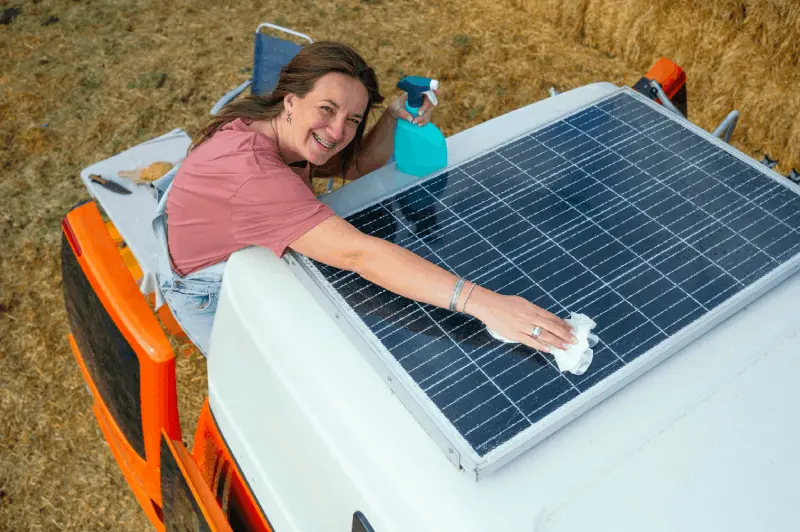
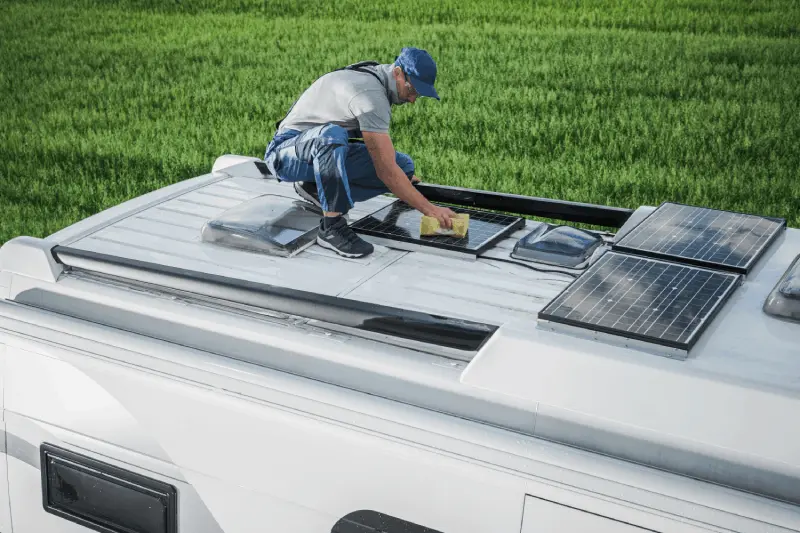
Since caravans often spend time in nature, on dusty roads, and under trees, the surfaces of the panels can get dirty quickly. Research shows that even a thin layer of dust on the panel surface can reduce efficiency by 10% to 20%. Especially sticky pollen or bird droppings in the spring months can hinder sunlight from reaching the cells, impairing the system's performance. For caravanners, panel cleaning should be a routine maintenance task. Cleaning with just pure water and a soft microfiber cloth can significantly increase energy production, especially during the winter months when low sun angles are present. Avoiding chemical cleaners prevents damage to the protective glass layer of the panel.
How Does Setting Up a 24 Volt System in a Caravan Reduce Panel and Wiring Costs?
Most caravans come with a 12 Volt electrical system, but switching to a 24 Volt system in larger vehicles with high energy needs offers significant advantages. According to the power formula (P=V*I), when the voltage doubles, the current required to carry the same power is halved. This means you can use thinner cables and save on cable costs. Additionally, MPPT charge controllers in 24 Volt systems can manage higher watt values. For example, a 30 Amp charge controller can support a 400 Watt panel in a 12 Volt system, while it can support an 800 Watt panel in a 24 Volt system. This situation maximizes system efficiency, especially for caravanners using inverters and running high-power devices.
Do Flexible Panels Installed Directly on the Roof Cause Heating Problems?
Yes, applying flexible panels directly to the caravan roof without leaving any gaps using silicone or similar adhesives can lead to serious heating issues. Solar panels generate a significant amount of heat while converting sunlight into electricity. In aluminum-framed panels, the height of the frame allows for natural ventilation, which is absent in the constructed flexible panels. When heat cannot be dissipated from beneath the panel, the silicone cells can overheat, leading to a decrease in production due to the "Efficiency Temperature Coefficient." To overcome this issue, placing "twinwall" polycarbonate sheets under flexible panels to allow airflow through small channels can protect both the lifespan and performance of the panel.
How Much Does Making the Panel Angle Adjustable Increase Efficiency for Winter Camping?
In mid-latitude countries like Turkey, the sun moves at a very low angle on the horizon during winter. A panel that is mounted flat on the roof of the caravan cannot even reach half of its production capacity because it cannot capture the winter sun directly. Mounting the panels with adjustable feet allows the panel to face the sun directly, increasing efficiency by 40% to 60% during winter months. While this difference may not be very noticeable in summer, tilting the panels on days when every Amp is valuable can be the only solution to ensure the batteries are fully charged. Of course, the disadvantage of this system is the hassle of manually adjusting the panel's angle at each campsite, but if energy needs are high, this effort is worth it.
How Should Portable Foldable Panels Be Used as Support for Fixed Panels?
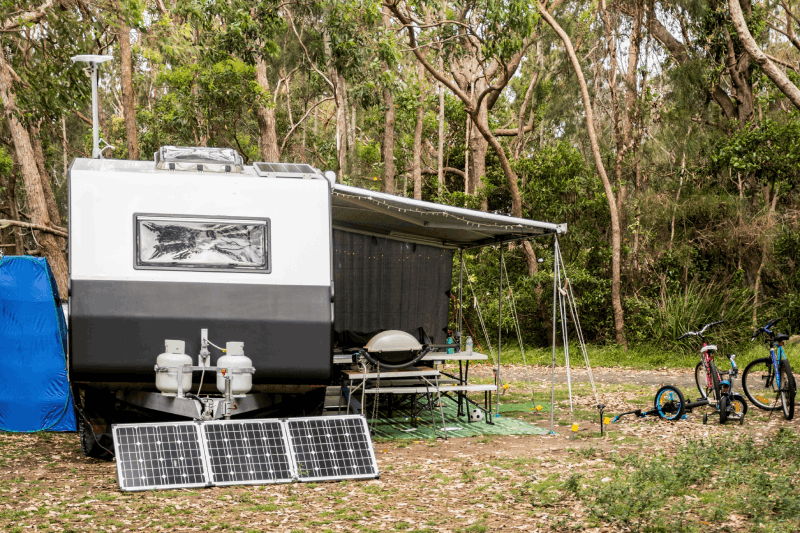
In some cases, the area on the roof of the caravan may not be sufficient to meet all energy needs, or you may have to park the caravan in the shade. In such scenarios, 100W or 200W foldable portable solar panels are excellent support. Connected to an external socket (solar input) with a long cable, these panels can be positioned to follow the sun. This way, while your caravan stays cool in the shade, your external panel can collect sunlight throughout the day. When choosing portable panels, it is advisable to select those with their own charge controllers or those that can be directly connected to the caravan's main system for ease of installation.
Why Does the Total Weight Capacity of the Caravan Play a Critical Role in Panel Selection?
Especially in caravans with a weight limit of 3.5 tons, every kilogram must be accounted for. A standard 200W monocrystalline panel weighs approximately 12-15 kg. When you place 4-5 of these panels on the roof of your caravan, the total load on the roof, including mounting feet and cables, can reach 80-100 kg. This load not only increases the total weight of the caravan but also raises the center of gravity, negatively affecting driving safety and cornering performance. If your vehicle is already at the weight limit, you should consider lighter flexible panels or high-efficiency (small surface area) premium panels to meet your energy needs without compromising safety.
How Can Damage from Salt Water to Panel Frames Be Prevented During Coastal Camping?
During long-term camping by the sea, salt particles suspended in the air can cause corrosion in the aluminum frames and mounting screws of the solar panel. The salt layer can also accumulate on the glass surface of the panel, reducing light permeability and efficiency. To minimize this damage, ensure that the panel frames are made of "anodized aluminum." Using stainless steel screws (SS316 quality) during installation is crucial. Additionally, washing the panels with plenty of fresh water after returning from coastal camps is the simplest and most effective way to prevent salt deposits from damaging metal components and sealing materials.
What Does the Superiority of Shingle Technology Panels in Shaded Areas Mean for Caravanners?
Panels with shingle (tile arrangement) technology are produced by laser-cutting the cells and stacking them on top of each other with special conductive adhesives. In this design, there are no gaps between the cells, and the "busbar" wires found in standard panels are absent. The biggest advantage of shingle panels is their incredible resistance to shading. While in classic panels, if one cell goes into the shade, the entire panel block is affected, in shingle panels, the energy flow continues through parallel paths. In partial shading caused by chimneys, vents, or surrounding branches on the caravan's roof, these panels offer much more stable production performance compared to standard panels.
Does the Choice of Inverter Inside the Caravan Directly Affect Panel Efficiency?
Rather than a direct effect, the choice of inverter is critical in terms of the overall efficiency of the system. The energy stored in the battery from the solar panel is DC (Direct Current). The inverter used to power 220V devices in the caravan converts this energy to AC (Alternating Current), losing some energy as heat in the process. Cheap and low-quality inverters can quickly drain the energy you collected from the sun, even if no device is running, due to high idle current. Using an inverter with "Pure Sine" and high efficiency rates (efficiency %90+) ensures that the valuable energy obtained from the solar panel reaches the end user without waste.
What Materials Should Be Used for Sealing in Caravan Panel Installation?
In installations made by drilling into the roof of the caravan, the biggest concern is water leakage. Relying solely on screws to secure the panel feet and cable entries is a significant mistake. At this point, "MS Polymer" based adhesives and sealing products (such as Sika 252 or similar professional products) should be used. These materials are resistant to UV rays from the sun and have the flexibility to adapt to the vibrations of the moving caravan. For cable entry, a special "solar cable entry box" (cable entry gland) must be used, and the area around this box should be meticulously sealed. Remember, even the most powerful solar system will not provide peace of mind in a caravan with a leaking roof.
Why Is the Use of MC4 Connectors in Solar Cables Mandatory?
MC4 connectors, which come standard on the back of solar panels, are specially designed for outdoor conditions. These connectors have an IP67 or IP68 protection class, meaning they provide complete protection against dust and water. Not using MC4 in cable connections exposed to rain, snow, and high heat on the caravan roof can lead to oxidation and arcing at the connection points in a short time. Arcing not only disables the system but also poses a fire risk. Using a professional MC4 crimping tool when connecting cables eliminates the risk of loosening the connection and completely removes energy losses due to contact resistance.
How Important Are Smart Monitoring Systems (Bluetooth) in Panel Selection for Caravans?
Modern solar system components (MPPT, Battery, Inverter) can now often communicate with smart phones via Bluetooth. This is like "flying blind" for a caravanner instead of "flying with radar control." Seeing how many watts are coming from the panel at that moment, how full the battery is, and what level your consumption is allows you to manage energy effectively. If production is low, you can understand through these screens that you need to change the location of the caravan or turn off an unnecessary device. Therefore, more than the panel selection, the ability to monitor the devices that will manage the panel is a crucial factor that directly enhances the overall lifespan and user experience of the system.
What Is the Difference Between the Label Values (STC and NOCT) on the Back of Panels?
When a panel says "200W" on it, it does not mean that the panel will produce 200W under all conditions. STC (Standard Test Conditions) values represent the ideal value that the panel provides under 25 degrees cell temperature and 1000W/m² sunlight. However, in the real world, panels can heat up to 60-70 degrees under sunlight. NOCT (Nominal Operating Cell Temperature) values show the performance that is closer to real-world usage (800W/m² sunlight, 20 degrees ambient temperature). It is critical for caravanners to look at the coefficients that indicate performance loss at high temperatures, not just the watt value in STC, when selecting panels, as this helps them understand the actual performance they will encounter during the summer months.
Is a Black Framed Panel or a Silver Framed Panel Better for Caravans?
While this question may seem like an aesthetic preference, it also has a technical aspect. Black framed and all-black panels look much sleeker and less noticeable on the caravan roof. This is especially important for those who practice "stealth" camping, as it is crucial that the equipment on the vehicle does not attract attention. However, black panels absorb more sunlight and can heat up a few degrees more than silver framed panels. While the difference in efficiency may not be enormous, for caravanners traveling in extremely hot climates, silver framed classic panels may offer a slight cooling advantage. Nevertheless, in today's technology, this difference is not significant enough to outweigh aesthetic preferences.
Why Is the Location of the Cable Entry Point Strategic in Panel Placement?
The point where the cables from the solar panels enter the caravan is important for both the layout of the interior and cable losses. Ideally, the cable entry should be as close as possible to the charge controller and batteries. Running the cable meters away from the outside or inside of the caravan increases resistance, leading to energy loss. Additionally, the cable entry box should not be placed in areas where water tends to accumulate or flow (flood-prone areas) to ensure waterproofing safety. Before installation, planning which furniture the cables will pass behind inside can prevent aesthetic clutter and optimize the system's electrical performance.
Why Is Using a Fuse in Caravan Panel Installation Life-Saving?
Fuses of appropriate amperage should be placed between the solar panels and the charge controller, as well as between the device and the battery. A short circuit or cable damage on the solar panel side poses a fire risk. The fuse protects both your devices and your caravan by cutting the circuit in case of excessive current. Generally, "DC Automatic" or "Blade" type fuses are preferred in solar systems. In case of a malfunction or when you need to perform maintenance on the system, you can easily cut off the energy using these fuses (or circuit breakers). Playing with cables without cutting off the power can lead to damage to the MPPT device or arcing in the batteries, so this safety step should never be overlooked.
Should Double-Sided Tape or Adhesive Be Used in the Installation of Flexible Panels?
Standard double-sided tapes available on the market are generally insufficient for the installation of flexible panels. The roof of the caravan is exposed to high wind pressure, vibration, and extreme temperature changes during driving. In these challenging conditions, the thing that will hold the panel in place is professional polyurethane adhesives. However, completely adhering the panel makes it impossible to remove in case of a malfunction. Therefore, a hybrid method can be followed: while the edges of the panel are turned with strong sealing adhesives, gaps can be left in the middle sections to allow for thermal expansion. Even if a very high-quality double-sided tape (such as the 3M VHB series) is used, the edges must be supported with mastic to prevent the panel from lifting off.
Is It Logical to Mount the Panel on the Caravan Window or Side Wall?
Panels mounted vertically on the side wall of the caravan can be very efficient during winter months or in the evenings when the sun is low. However, in summer, when the sun is directly overhead, these panels produce almost no energy. Additionally, vertical mounting can increase the wind resistance of the panel, affecting fuel consumption and posing a risk of the panel hitting external objects (branches, etc.). Some caravanners make these side panels "movable" to adjust their angle at the campsite. While this significantly increases efficiency, it also brings mechanical complexity. If there is space on your roof, optimizing the roof placement is always a more sustainable solution than vertical mounting.
What Should Be Considered When Buying Second-Hand Solar Panels for the Caravan?
If the budget is tight, second-hand panels may be an option, but this comes with certain risks. When buying a second-hand panel, you should check for "snail trails" (micro-cracks) on the cells. These trails indicate that the cell has been damaged. Additionally, the junction box on the back of the panel should be opened to check for corrosion. The most reliable method is to measure the panel's "Open Circuit Voltage" (Voc) and "Short Circuit Current" (Isc) values under sunlight with a multimeter. If the measured values are significantly lower than the values on the label (taking into account the sunlight intensity), that panel may have reached the end of its life or be damaged.
How Important Are "Tier 1" Standards When Choosing a Panel Brand for Caravanners?
The term "Tier 1" is essentially a list that measures the reliability of banks for large-scale solar power plant projects. However, it is also an indicator of quality for caravanners. Brands listed in Tier 1 (such as Jinko, Longi, Trina, etc.) are companies that allocate large budgets for R&D and have high manufacturing standards. If you are looking for a panel that can withstand shocks and external factors in a challenging environment like a caravan, choosing products from these brands will prevent future headaches. Of course, there are also boutique brands that are "specially produced for caravans"; what matters here is the warranty conditions offered by the company and the technical support behind the product.
How Is the Return on Investment (ROI) of Solar Panel Investment in a Caravan Calculated?
Investing in a solar panel in a caravan is not just a cost but a quality of life investment. If you do not have a solar panel, you will have to go to a camping site every evening and pay for accommodation and electricity. Considering camping fees in Turkey, a quality solar energy system (panel, lithium battery, MPPT) pays for itself in about 1.5 to 2 seasons. However, this calculation does not include the "freedom" factor. The joy of being able to stay in any cove without being tied to any facility is much greater than the cost of the system. Therefore, when choosing a solar panel for your caravan, it is a real saving to set up the most efficient system that will keep you away from camping sites for the longest time, rather than opting for the cheapest option.
Is Grounding Necessary in Caravan Energy Systems?
The issue of grounding the panel frames and the system's base during solar panel installation is often debated. This is mandatory in fixed home systems, but since caravans sit on insulating rubber tires, there is no real grounding connection. Instead, "earthing" is done. The aluminum frames of the panels and the base of the inverter are connected to the metal body of the caravan to ensure equipotential balancing. This is important for protecting the user against electrical leaks that may arise from the inverter and for dissipating static electricity in the system. However, care should be taken to avoid creating an incorrect "ground loop" and to protect connection points from corrosion during these connections.
Is Choosing a Solar Panel for a Caravan More of an Engineering Task or an Experience-Based Task?
Choosing a solar panel for a caravan is actually a perfect blend of both disciplines. Knowing technical data, watt calculations, and voltage drops requires an engineering perspective. However, knowing which panel will perform best in which path, which shade will hinder production, or how long dust will accumulate is entirely a caravanning experience. The niche topics we have covered in this guide will help you establish the most accurate energy system by combining both technical and practical worlds. Remember, a well-chosen solar panel will not only recharge your batteries but also your dreams of freedom every day.