Is It Really Possible to Camp Freely in Europe with a Caravan?
When traveling by caravan in Europe, wild camping, which refers to staying overnight in places outside official camping areas, is both a great passion and a serious area of legal uncertainty. Generally, the rules vary dramatically from country to country within the European Union, and even from state to state within the same country. Some countries completely prohibit this practice, while others allow it under certain conditions, referred to as "resting." Technically, it is not possible to camp freely everywhere; however, knowing the legal loopholes that laws permit and understanding the tolerance levels of local administrations is the only way to sustain this freedom.
What Is the Right to Roam Rule Applied in Scandinavian Countries?
Scandinavia, particularly Norway, Sweden, and Finland, are the most tolerant regions in Europe for caravaners. Here, there is an ancient tradition and law known as "Allemansrätten" (Right to Roam). This rule advocates that nature belongs to everyone and that everyone has the right to benefit from nature responsibly. However, this right is subject to certain restrictions for caravans. Generally, overnight stays are allowed on the condition that motor vehicles do not enter far off the road, do not damage agricultural land, and do not intrude on the view of houses. Even in these countries, the rule of "no camping"—meaning not setting up tables and chairs outside—is fundamental.
What Is the Fine Line Between Overnight Stays and Camping in France?
Despite being one of the most developed countries for caravan culture, France has quite specific rules. According to French laws, "stationnement" (parking) and "camping" (camping) are sharply distinguished. If your caravan does not have any equipment that touches the ground outside its wheels, meaning you haven't set up steps outside, the awning is not extended, and no cooking is done outside, this situation is considered "parking." In many municipalities, sleeping in a parked vehicle is not prohibited; however, "wild camping," meaning taking out camping equipment outside, is subject to heavy fines.
How Does the "Resting to Overcome Fatigue" Exception Work in Germany?
In Germany, wild camping is generally prohibited, but there is a very important legal term in favor of caravaners: "Wiederherstellung der Fahrtüchtigkeit." This term means resting to regain driving ability. In Germany, you are allowed to stay overnight on highways or in publicly accessible parking lots only once and for no more than 10 hours. The main purpose here is to prevent traffic accidents caused by sleep deprivation. However, taking out camping gear or lighting a campfire during this period is considered an abuse of this right and is punishable.
What Are the Penalties for Wild Camping in the Swiss Alps?
Switzerland is one of the strictest countries in Europe regarding caravan accommodation. Due to the cantonal governance system, the rules vary significantly. In many areas of the Alps, especially in national parks, wild camping is strictly prohibited, and you may face fines reaching thousands of Swiss Francs. While some low-altitude cantons and local municipalities may allow it, the general rule is "prohibition." It is vital to check the local municipality's (Gemeinde) website or tourism offices for information before camping in Switzerland to protect your wallet.
What Do the New Restrictions Along the Coasts of Spain and Portugal Include?
In recent years, the Iberian Peninsula, which has seen a rise in popularity, has tightened its rules due to excessive caravan traffic. In Portugal, laws that came into effect in 2021 have severely limited the places where caravans can stay overnight. Overnight stays are only allowed in areas designated by local administrations and for no more than 48 hours. In Spain, due to coastal protection laws (Ley de Costas), it is completely prohibited to camp with a caravan along the coastal strips. While there may be a more flexible attitude in inland areas, the Guardia Civil conducts strict nighttime checks in tourist areas.
Why Is It So Difficult to Wake Up with a Caravan on the Adriatic Coasts?
Countries like Croatia, Slovenia, and Montenegro are among the regions that strictly monitor wild camping, especially during the summer months. In Croatia, staying overnight anywhere outside official camping areas is legally considered an offense, and the tourism police do not make any concessions in this regard. You can see "No Camping" signs at every corner in parking lots along coastal roads or at the entrances of secluded bays. Since the tourism economy in these countries is entirely based on camping facilities, vehicles staying outside are directly regarded as potential offenders and economic losses.
Is Wild Camping Safer in Eastern Europe and the Balkans?
Countries like Romania, Bulgaria, and Albania offer much more flexible and free spaces for caravaners compared to Western Europe. In these countries, wild camping generally does not pose a legal issue; however, here, "legal rules" give way to "safety concerns." Camping in areas with inadequate infrastructure and secluded rural areas requires caution from the perspective of personal safety and local wildlife (especially in Romania, bears). The local people are generally hospitable, but it is important to respect property boundaries and maintain good communication with local authorities.
What Are the Strict Rules That Vary from State to State in Austria?
Austria establishes camping rules at the state level due to its federal structure, which can be confusing for caravaners. For example, in the state of Tyrol, the camping law is so strict that even sleeping inside the vehicle is considered wild camping and is heavily penalized. In Vienna, however, parking rules are more focused on city traffic and order. In regions like Upper Austria or Styria, some municipalities may be more tolerant. Generally, camping in the middle of nature outside of rest areas on main roads (ASFINAG areas) poses a significant risk in Austria.
Why Is Overnight Camping Always Prohibited in National Parks?
No matter where you are in Europe, as soon as you enter the boundaries of a "National Park" or "Nature Reserve," wild camping rules are enforced at the highest level. These areas are established to protect biodiversity and keep wildlife away from human impact. Camping overnight in a national park is not only a park violation but also considered environmental crime. Fines can be three or four times higher than in normal areas, and your vehicle may be requested to be removed from the area. Protecting nature is the first and most important rule of traveling freely.
How to Camp Without Attracting the Local Population's Reaction?
The biggest risk in wild camping is not the police but the local people who may feel disturbed. Camping too close to a settlement or in a way that obstructs a local farmer's view can lead to complaints. It is essential to practice the art of "stealth." Keeping your lights to a minimum, avoiding noise, and respecting the daily rhythm of those living nearby is important. If you suspect that a place is privately owned, asking for permission from the owner usually opens doors. A friendly smile and a few words of greeting in the local language can turn prohibitions into tolerance.
Why Are "Leave No Trace" Principles Vital for Caravaners?
The "Leave No Trace" principle is essential for the caravan community to sustain its presence in Europe. When leaving the place you stayed, there should not be a single trace that you were there. Even better, you should leave the area cleaner than you found it by picking up any litter in the area. Leaving trash, dumping dirty water, or lighting a fire are the main reasons local administrations impose stricter laws against caravans. A responsible caravaner knows that they manage not only their waste but also the community's image.
What Is the Impact of Applications Like Park4Night on Legality?
Applications like Park4Night, Caramaps, or iOverlander are indispensable for modern caravaning. However, every "green tree" symbol in these applications does not mean that the location is legal. These points are based on experiences entered by users. A place where one user stayed without issues may have been closed by police operations the next day. When using these applications, it is necessary to check the date of comments and verify the legal status with local signs. Additionally, every popular spot risks becoming a victim of "overtourism" and being banned over time; therefore, it is more sensible to discover lesser-known spots.
How Effective Is "Stealth Van" Design in Secretive Camping?
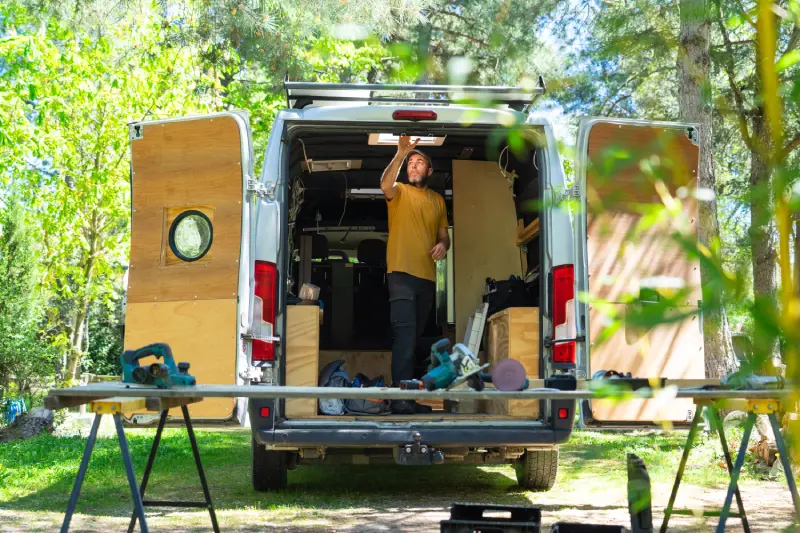
"Stealth Van" designs that look like a work vehicle from the outside, with no windows or completely covered windows, are a way to survive in city centers and restricted areas in Europe. A panel van that does not look like a caravan can park on a street corner without attracting the attention of police or locals. However, this method is only valid for short-term stays. The need for ventilation and signs of life inside the vehicle (noise, light leakage) can easily be noticed by professional eyes. Therefore, this design should only be seen as an additional layer of security and should not be used as an excuse to disregard the rules.
How Should One Stay Calm and Communicate Properly During Police Checks?
Panic when your caravan's door is knocked by the police in the middle of the night only makes the situation worse. Most police officers in Europe are generally polite and will try to help you once they understand that your only intention is to rest. Instead of arguing with them, gently express your ignorance, say, "I was just resting safely because I was tired," and indicate that you are ready to leave immediately, which often helps you avoid penalties. Having your identification and vehicle documents complete is the most basic element that ensures the police trust you.
What Are the Risks of Wild Camping in Europe During Winter?
Wild camping in Europe during the winter months is not only illegal but also poses life-threatening risks. Many mountain roads are closed to traffic in winter, and navigation may leave you stranded in a dead-end street under snow. If your heating system (Webasto, etc.) malfunctions, finding help in an unofficial camping spot can be very difficult. Additionally, parking lots must be empty for snow removal vehicles to operate; a caravan hidden under snow can endanger both your safety and that of the officials. It is safer to prefer open camping areas or official caravan parks (Stellplatz) in winter.
What Are the Legal Consequences of Mismanaging Caravan Waste?
One of the least discussed but most important aspects of caravan travel is waste management. Disposing of gray water (kitchen and shower water) and black water (toilet waste) into nature or rainwater channels constitutes a serious offense across Europe. In many countries, this situation is classified as "environmental pollution" and can lead to penalties up to imprisonment. It is essential to use "Euro-Relais" stations or disposal points in camping areas. This respect for the environment is the key to ensuring that caravaning continues to be regarded as a free lifestyle.
How Is the Culture of Staying with Permission in Private Lands Developing?
In recent years, a new culture of accommodation has emerged in Europe through networks like "Agriturismo" or "France Passion." In these systems, farmers, landowners, or local producers allow caravaners to stay in their lands for free or for a symbolic fee. This is a great way to escape legal uncertainties and support local producers. By purchasing fresh milk, cheese, or wine from farms, you effectively pay for your stay. This method combines the thrill of wild camping with the safety of official camping.
Which Regions of Europe Are Most Tolerant Towards Caravaners?
If you want to chart a route without legal stress, the inland areas of France, Scotland (especially the northern coasts), Norway, and Sweden will be a paradise for you. Additionally, less touristy inland areas of Spain, such as Extremadura or Castile, are also quite welcoming to caravaners. The Alentejo region of Portugal is quieter and less restrictive compared to the Algarve. Tolerance is generally inversely proportional to tourist density. When you escape the crowded popular beaches and head inland, you will not only get to know the local culture better but also face fewer accommodation issues.
Could Caravan Travel in Europe Be Completely Banned in the Future?
The explosion in the number of caravans and the environmental issues it brings are pushing many European countries to enact stricter laws. However, a complete ban is unlikely; because caravan tourism is an important source of income for many small municipalities. The future may evolve towards more "reservation-based wild camping" systems or digital permits. To protect our freedom, we must comply with social rules, show respect for the environment, and prove that we are responsible travelers from today onwards. Caravaning is not a right but a privilege granted to us as long as we respect nature and local communities.