Why is Choosing the Right Battery in Caravan Electrical Systems So Critical?
When you are away from the city with your caravan, the amount of energy you have determines the limits of your comfort. The operation of the refrigerator, lighting, water pump, and charging of your personal electronic devices entirely depends on the performance of your battery bank. Choosing the wrong battery not only leaves you without power in the middle of your vacation but can also reduce your solar panel efficiency and harm your budget in the long run. In platforms like caravans, which are mobile and have limited space, technical details such as the weight of the battery, charging speed, and depth of discharge are much more important than in home systems. Therefore, understanding the technological differences is the first step to securing your freedom.
What is Gel Battery Technology and How Does it Work in Caravans?
Gel batteries are a member of the "VRLA" (Valve Regulated Lead Acid) battery family. In these batteries, the electrolyte is turned into a gel consistency by adding silica dust into sulfuric acid. This structure ensures that the battery is leak-proof and allows it to operate even in non-vertical positions. The reason for its long-standing preference in caravans is its maintenance-free nature and its greater durability in deep discharge cycles compared to classic flooded batteries. The gas emission inside is minimal, allowing it to be safely used in enclosed spaces like the interior of a caravan. Its shock-resistant structures provide a significant safety element for travelers on bumpy roads.
Why are Lithium (LiFePO4) Batteries Considered the "Technology of the Future"?
Lithium Iron Phosphate (LiFePO4) batteries have revolutionized the energy storage world. These batteries, which have a completely different chemistry from traditional lead-acid technology, offer much higher energy density. This means they can store significantly more energy than a gel battery of the same size and can release that energy much faster. The reason lithium batteries shine in caravans is that they do not lose capacity over thousands of cycles and can maintain voltage levels stable until the very end. Additionally, having a Battery Management System (BMS) inside ensures protection from situations like overcharging, over-discharging, and short circuits, bringing safety to a software level.
Which Battery is More Advantageous in Terms of Usable Capacity?
The amp (Ah) value on a battery does not always represent the energy you can use. In gel batteries, it is generally recommended to use only 50% of the battery's capacity to protect its lifespan. If you continuously discharge a 100Ah gel battery at 80-90%, the battery plates will sulfate in a short time and deteriorate. On the other hand, lithium batteries can be discharged up to 90% or even 100% of their total capacity. This means that a 100Ah lithium battery provides energy equivalent to a 200Ah gel battery in practical use. In terms of efficiency, lithium is undoubtedly superior as it offers nearly all the data on paper to its user.
Why is Weight and Space Saving So Important in Caravans?
Every kilogram in caravans directly affects fuel consumption and driving safety. A standard 100Ah gel battery weighs about 30-32 kilograms, while a lithium battery of the same capacity weighs only around 10-12 kilograms. Considering the difference in usable capacity, the weight advantage provided by lithium batteries is threefold. A caravan owner needing 200Ah of usable energy would have to carry 120 kg if using a gel battery, while with lithium, this load can be reduced to 25 kg. This not only saves fuel but also provides significant comfort in terms of staying within the total weight limits (MTPLM) of the caravan and legal limits, as well as tire lifespan.
Who Wins in Cycle Life Comparison?
Cycle life indicates how many times a battery can be charged and discharged. A quality gel battery can provide about 500 to 800 cycles at a 50% depth of discharge. This corresponds to approximately 2-3 years of intensive use. LiFePO4 lithium batteries, even at an 80% depth of discharge, offer a lifespan between 3000 and 5000 cycles. In fact, in some high-end models, this number can reach up to 10,000 cycles. This means that lithium batteries can be used for over 10 years without experiencing performance loss. When viewed as a long-term investment, lithium batteries become a much more economical solution per cycle compared to gel batteries.
What are the Differences in Charging Speed and Efficiency?
For caravan owners, sunny hours are valuable. Lithium batteries have much lower internal resistance compared to gel batteries, allowing them to be charged at much higher currents. A gel battery charges very slowly during the "absorption" phase after reaching about 80% charge and can take hours to fully charge. Lithium batteries, on the other hand, continue to charge at maximum speed until nearly 100% full. Additionally, the charging efficiency of lithium batteries is around 98%, while in gel batteries, this rate can drop to 85%. This means that while almost all the energy from your solar panel is stored in lithium, some is lost as heat in gel batteries.
How Do Their Performances Change in Cold and Hot Weather Conditions?
Heat is the biggest enemy of battery chemistry. Gel batteries can experience capacity loss in extreme heat, although they do not have a risk of evaporation; however, the risk of freezing in extreme cold is low, and they continue to operate. Lithium batteries are more tolerant to high temperatures but can be dangerous to charge at temperatures below 0°C (should not be charged). Most modern lithium batteries have "heating" systems that warm the cells, but for those who camp in winter, gel batteries may offer a simpler solution. However, keeping lithium batteries inside (in the living area) usually solves this problem since the interior of the caravan is already heated.
What are the Differences in Maintenance Requirements and Ease of Use?
Both gel and lithium batteries are categorized as "maintenance-free," meaning you do not have to worry about adding distilled water. However, in terms of ease of use, lithium is a step ahead. Gel batteries sulfate when left discharged for long periods and cannot return to their previous performance. Additionally, due to the "Peukert effect," when high-draw devices (like coffee machines, hair dryers) are used, the voltage of gel batteries can drop suddenly, causing the inverter to shut down. In lithium batteries, the Peukert effect is negligible; even if high current is drawn, the voltage remains stable, and the battery is not damaged.
Cost Analysis: Initial Investment or Long-Term Savings?
The biggest disadvantage of lithium batteries is the initial purchase cost. A lithium battery can be sold for 3 to 5 times the price of a gel battery of similar capacity. However, at this point, the "total cost of ownership" (TCO) comes into play. While gel batteries need to be replaced every 3 years, lithium batteries last 10 years or more. Additionally, due to the difference in usable capacity, one lithium battery is sufficient instead of two gel batteries. When divided over the years, lithium batteries always turn out to be the cheaper option. If you only use your caravan for a week a year, gel may make sense, but if you are an active caravaner, lithium means savings.
Which Works Better with Solar Panel Systems?
Energy production in solar panel systems varies; current drops in cloudy weather or under tree shade. Lithium batteries are considered much more efficient than gel batteries for this irregular current. Gel batteries require a certain "saturation" time to reach full charge, while lithium batteries can quickly absorb even short bursts of high current between clouds. When used with MPPT charge controllers, lithium batteries maximize your solar energy harvest. Gel batteries, due to their slower response, may not reach full charge by the end of the day, leading to the "partial state of charge" (PSoC) issue that shortens the lifespan of the battery.
What are the Safety Standards and Risks of Explosion/Fire?
Both technologies are quite mature in terms of safety. Gel batteries are leak-proof and do not emit gas, but they can swell when overcharged. When it comes to lithium batteries, chemistry is very important. While older generation lithium batteries (like LCO) carry a risk of fire, the LiFePO4 (Lithium Iron Phosphate) chemistry used in caravans is extremely stable and does not catch fire even if punctured. Additionally, the BMS (Battery Management System) inside lithium batteries monitors each cell every second and automatically shuts down the system when voltage, current, and temperature limits are exceeded. This active protection actually makes lithium safer than traditional batteries.
How Do Environmental Impact and Recycling Processes Work?
Lead-acid (gel) batteries are among the products with the highest recycling rates in the world; 99% of the lead inside can be recovered. However, lead is a heavy metal, and if it leaks into nature, it has significant toxic effects. The lithium used in lithium batteries, along with materials like iron and phosphate, is less toxic than lead, but the recycling processes for lithium are still in development and are currently not as economical as lead. Nevertheless, the fact that a lithium battery lasts 5-6 times longer than a gel battery significantly reduces the total amount of batteries produced and disposed of, making it a more environmentally friendly option in terms of overall carbon footprint.
Which Battery is Easier to Install and Integrate?
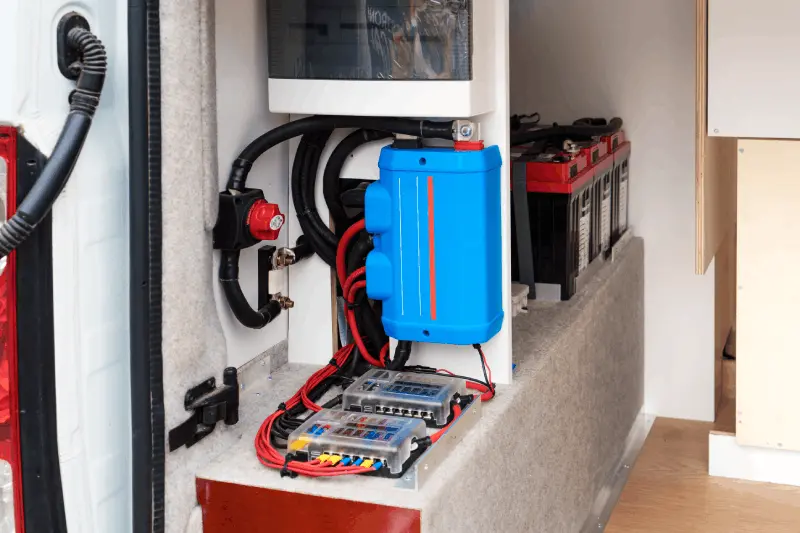
Installing gel batteries is very simple; they can work with any standard lead-acid charger or alternator relay. In lithium batteries, the situation is a bit more technical. The charging voltage profiles of lithium batteries are different, so your charge controller and, if applicable, your 220V charger must have a "Lithium" mode. Additionally, if you plan to charge from your vehicle's alternator, you must use a "DC-DC charger" to prevent the lithium battery from drawing too high a current and burning out the alternator. While this additional equipment increases installation costs and complexity, it is critical for the overall efficiency and safety of the system.
Is Gel Battery Sufficient for Weekend Travelers?
If you only use your caravan a few times a year on weekends and your electricity needs are limited to lighting and a small refrigerator, a gel battery may be the most rational choice for you. In this type of use, the high amount paid for a lithium battery will not amortize enough to justify its cost. Gel batteries perform successfully in these types of periodic uses as long as they are properly charged and not left discharged in winter. For new caravaners looking to keep initial investment costs low, gel batteries are a reliable and economical option for entry-level use.
Is Lithium a Must for Full-Time Caravan Living?
For those living full-time in a caravan or going on long-term (months-long) trips, lithium batteries are almost a necessity. For a "full-timer" who is constantly on the move or trying to survive on limited solar energy, the fast charging feature and 90% depth of discharge of lithium is invaluable. If you plan to use high-power devices like coffee machines, induction cookers, or air conditioners, a gel battery bank will quickly struggle under this load. Lithium batteries can support these devices without experiencing voltage drops. In this lifestyle, lithium is not just a luxury; it is a fundamental requirement for the sustainability of the system.

Can Different Battery Types Be Mixed in the Same System?
The answer to this frequently asked question in the caravan world is a clear "no." You should never connect a gel battery with a lithium battery (or even two gel batteries of different brands) in parallel or series. Each battery type has different internal resistance, charging voltage, and discharge characteristics. In such a mixed use, the stronger battery will continuously try to charge the weaker one, leading to overheating and rapid deterioration of both batteries. If you want to upgrade your system to lithium, you must completely remove your existing gel batteries and reconfigure the system according to lithium technology for the safety of the system.
What Tips Should Be Followed to Extend Battery Life?
Regardless of which battery you choose, the key to extending its life lies in proper charging management. Gel batteries should never be discharged below 50% and must be fully charged to 100% after each use. In lithium batteries, the opposite is true; keeping lithium batteries between 20% and 80% instead of continuously at 100% (floating) extends their lifespan even further. Additionally, ensuring that battery terminals are clean and tight, not leaving batteries completely discharged in winter, and using high-quality chargers are golden rules for both technologies. Temperature control should not be overlooked; you should store your batteries in an area as insulated from extreme heat as possible.
How Does Voltage Stability Affect the Health of Your Devices?
Many caravan devices (especially diesel heaters like Webasto and compressor refrigerators) are sensitive to voltage drops. In gel batteries, when capacity drops to 40%, voltage can fall to 11.5V levels, causing devices to malfunction. Lithium batteries, on the other hand, keep voltage stable at 12.8V - 13V until capacity drops to 5%. This stable current ensures a longer lifespan for electronic boards and guarantees the efficient operation of your devices. Stable voltage means not only the amount of energy but also the quality of energy, and in this regard, the technological superiority offered by lithium is indisputable.
What is the Most Efficient Choice for Your Caravan?
Ultimately, how you define the concept of "efficiency" will determine your choice. If you see efficiency as "energy per gram" and "fast energy recovery," lithium (LiFePO4) batteries leave gel batteries behind in every aspect. Lithium is an advanced technology that meets all the needs of modern caravaning, saves weight, and promises a 10-year lifespan. However, if you have a limited budget and use your caravan only occasionally for hobby purposes, gel batteries are still a reliable, easy-to-install, and low initial cost alternative. By analyzing your usage habits and energy budget, you can decide on the most suitable battery that will be the heart of your caravan.