Why is Choosing the Right Equipment Vital for Preparing Campfire?
Camping requires not only finding peace in the heart of nature but also being prepared for the challenges that may arise. Chopping wood and starting a fire are among the most fundamental aspects of this preparation. Choosing the wrong equipment not only leads to physical fatigue but also brings serious injury risks in an environment far from settlements. The continuity of the campfire, which serves functions such as warmth, cooking, and keeping wild animals at bay, depends on how efficiently the wood is processed. Therefore, the choice between an axe and a saw directly affects the quality of the camping experience.
How to Minimize the Risks of Kickback and Glancing When Using an Axe?
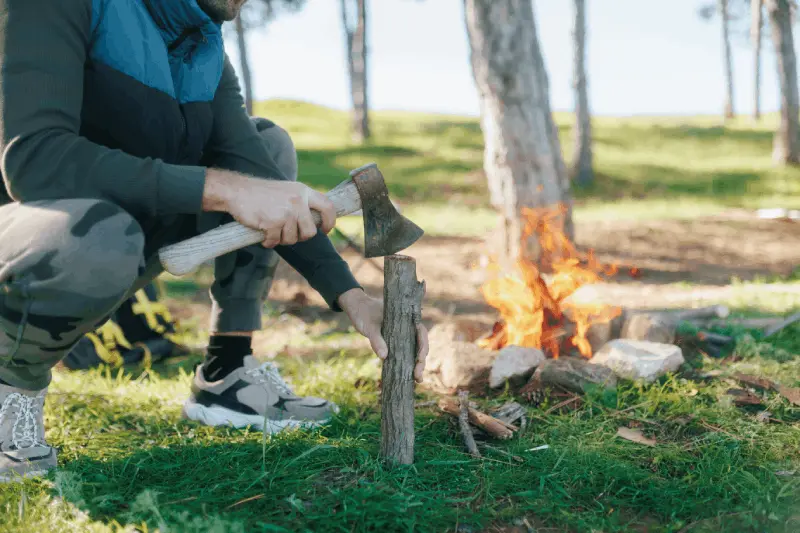
Although the axe is one of humanity's oldest tools, its use requires high attention and skill. Especially when striking hard woods or knotted sections, the axe's tendency to glance is one of the most common causes of accidents. To enhance safety, it is essential to adjust the angle of the strike correctly and to adopt a stance that will not harm the body in case the axe deviates from the target. Additionally, ensuring that the axe handle is not wet or slippery, using gloves, and clearing obstacles around the striking area are critical measures that significantly reduce the risk of glancing.
How to Solve the Jamming Problem During Cutting with Portable Saws?
Portable saws often face the issue of the blade getting jammed in the wood, especially when cutting fresh or fibrous woods. This situation slows down the cutting speed and can cause the user to lose balance, leading to the hand hitting the saw teeth. To prevent jamming, it is necessary to analyze the tension direction of the wood well. Cutting from the point where the wood opens under its own weight or placing a small wedge inside the cut to keep the channel open ensures that the saw operates smoothly. A saw used with the correct technique offers cuts that are much more precise than those achievable with an axe.
Which is More Suitable for Lightweight and Portability for Backpackers?
When every gram counts in a backpack, carrying a heavy axe may not always be a logical choice. Modern portable saws typically weigh between 200 to 400 grams, making them lighter than even half an axe. Thanks to their foldable designs, they can be safely placed in the side pockets or inside the backpack. Axes, on the other hand, usually require a sheath and external hanging apparatus, which can disrupt your balance while hiking. If you are only preparing enough wood to last the night, the saw is clearly superior in terms of weight and volume savings.
Can the Physical Strength Required for Splitting Wood with an Axe be Compared to Using a Saw?
Splitting wood means separating the fibers of the wood lengthwise, and this process requires kinetic energy. The axe easily provides this energy due to its mass; however, this process creates a significant load on the user's shoulders, back, and arms. On the other hand, splitting wood with a saw is nearly impossible; saws are designed only for cross-cutting the wood. A camper using a saw to thin out wood may actually tire themselves out much more from the back-and-forth motion, which is cardiovascularly exhausting. In terms of physical strength, the axe requires explosive power, while the saw demands endurance and rhythm.
Which Tool is More Practical for Reaching Dry Parts Inside Wet Woods?
It is impossible to ignite a completely soaked piece of wood on a rainy day while camping. To start a fire, you need to reach the dry parts in the center of the wood. At this point, the axe is far superior to the portable saw. By splitting the wood lengthwise, you can expose the dry core inside and create small kindling. With a saw, you only get wet slices, and you will again need a knife or axe support to open the inside of these slices. Therefore, in humid weather conditions, the axe is a tool that increases your chances of survival.
Why is a Saw Safer than an Axe for Safety in the Dark?
Preparing firewood during the night when the campfire has started to die down and visibility is reduced is quite dangerous. Swinging an axe can lead to serious injuries due to misjudging distances in the dark and poor coordination. The saw, however, is in constant contact with the wood, which significantly reduces the margin for error. Once the teeth of the saw engage with the wood, you can work safely with a controlled back-and-forth motion without needing a wide swing area. This controlled working method makes the saw a much safer choice in low-light conditions.
Can the Batoning Technique Completely Eliminate the Need for an Axe?
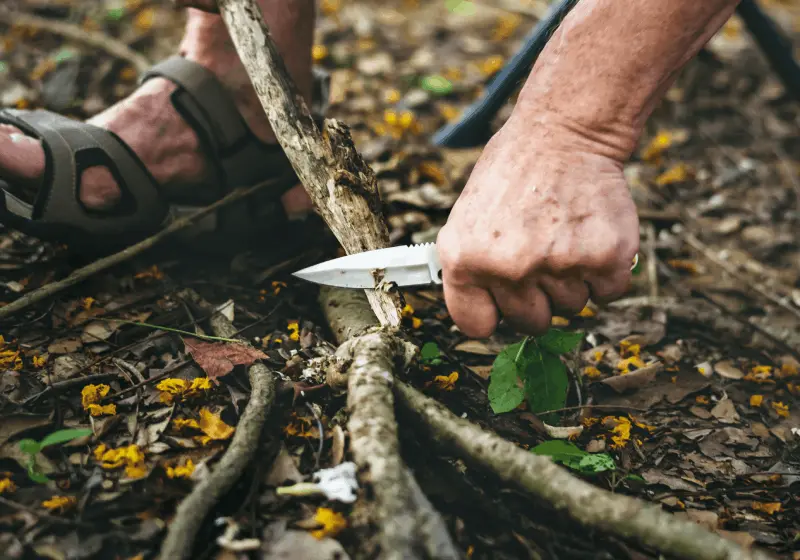
Batoning is the process of splitting wood by striking a piece of wood with a sturdy camping knife. Many minimalist campers believe that this technique allows them to avoid carrying a heavy axe. However, batoning is only valid for certain diameters and straight-grained woods. In thick and knotted woods, batoning can cause your knife to break or bend. Batoning appropriately sized wood cut with a saw is a great combination; however, it does not fully replace the massive splitting power that an axe provides. The versatility of the axe is always a step ahead of batoning.
How Much More Efficient is an Axe Compared to a Saw for Splitting Thick Logs?
If you need to split a log thicker than 30 centimeters, a small portable saw can keep you busy for hours and eventually dull the saw blade. An axe, especially one with a hefty head, can find the weak points of the log and break off large pieces in a single strike. However, this situation varies depending on the type and dryness of the wood. While even an axe can struggle with very hard woods like oak, it can gain incredible speed with soft woods like spruce or pine. If you are going to deal with thick logs, an axe is a necessity, while a saw is more ideal for "wrist-thick" branches.
What is the Difference in Noise Levels for Those Seeking a Quiet Camping Experience?
If you want to enjoy the silence of nature or remain unnoticed while "wild camping," the sound of your equipment is an important factor. The sound of striking wood with an axe (the thudding sound) can echo for long distances in the forest and can disturb wildlife as well as reveal your location. The saw, on the other hand, produces a much lower frequency and rhythmic sound. It is quite difficult to hear from a few meters away. Therefore, using a saw for a peaceful camping experience away from noise pollution would be a more respectful approach for both you and the living beings around you.
Which is Less Troublesome in Terms of Equipment Maintenance and Knife Sharpness?
Maintaining an axe only requires sharpening the blade with whetstones and oiling the handle (if it is wooden). Even if the axe blade becomes dull, it can still be functional with the right technique. However, when the teeth of portable saws become dull or bent, it is nearly impossible to sharpen them in the field. Most saws have disposable blades due to their tooth structure, and when performance declines, the blade must be completely replaced. For long-term exploration trips, an axe that can be continuously revitalized with a whetstone is a more logical investment in terms of durability.
What Should Be the Priority for Safety in Family Camps with Children?
In a family camp where children are running around, an axe that is left out or in use is always a potential danger. The possibility of children reaching for the axe and swinging it uncontrollably is a significant source of stress for parents. Portable saws usually have a locking mechanism and are only effective when used with both hands. The likelihood of a child causing serious harm to themselves or someone else with a saw is much lower compared to an uncontrolled axe swing. When it comes to family safety, a saw provides a more controlled and manageable risk.
What is the Starting Tool for Those Looking to Develop Bushcraft Skills?
Bushcraft is the art of establishing a living space using available resources in nature, and in this discipline, an axe is as valuable as a "Swiss Army knife." With an axe, you can not only chop wood but also build shelters, carve hollows from logs, and even create kitchen utensils when used skillfully. A saw is only for cutting. For someone new to the bushcraft world, understanding the weight distribution of an axe and learning the usage techniques (swinging, carving, splitting) will greatly enhance their proficiency in nature. Therefore, for artistic and functional depth, the axe is the first choice.
Which Equipment is More Durable in Harsh Winter Conditions and Frozen Woods?
When the air temperature drops below zero, woods freeze and the moisture inside turns into ice crystals. In this case, the wood becomes much more brittle but also resilient. The teeth of a saw can easily get clogged or break due to the freezing of the wood. An axe, however, can split frozen fibers by breaking them with striking force. However, it should be noted that in extreme cold, the steel of the axe can also become brittle; therefore, lightly warming the axe near the fire before starting strikes is a professional technique. In winter camps, the axe performs more durably.
Why is a Saw Preferred in Emergency Kits (Bug-Out Bags)?
In emergency scenarios, speed, weight, and compactness are the most important criteria. A foldable saw that you can fit into your bag during an earthquake, flood, or evacuation allows you to quickly set up a shelter or clear branches blocking your path. An axe takes up a lot of space in the bag and increases the risk of accidents when used with a tired and stressed mind. A saw allows you to make maximum cuts with minimal energy expenditure. Survival experts recommend this tool by emphasizing the margin of error and energy savings that a saw provides in emergencies when physical condition declines.
Is the Difference in Calorie Expenditure While Cutting Wood Significant?
Preparing firewood is one of the highest energy-consuming activities while camping. Using an axe requires explosive power that engages almost all muscle groups (especially core, back, and shoulders) and quickly raises the heart rate. Using a saw, on the other hand, is more like a long-duration, low-intensity exercise that relies more on arm muscles. If your food supplies are limited and you need to conserve energy to maintain your body temperature, cutting wood rhythmically with a saw expends much less calories than chopping with an axe. When energy management is vital, the saw is more economical.
How Does Ergonomics and Grip Comfort Change with Long-Term Use?
The handle ergonomics of an axe is designed to absorb shock at the moment of impact; however, a certain amount of vibration is still transmitted to your joints with each strike. This can lead to wrist and elbow pain (like tennis elbow) even with long-term use. Portable saws usually have soft rubber-coated handles and do not impose sudden impact loads on the joints since they are based on pulling-pushing movements. If you are setting up a large camp where you need to work with wood for hours, the comfort provided by the saw will make you feel less worn out by the end of the day.
Which is More Precise for Preparing Kindling and Feather Sticks?
To start a fire, you need thin twigs as fine as matchsticks and feather sticks. It is difficult to work with such fine details with a saw because it only cuts by breaking the wood. However, by holding the sharp axe head close to your hand, you can use it like a knife and carve very fine shavings or kindling from the wood. The fact that the axe has not only a "striking" surface but also a "cutting" surface makes it more functional in the early stages of the fire-starting process. The saw is only used for cutting the main firewood.
What are the Performance Differences Among Different Tree Species (Oak, Pine, Fir)?
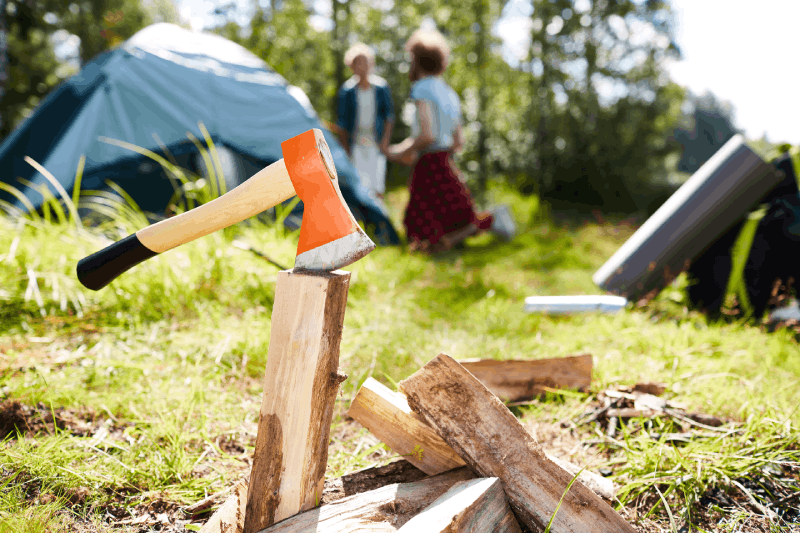
The type of wood directly affects the choice of tool. In soft and resinous woods like pine, the teeth of the saw can quickly become clogged with resin and lose performance; however, the axe can easily split these types of wood. In very dense and hard woods like oak or hornbeam, the axe may struggle to penetrate the wood and can kick back; in this case, making a patient cut with a fine-toothed saw may be more result-oriented. Trees like fir, which have easily separable fibers, are suitable for both tools. Knowing the vegetation cover in the area where you will camp will guide you in determining the tool you will take with you.
How Does the Material of the Handle (Wood vs Composite) Affect Usage Safety?
Traditional wooden-handled axes are aesthetically and tactilely excellent; however, if not maintained, they can dry out and crack or the head can come off the handle, posing a significant safety risk. Modern axes and saws with composite (fiberglass-reinforced) handles are nearly indestructible and are not affected by weather conditions. Since composite handles are usually produced in conjunction with the head, the risk of "head flying off" is completely eliminated. The safety priority of a modern camper should be to prefer equipment with non-slip handles made from technological materials, minimizing the margin of error in the field.
What Should Be the Ideal Combination for a Versatile Camper?
In fact, most experienced campers prefer to take advantage of both tools rather than saying "either or." A combination of a lightweight portable saw (such as a Silky or Bahco brand) and a small bushcraft axe (hatchet) responds to all firewood preparation scenarios. You can quickly cut the wood into suitable lengths with the saw, and with the axe, you can split these pieces to extract the dry part inside and prepare kindling. If you have a weight limit, combining two small and functional tools instead of one large tool will increase your work efficiency in the camp by 100%.
Is the Price Difference Between a First-Class Axe and a Saw Worth the Investment?
It is possible to find axes and saws sold very cheaply on the market; however, they often dull, bend, or break from the handle in a short time. A quality Swedish steel axe (like Gränsfors Bruk) is a legacy that can be passed down for generations. Similarly, a Japanese steel saw (like Silky) can triple your cutting speed. Paying a high price initially actually means buying the potential disappointments and risks of accidents you will face in the field. An investment in a reliable tool guarantees the quality of your time spent in nature and your safety.
How Important is the Ability to Use One Hand in Emergencies?
Imagine that one of your hands is injured in the field or that you have to hold something. It is possible to use an axe with one hand (for small axes), but it is quite tiring and dangerous. Although most saws encourage two-handed use, many foldable models can be easily opened with one hand, allowing you to cut while stabilizing the wood with your foot. However, splitting wood with an axe usually requires a support or sometimes the help of a second hand (indirectly) to hold the wood upright. In emergencies, the controlled one-handed use offered by the saw is much more practical than swinging an axe.
Which Tool is More Suitable for Architectural Details When Building a Shelter?
When making a shelter (lean-to or A-frame) from natural materials, you need to cut branches to specific lengths and create notches that will interlock. A saw allows you to cut branches to the same length with millimeter precision, ensuring the structure is balanced. The axe, however, is unrivaled for making "V" shaped notches at connection points and sharpening the ends of stakes. If you are only going to make a sleeping area, the saw is sufficient, but if you plan to build a complex and durable structure, it is quite difficult to achieve a professional result without the shaping ability of an axe.
Which is More Suitable for Environmental Impact and the "Leave No Trace" Principles?
When camping with a consciousness of protecting nature, the fundamental rule is not to harm living trees. A saw allows you to cut dead branches cleanly without damaging the remaining part of the tree; thus, you do not harm the tree's main body. Cuts made with an axe are generally more destructive and scatter too much debris. Additionally, an axe in the wrong hands can cause deep wounds to the trunks of living trees. According to the "Leave No Trace" principles, using a saw only to process dead and downed wood minimizes your impact on the ecosystem and is a more environmentally friendly method.
In Which Situations is Carrying an Axe an Unnecessary Burden?
If the area you will be camping in is a regular camping site and the wood is sold to you pre-split/cut, carrying an axe is completely unnecessary. In such places, the wood has already been dried and split, so a hand saw or a sturdy camping knife will be sufficient for preparing kindling. Similarly, in high-altitude camps above the forest line (where there are only shrubs and stunted plants), you will not find wood thick enough to work with an axe. Researching the terrain and the opportunities offered by the camping area in advance will prevent you from carrying unnecessary weight in your bag.
What Should Be Done to Extend the Lifespan of Portable Saw Blades?
If you want to use your saw blade for a long time, you must clean the resin and debris left between the teeth after cutting. After cleaning with a simple brush or damp cloth, lightly oiling the blade prevents rust. Additionally, not applying too much pressure while cutting and allowing it to slide under its own weight slows down the dulling of the teeth. Just like with an axe, the biggest enemy of a saw is the ground; inserting the blade into the ground instantly dulls the teeth. These small maintenance steps will ensure that your portable saw remains sharp for several camping seasons.
How to Prevent Knee and Leg Injuries While Using an Axe?
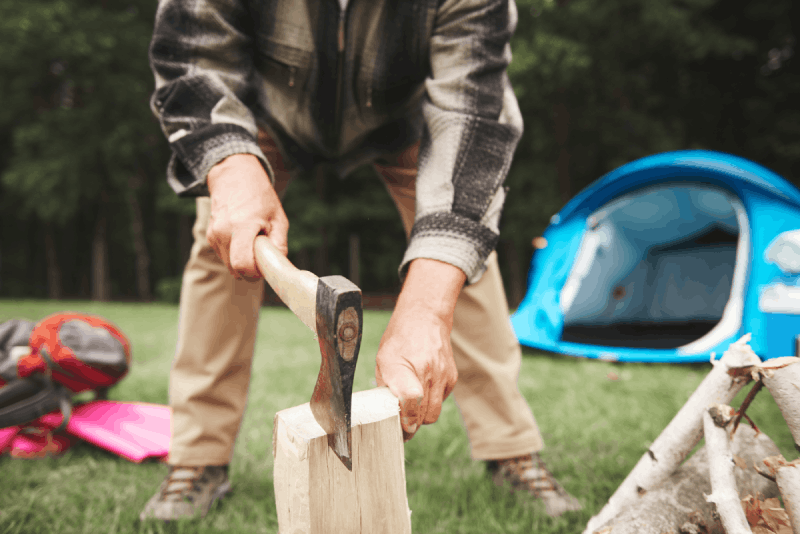
The majority of axe accidents occur when the axe glances off the wood or passes through and strikes the user's knee or shin. The most basic way to prevent this is to kneel during the strike (kneeling position). If you work while kneeling, the axe will strike the ground directly if it deviates from the target and will not reach your body. If you must work standing, you should spread your legs wide and ensure that the strike line passes between your legs. This simple mechanical rule is the most important safety knowledge that can save your camping life.
Why is an Axe Indispensable in Long-Term Survival Scenarios?
While a saw may offer practicality in short-term camps, in a survival situation that could last for months, the saw blade will eventually break or lose its functionality. An axe is not just a tool; it is also a weapon, a lever, and a construction tool. The steel of an axe is much thicker and can tolerate even the hardest blows. In addition to starting a fire, an axe is vital for breaking ice on frozen lakes, processing game animals, and for defense. In long-term scenarios where uncertainty exists, durability always takes precedence over practicality.
Which Tool Creates a More "Peaceful" Camping Atmosphere?
This question is entirely based on personal preferences, but the rhythmic "thud thud" sound created by using an axe creates a traditional and satisfying feeling for many campers. The physical satisfaction and sense of accomplishment that comes from chopping wood is like a meditation that fits the spirit of camping. On the other hand, a saw allows you to move at a more harmonious pace with nature due to its silence and elegance. If your goal is not to fight against nature but to be a part of it, the saw will provide the atmosphere you are looking for; if you want to test your own strength and skills in nature, the axe will offer you the atmosphere you seek.
Which Equipment is the Right Choice for You?
If you are a beginner camper and weight and safety are your priorities, a quality portable saw (such as a 240mm model) will make your life easier. However, if you want to improve yourself, start with wet woods, and experience true bushcraft, it is time to get a small axe. The best solution is always to use these two tools in a complementary way within your budget and carrying capacity. Remember, the best tool in nature is the one you know how to use best and feel safest with.
Does the Risk of Slipping While Using an Axe Depend on Shoe Selection?
Chopping wood with an axe is a vertical force that combines gravity and momentum. If you do not have professional hiking boots on your feet and the ground is wet, it is inevitable that you will lose your balance in case of a kickback or if the axe glances off the wood during the strike. Flat-soled or city-type sneakers cannot absorb the shock created by the axe and can lead to ankle sprains. Especially on wet leaves, using an axe carries a much higher risk of slipping and thus injury compared to a saw. For your safety, it is essential to plant your feet firmly on the ground while using an axe.
Do the Teeth of a Foldable Saw Continuously Jam When Cutting Wet Wood?
You will not always find dry and ideal woods in nature; most of the time, you will have to work with rain-soaked or damp tree trunks. The tooth structure of portable saws can create the problem known as "sawdust jamming" when combined with moisture and resin in the wood. If your saw does not have an aggressive design like "XT" or "Laplander," you may have to remove the saw every five forward-backward movements to clean the teeth. This not only causes a waste of time but also doubles the effort you expend, tiring you out prematurely. With an axe, however, such jamming is not an issue, but there is still a risk of glancing off wet wood.
Which Equipment is Easier to Manage with One Hand in Case of Injury While Camping Alone?
The biggest fear in solo camping is having to fend for yourself until help arrives in case of an accident. A mistake made with an axe usually results in deep cuts or broken bones, making it impossible to use the axe again in that situation. However, while working with a portable saw, in the event of a potential injury (usually superficial cuts), you can fold the saw with your remaining hand and put it in your pocket or continue cutting small branches with minimal effort. The controllability of the saw is always a safer harbor compared to the uncontrolled power risk created by an axe in emergency scenarios.
Is it Safer to Use a Saw for Preparing Firewood with a Headlamp in the Dark?
When darkness falls, your depth perception decreases, and shadows can mislead you. When swinging an axe, misjudging the impact point by even a centimeter can cause the axe to glance off and hit you instead of splitting the wood. The saw, however, minimizes the margin for error in limited lighting conditions since it starts by being anchored to the wood (with a notch cut). The back-and-forth motion of the saw is linear, and the likelihood of going out of control is very low. Using an axe in the limited visibility created by a headlamp during firewood preparation poses a serious risk of limb loss, even for professionals.
What is the Likelihood of the Axe's Steel Breaking When Splitting Frozen Woods?
In temperatures below zero, steel becomes brittle. If you are using a cheap axe with poor heat treatment, small pieces can break off the axe head when you strike a frozen hard wood. This not only renders the axe unusable but can also cause flying metal pieces to injure your eyes or face. Saws are generally made from more flexible steels (like spring steel) and can absorb energy by bending when cutting frozen wood. If you are going to use an axe in winter camps, it is vital to choose a forged steel axe from a high-quality brand.
Does Using a Saw for Long Periods Cause Chronic Pain in Finger Joints and Wrists?
Using a saw is an activity based on repetitive motion. If the handle of your saw is not ergonomic and does not fit your palm properly, you may feel numbness and "carpal tunnel"-like pain in your fingers after 30 minutes of cutting. Especially in cold weather, tendons are more tense, and making strenuous cuts can lead to wrist pain that lasts for days after camping. The axe, on the other hand, distributes the load across the entire body; however, the shock effect created by the axe can also trigger "tennis elbow" issues in the elbows.
How Practical is it to Make a New Handle in the Forest When the Axe Handle Breaks?
A logistical disaster scenario: Your axe handle breaks right in the middle. If you do not have a spare handle nearby and your bushcraft skills are not very advanced, that axe is nothing more than a burden at that moment. Carving a new handle requires finding the right wood and fitting it to the axe head, which can take hours and requires significant hand skill. On the other hand, most portable saws have metal or high-strength polymer bodies. The likelihood of the handle breaking is much lower than with an axe; usually, only the blade tip breaks, which can be replaced in seconds with a spare blade tip.
Does the Weight of the Axe Cause Damage to My Knee Joints While Trekking for Miles with a Backpack?
A camping axe (hatchet) typically weighs between 600 grams and 1.2 kilograms. A foldable saw usually weighs around 200-300 grams. On long-distance trekking routes, every 100 grams in your backpack increases the load on your knees exponentially. If you plan to walk 15-20 kilometers every day, carrying an axe will create unnecessary pressure on your lower back and knees. In terms of lightness and portability, the saw offers a logistical advantage. The weight of the axe is only tolerable if you are going to reach the campsite with a vehicle.
Is it Possible to Prepare Firewood Quietly Enough Not to Disturb Other People in the Camping Area?
The "thud thud" sounds of an axe echoing in the silence of nature can sometimes disturb the peace of other campers, especially when preparing firewood late at night or early in the morning. Using an axe is a noisy operation. The saw, on the other hand, produces a much finer and rhythmic sound, which tends to get lost in the natural noise after a few meters. If you are staying in crowded camping areas or want to prepare quietly without scaring off wildlife, the acoustic advantage of the saw makes it a more civilized and practical option.
Can Sparks from Chopping Wood with an Axe Melt My Synthetic Clothes?
An axe does not produce sparks when it strikes wood, but when sharpening the axe or hitting stones inside the wood, flying fragments can pierce your expensive outdoor jacket. More importantly, sharp wood fragments (not sawdust, but actual splinters) thrown by the axe can quickly reach your eyes or tear your technical fabric pants. In using a saw, everything is controlled; debris falls to the ground due to gravity, and no dangerous pieces fly around. If you want to extend the life of your clothes and equipment, using a saw is a gentler method.
Is a Sheath Necessary for Safely Storing an Axe in Family Camps with Children?
In an environment with children, an axe is like a hand grenade with the pin pulled. If the axe head is left exposed, even a child simply falling on it can lead to irreversible injuries. It is irresponsible to carry an axe without a quality leather or kydex sheath. Saws, on the other hand, usually have a folding mechanism; the blade is concealed within the handle and protected by a locking mechanism. The likelihood of a child harming themselves with a closed saw is much lower than with an exposed axe. Nevertheless, both tools should be kept in locked areas out of children's reach.
Should I Use Gloves to Protect My Fingers While Carving with an Axe?
You may want to use the axe not only for splitting wood but also for preparing fine twigs (feather sticks) to start a fire. In such delicate tasks, the axe head is held close to your hand, which puts your fingers very close to the sharp edge. If you are not using professional gloves that are non-slip and cut-resistant, you could lose a fingertip with a small jolt. It is more difficult to perform such fine tasks with a saw, but the debris created by the saw is a safer alternative for starting a fire. Wearing gloves is not an option when using an axe; it is a necessity.
How Much Energy Does it Consume to Cut Thick Trunks of Fallen Trees with a Portable Saw?
If you intend to cut a tree thicker than 20 centimeters, using a 20-centimeter Silky Gomboy will turn this task into a full cardio workout. The energy you expend on thick wood increases due to the friction surface of the saw, which may not be comparable to the amount of wood you produce. In such cases, the axe can provide a quicker result due to its striking power and momentum. However, swinging the axe with the wrong technique can lead to much more lactic acid buildup than using a saw. Before making a decision, you should research the general thickness of the woods in the area where you will camp.
How Does the Rusting of an Axe in Humid Weather Affect Its Sharpness Negatively?
An axe made of carbon steel can develop surface rust even in a single night of humid forest air. Rust damages the micro teeth on the axe's edge and makes it difficult to penetrate the wood. You should oil and dry your axe after each use. Saw blades made of stainless steel or with special coatings are more tolerant of maintenance. If you are camping by the sea or in an area with constant humidity, the maintenance of your axe will require much more attention than that of a saw. An unmaintained axe not only dulls but also becomes a dangerous tool.
How Many Hours of Technical Training are Required to Safely Use an Axe?
Using an axe safely is an art; calculating the angle of the strike, the stance position, and the swing path of the axe requires serious practice. A person using an axe for the first time has an 80% chance of injuring themselves or others. Using a saw, however, is much more intuitive; anyone who has been cutting bread since childhood can use a saw correctly. If you are a new camper and do not have time for technical training, starting with a saw instead of an axe can save your life (and limbs). An axe is not a tool to be learned through "trial and error."
Does Checking in an Axe with Luggage Cause Customs Issues?
If you are traveling by air and planning to camp in a different country or city, logistical rules can be a hassle. An axe is often classified as a "weapon" by most airlines and may be subject to extra scrutiny during baggage check-in; in fact, it may not be accepted on some domestic flights if the sheath is not appropriate. A foldable saw, on the other hand, is more easily accepted as a "gardening tool" and attracts less attention in your bag. The stress you will experience at customs and security checks can ruin your camping enjoyment before it even begins; therefore, a saw is a travel-friendly option.
Is There a Risk of Injury to the Elbows from the Vibrations of the Axe Handle?
The shock waves created while chopping wood are transmitted directly to your arms through the handle. If your axe handle is made of a very hard material like fiberglass and does not absorb the shock, you may experience micro-traumas to the connective tissues in your elbows with each strike. This can lead to a long-term condition known as "epicondylitis." There is no such shock wave in a saw; the energy is distributed through the cutting and sawing motion. If you have joint sensitivity or if your bone structure has started to weaken due to age, using an axe may result in physical therapy sessions.
Can an Axe Damage Other Equipment in a Small Backpack?
When you put an axe in your backpack, even the highest quality sheath can sometimes shift due to jostling. The sharp edge of the axe can slice through your sleeping bag, tent fabric, or water bottle in seconds. You do not want to be left with a punctured mat or torn tent in the middle of a camping trip. The blades of saws are usually completely concealed within the handle and locked, so there is no risk of damaging anything inside your bag. For the safety of your equipment and the logistics inside your bag, a saw is a much more peaceful choice.
Is Leaving an Axe Embedded in Wood a Safety Violation?
Most campers leave their axes embedded in a log because it looks cool. However, this is a huge invitation for someone passing by in the dark or in a hurry to accidentally hit their leg on the axe. An axe left embedded in wood is always a potential "guillotine." The saw, on the other hand, can be folded and put in your pocket or sheath when you are done; it does not leave a cutting edge exposed in the open. If you want order and safety discipline in the camping area, any cutting tool left exposed is a risk, and the axe is at the forefront of this risk.
Can a Saw Blade Be Repaired in the Middle of a Camp if it Breaks?
You cannot repair a saw blade in the forest, but if you carry a spare blade weighing 30-40 grams, you can make your saw as good as new with a screw or pin. If the head of the axe takes a significant blow and "chips," you will need to spend hours sharpening it to return it to its original sharpness. Logistically, the saw offers the possibility of redundancy, eliminating the fear of being stranded if there is a mistake at "one point." A smart camper is always the one who has a Plan B.
How to Calculate the Kickback Angle of an Axe When Cutting Wet and Slippery Tree Trunks?
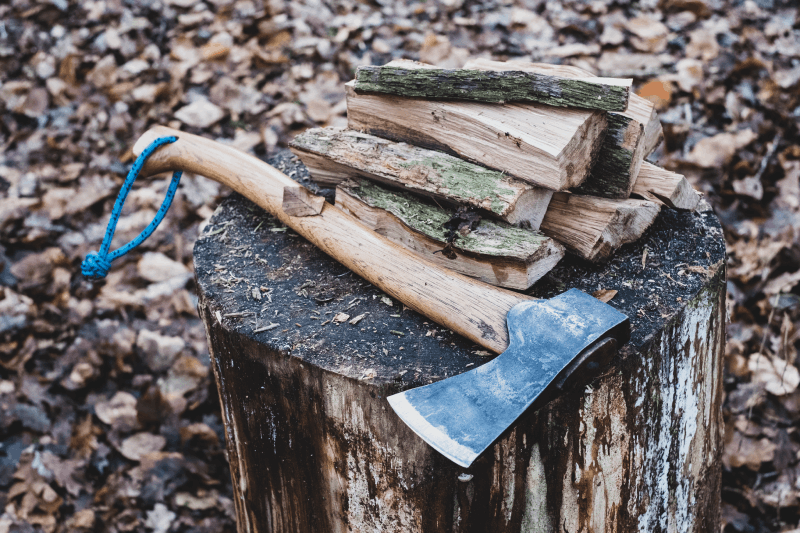
A physical fact: An axe always wants to strike in the direction that shows the least resistance. When you strike a wet and slippery tree, the axe may slide over the wood instead of penetrating it, directing the blow towards your shin. Calculating this "kickback angle" requires professional experience. There is no such physical risk with a saw because the teeth of the saw grip the wood and make slipping impossible. For someone who has never swung an axe in their life, using an axe on wet wood is one of the biggest safety mistakes that can be made.
Is There a Risk of Infection from Calluses on the Hands While Using an Axe?
Chopping wood creates serious abrasions on the hands. If you do not use gloves, you will develop water-filled wounds within a few hours. Since hygiene conditions are limited in nature, the bursting of these wounds and contact with dirt can quickly lead to infection and end your camping trip in the hospital. Using a saw results in less abrasion and offers more control. However, in any case, according to the principles of "hygiene and comfort," you should protect your hands while using cutting tools and pay attention to cleanliness in your camp kitchen as much as you do with your equipment.
Does the Lack of Oxygen at High Altitudes Reduce the Efficiency of Using an Axe?
When the oxygen level drops above 3000 meters, your muscles tire more quickly, and your attention is distracted. Using an axe, which requires high effort, quickly raises your heart rate and can lead to dizziness. In an environment with low oxygen, loss of coordination increases the risk of axe accidents fivefold. The saw, on the other hand, allows you to work at a lower pace without raising your heart rate too much. As a logistical and biological necessity, less energy-consuming methods should always be preferred in high-altitude camps.
How Does Chopping Wood with an Axe Affect the Burning Duration of the Fire?
For efficient burning of the fire, the surface area of the wood must be increased. Splitting wood lengthwise with an axe exposes the dry veins inside the wood, which helps the fire burn faster and hotter. A saw is only designed to cut wood lengthwise (cross-cut) and is not intended for splitting. If you only have a saw, you may struggle to burn thick logs. Here, a "hybrid" solution comes into play: Cutting the wood to the appropriate size with a saw and then splitting it with an axe (or batoning by striking the back of the saw) is the most professional fire preparation tactic.
Do the Lock Mechanisms of Portable Saws Become Loose Over Time and Create Danger?
Like any mechanical part, the locks of saws can wear out over time. If your lock does not close completely, the saw blade can suddenly fold during cutting and crush or cut your fingers. There is no such "moving part" risk with an axe; the axe is a single piece. For your safety and hygiene standards, you should check the locking mechanism of your saw before every camping trip and oil it if necessary. The mechanical safety issue is the weakest point of the saw compared to the simple and robust power of the axe.
Is the Weight of the Stones Required for Sharpening the Axe a Burden in the Backpack?
A dull axe is more dangerous than a sharp one because it does not cut, it glances. To keep the axe sharp, you need to carry at least a 100-200 gram whetstone with you. This is a logistical extra weight. Saw blades usually have "induction-hardened" teeth and cannot be sharpened in the field; you simply replace them. When maintenance of the axe becomes a ritual during long-term camps, the saw offers the practicality of "use-and-dispose" or "use-and-replace." If you do not enjoy sharpening tasks, the axe will become a burden for you.
Which is More Deterrent in Defense Against Wild Animals: An Axe or a Saw?
While this is a very rare scenario, it is always in the back of campers' minds. Having something in your hand when you encounter a bear or wild boar provides psychological comfort. The axe, with its heavy head and range, is much more deterrent and effective as a defense weapon compared to a saw. A saw (unless it is a very long model) is too flexible for defense and its impact is lower. However, to be realistic, both tools should always be the last resort against wild animals; priority should always be bear spray and making noise.
Does Sweating While Using an Axe Increase the Risk of Hypothermia?
The biggest enemy in winter camping is sweating. You exert a lot of effort while swinging an axe, which can cause your inner layers to become soaked. The moment you go to rest, that sweat cools and rapidly lowers your body temperature, putting you at risk of hypothermia. A saw allows you to exert effort more controlled and makes it easier to manage your sweating levels. Being "steady, not fast" is vital when preparing wood in winter. This practical need makes the saw a more comfortable and healthier option in winter.
How to Minimize the Ecological Damage to the Environment While Using an Axe?
Using an axe often awakens a more "destructive" feeling, and an inattentive user can harm living trees. A saw, however, is a more surgical tool; it allows you to cut only the dead branch you need without damaging the main body of the tree. As a logistical and ethical responsibility, campers should act according to the "leave no trace" principle. The saw offers a more precise and environmentally friendly working discipline as a sign of respect for nature. The recklessness of the axe can sometimes lead to unnecessary interference with the forest ecosystem.
Are Saw Blades Suitable for Cutting Meat as Well?
Some campers want to use their equipment for multiple purposes. However, the teeth of a wood saw are not designed to cut meat and bone; they crush the meat and fill it with sawdust. An axe, on the other hand, can be used like a cleaver to chop large pieces of meat or bone (if it is very clean). However, from a hygiene perspective, bringing a tool that has been used to cut wood into the kitchen is a significant mistake. In both cases, using the right tool for each job is a requirement for clean usage.
Is it a Manufacturing Error if the Axe Head Flies Off the Handle?
If you are using a traditional axe with a wooden handle, the wood can dry out and become brittle, causing the axe head to loosen. If the axe head flies off during a strike, it poses a deadly risk to everyone nearby. This is usually not a manufacturing error but a maintenance error. There is no such "flying off" risk with a saw. While modern polymer-handled axes largely solve this issue, traditional axe enthusiasts should always keep this life-threatening danger in mind and regularly check the handle.
Final Decision for Preparing Campfire: Which Will Safely Bring You Home?
At the end of all this analysis, as a content strategist and an experienced camper, I can say this: If you are just starting out, and weight and safety are your priorities, a portable saw (such as a Bahco or Silky) will be your best friend. However, if you want to experience the spirit of bushcraft, split wood, and engage in more rugged tasks, an axe is indispensable. The safest scenario is to cut with a saw and split with an axe. However, if you have to make a single choice, the saw will tire you less and bring you home to your loved ones with less risk.