How Should We Determine Hygiene Standards in Caravan Life?
Caravan life is a minimalist lifestyle that requires getting by with limited space and resources (water, electricity, storage). The most critical point in determining hygiene standards in this setup is the efficient use of water and energy. Instead of washing textiles every day without limits like at home, methods that extend the lifespan of textiles, prevent odor formation, and do not harm nature should be preferred. Especially the capacity of the gray water tank and the distance to the points where wastewater will be emptied directly affect your washing periods. Therefore, creating a strategy for laundry management before embarking on a caravan journey ensures both psychological relaxation and prevents moisture and unpleasant odors that may occur inside your vehicle.
Are Manual Hand Washing Bags a Practical Solution?
Manual hand washing bags like Scrubba are one of the miraculous solutions for caravaners living off-grid. The flexible protrusions on the inner surface of these bags act as a traditional washboard, allowing dirt to be mechanically removed from the fabric. With just a few liters of water and a very small amount of detergent, you can make your laundry spotless with a rinsing and scrubbing process that takes about 3 minutes. Not consuming electricity and taking up almost no space when folded makes these bags indispensable for small caravans and campers. Additionally, washing delicate inner garments and t-shirts with this method helps maintain the shape of your clothes by preventing the wear and tear that machines can cause.
Do Mini Foldable Silicone Washing Machines Really Work?
Foldable silicone machines, which have gained popularity in recent years, typically offer a capacity between 2-5 kilograms and are ideal for users with limited storage space. These machines are quite successful in cleaning lightly soiled daily clothes by using a motor at the bottom to agitate the water. However, for heavy-duty clothes, jeans, or large towels, the motor power of these devices may be insufficient. These devices, which consume very little electricity, can be easily operated through an inverter. After use, they fold like an accordion to fit into a drawer, maintaining the visual order inside the caravan. If you need to wash small items like baby clothes, socks, or underwear frequently, this technology should definitely be part of your caravan.
Are Centrifugal Dryers Worth the Space in a Caravan?
The only thing more challenging than washing laundry in a caravan is drying it. Centrifugal dryers physically expel water by spinning laundry at high speeds. These devices do not produce heat; they only remove 90% of moisture using centrifugal force. Laundry that comes out of this process is almost damp and dries very quickly when hung up. If you have space in your caravan, investing in these devices is worth it not only for drying speed but also for reducing humidity levels inside the caravan. Especially if you are traveling in winter months or in high-humidity coastal areas, you can completely eliminate the risk of mold and odor that can occur from laundry remaining damp for days with these machines.
Are Ultrasonic Cleaners Safe for Delicate Fabrics?
Ultrasonic washing devices are characterized by small, soap-sized units placed in a bucket of water. These devices generate high-frequency sound waves in the water, creating microscopic vacuum bubbles known as "cavitation." These bubbles penetrate the deepest fibers of the fabric, breaking down dirt. Ultrasonic cleaners are the safest method for delicate fabrics that are risky to wash in machines, such as silk, wool, or lace. They do not damage the fabric's texture as they do not involve any scrubbing or harsh movements. Their quiet operation in a caravan and very low amperage draw is a significant advantage. However, they may not perform as expected on heavily soiled or greasy fabrics; therefore, they should be preferred more for "refreshing" and "delicate cleaning" purposes.
Is It Possible to Use Washing Machines Powered by Solar Energy?
Although a washing machine directly connected to a solar panel is not commercially widespread in the world, thanks to lithium battery systems and powerful inverters in caravans, washing machines can be indirectly powered by solar energy. The key point here is the wattage of the machine. A mini machine with an A+++ energy rating consumes about 300-500 watts during the washing cycle. If your caravan has a solar panel of 400 watts or more and at least a 200 Ah lithium battery, you can wash your laundry during peak sunlight hours without depleting the batteries. By turning off the heating function and using water from an external (sun-warmed) tank, you can further minimize energy consumption. This freedom allows you to lead a sustainable nomadic life without being dependent on external sources.
How to Secure Outdoor Laundry Lines in Windy Weather?
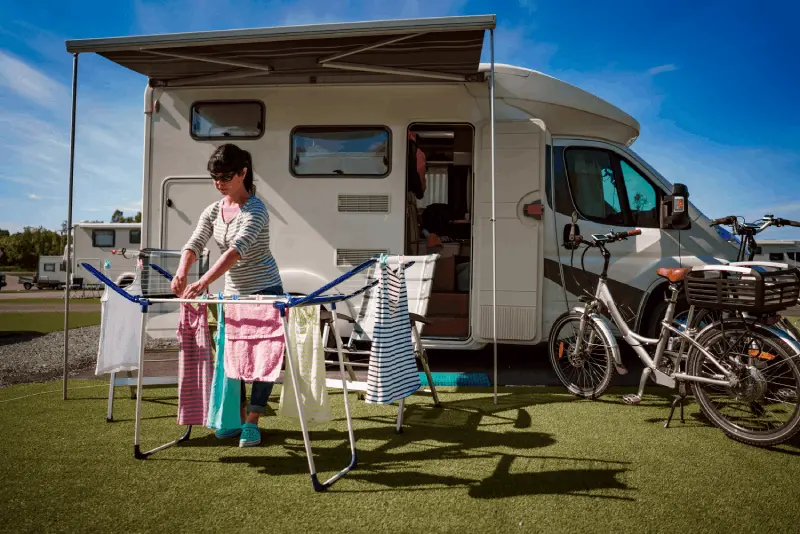
Hanging laundry outside the caravan not only saves space but also allows the laundry to be naturally sterilized by the sun and wind. However, in windy weather, the laundry blowing away or the line loosening is a significant issue. As a solution, steel wires or thick nylon ropes with tension mechanisms mounted on the caravan's awning or bike rack should be used. Strong clips prevent the laundry from "slipping" by being hung over the line. Additionally, foldable aluminum drying racks mounted on the caravan wall should be strategically positioned against the direction of the wind to reduce wind resistance. This way, your laundry stays secure, and you benefit from a free drying service provided by nature.
Heated Towels
Can Heated Towel Rails Be Used for Drying in a Caravan?
Heated towel rails, although designed for bathroom comfort, are actually a fantastic tool for creating vertical drying space in caravans. These rails, available in 12V or 220V options, quickly dry socks, inner garments, and small towels by consuming low energy. When mounted vertically on the discarded wall areas inside the caravan, they take up no space at all. They play a vital role in drying wet gloves and hats, especially for those traveling in winter. The heat also provides a small contribution to the overall warmth inside the caravan. However, a timer must be used when operating these systems, and energy consumption should be continuously monitored for battery health. A heated towel rail allows you to implement the concept of a "drying cabinet" in a small scale within the caravan.
How Should Grey Water Tank Management Be Done During Washing?
The water produced while washing clothes in the caravan goes directly to the grey water tank. The amount of soapy water causes the tank to fill up quickly. To manage this process, the principle of "high efficiency with low water" should be applied first. If manual washing is being done, the rinse water can be used as the pre-wash water for the next wash. Additionally, the use of tank cleaning tablets should be increased to prevent soap residues in the water going to the grey water tank from causing odors. Some caravaners prefer to wash near waste water disposal stations. This way, they can instantly empty the filled tank and refresh the water tank. It should be noted that washing clothes in a caravan is not only about cleaning clothes but also about managing water logistics.
Why Is Using Ecological Detergent Essential for Caravaners?
Caravan life is inherently connected to nature, and most of the time our waste waters do not go to treatment facilities but rather to specific disposal points. Traditional detergents cause serious harm to the water ecosystem due to the phosphates, optical brighteners, and harsh chemicals they contain. Using biodegradable, plant-based, and fragrance-free detergents in the caravan is a moral obligation. Additionally, these types of ecological detergents require much less water during rinsing because they do not contain synthetic foaming agents. Less foam is a significant advantage in preserving the limited water supply of the caravan. Completely natural cleaners like soap nuts are also preferred products in the caravan kitchen and bathroom due to their space-saving properties and the fact that the waste water is harmless to nature.
How to Plan the Laundry Washing Period According to the Caravan Route?
The laundry washing day is the most strategic day of your caravan route. Generally, days when the sun is brightest and you are close to a water source (campground, gas station, spring) should be chosen. If there are large cities along the route, self-service laundries in those areas should be used for "large washes" (bedding, coats, blankets). In mountain tops or secluded bays, only urgent and small items should be washed manually. It is also important to monitor the humidity level on your route; stacking all laundry dried before entering a very humid area like the Black Sea prevents the heavy odor that damp clothes can create. A smart caravaner synchronizes the weather conditions and accommodation points with the fullness of the laundry basket.
How to Dry Laundry Inside the Caravan Without Creating Humidity in Winter?
Drying laundry inside the caravan in winter brings the risk of intense condensation and fogging on the windows. To prevent this, ventilation (ceiling fan or window gap) must be kept open during the drying process. When using a diesel heater (like Webasto), hanging laundry near the warm air outlet helps to expel moisture into the air. However, the most professional solution is to use a small compressor dehumidifier. This device captures the steam from the laundry and protects the wooden furniture of the caravan from moisture. Instead of hanging laundry all together, hanging them spaced out and vertically increases air circulation and shortens drying time. Remember, the drying process in winter is not about heat, but about airflow and humidity control.
How to Find Laundries and Self-Service Points?
In modern caravanning, technology is our greatest ally. To find self-service laundries that are common in Europe and Turkey, it is sufficient to use applications like "Park4Night" or "iOverlander" as well as search for "Laundry" or "Launderette" on Google Maps. These points usually offer both washing and drying facilities within 1 hour, providing significant time savings. Some large fuel stations (very common in France) have outdoor washing machines. In caravan parks (Camping), machines that operate with tokens are usually available. Bringing your own detergent when using these facilities reduces costs and ensures you use a product suitable for your skin. Allocating weekly "big cleaning" days to these professional points reduces chaos inside the caravan.
Where Is the Most Efficient Area for the Dirty Basket in the Caravan?
Having dirty laundry visible in the caravan is undesirable both aesthetically and in terms of odor. For efficiency, the area under the bed (base) or the rear storage compartment known as the "garage" is generally reserved for this purpose. Dirty laundry can be stored in plastic boxes.
Storing dirty laundry in mesh bags helps trap moisture and prevents bacteria from growing and spreading bad odors. Some users save space by hanging vertical dirty bags behind the bathroom door. If your space is very limited, you can reduce the volume of your laundry by placing them in vacuum bags; however, this method is only suitable for clothes that won't be washed for a long time. Strategic placement prevents dirty laundry from interfering with the living area of the caravan and maintains a sense of order.How Much Do Microfiber Towels Reduce Drying Time?
Traditional cotton towels absorb a lot of water, are heavy, and can take hours or even days to dry in a caravan environment. Therefore, using microfiber or towels in the caravan is not just a luxury, but a necessity. Microfiber towels can absorb several times their weight in water and release a large portion of the water instantly when wrung out. This feature reduces the load in the washing machine or when hand-wringing. Additionally, microfiber fabrics can dry completely in 15-30 minutes in open air. Towels also offer a similar advantage with their minimal space requirement and quick drying. This transition not only ensures ease of washing and drying but also allows you to save up to 70% of space in your towel cabinet.
Do Manual Foot-Pump Machines Save Energy?
Foot-pump manual machines (like models from Drumi) are designed for campers aiming for complete energy independence. These devices turn the drum with the help of a pedal and perform both washing and rinsing processes using muscle power. About 5-10 minutes of pedaling is sufficient to clean a daily load of laundry. Having zero electricity consumption is a tremendous advantage, especially on cloudy days to preserve batteries. Additionally, this method can be considered a form of "in-caravan exercise." Due to their simple mechanical structure, the likelihood of malfunction is low, and they save both water and detergent in the long run. It is one of the most sincere solutions for those who embrace a minimalist and ecological lifestyle.
What Are the Key Points for Washing Bedding in a Caravan?
Bedding is the bulkiest laundry item in a caravan and requires significant logistical planning for both washing and drying. Instead of washing bedding in the caravan's small machines, it is usually more sensible to wash them in professional drying machines located in a city center, typically every 2-3 weeks. If you must wash them yourself, you should wash the sheets individually and quickly remove detergent residues by using vinegar during the rinsing process. For drying, spreading the bedding over the caravan's awning or stretching it between two trees yields the fastest results. Bedding should never be laid inside the caravan (on the bed) before it dries; otherwise, it can trigger mold formation on the wooden floor beneath the bed.
Do Dehumidifiers Speed Up the Drying Process?
Absolutely yes. Dehumidifiers, especially compressor models, draw moisture from the air and trap it in a water tank. By drying the air around the wet laundry you hang inside the caravan, they physically increase the evaporation rate. These devices are lifesavers when you can't open windows for ventilation on cold and rainy days. They can cut the drying time of laundry in half. Some models have a "Laundry Mode"; in this mode, the device operates at maximum fan speed, focusing on the laundry. The collected water can be added back to the caravan's windshield washer fluid since it is of a quality close to pure water (not for drinking). This ensures a closed-loop resource management in the caravan.
Do Portable Wringer Devices Reduce Wrist Strain?
The biggest complaint of manual washers is the strain on their wrists from the weight of the laundry while wringing and the tendency for insufficiently wrung laundry to take too long to dry. Modern and portable versions of the roller wringer devices once used in homes solve this problem at its root. Clothes passing between two rollers leave their water evenly. This method protects your wrists and prevents fabric fibers from being damaged by excessive wringing. These devices, which can be mounted on a table in the caravan or on an outdoor counter, make a significant difference, especially with heavy towels and denim pants. Well-wrung laundry means that 80% of the drying process is complete; this is a significant victory in managing humidity inside the caravan.
What Are the Drying Strategies in a Caravan on Rainy Days?
When it rains outside, the inside of the caravan can quickly turn into a damp environment. Drying laundry on these days is a strategic game. The first rule is to never hang laundry right in the middle of the living area. If possible, use a hanging device inside the shower cabin and run the bathroom ceiling fan (like Maxxfan) at the highest speed to blow air outside. This turns the shower cabin into a small drying room. If your caravan has a diesel heater, turn it on and position the laundry where the warm air rises. On rainy days, only wash the laundry that is urgently needed; store larger washes for a sunny day or a facility with a dryer.
Can Home-Type Machines Be Integrated into Caravans?
In large and luxury caravans (especially truck-based or large motorhomes), standard home-type washing machines with a capacity of 3-5 kg can be integrated. However, this requires serious technical infrastructure. First, a powerful inverter is needed for the machine to operate on 220V, and a battery bank that can handle the current exceeding 2000 Watts when the machine's heating element is activated is essential. Secondly, these machines are sensitive to vibrations; therefore, they should not be used while the vehicle is in motion. Special fastening devices should be used for this purpose. Additionally, water consumption is higher in home-type setups, which means your clean water tank will deplete very quickly. If you can overcome these technical challenges, taking the comfort of home on the road is a unique luxury.
How to Extend Fabric Life with Natural Drying Methods?
While dryers wear out fabrics with heat and friction, natural drying preserves the fibers of the fabric. Sunlight (UV rays) is a natural disinfectant; it kills bacteria in white laundry and helps fade stains. Drying laundry in a lightly breezy shaded area in the caravan prevents colors from fading while keeping the fabric soft. Instead of fabric softeners, adding a bit of apple cider vinegar to the rinse water naturally softens the fibers and removes static electricity. The natural drying method supports the "less but quality" clothing philosophy you will need in the caravan by extending the life of your textile products. Additionally, this process contributes to your caravan budget as it is realized with zero energy cost.
Is the Kitchen Sink Suitable for Washing Laundry?
The kitchen sink is one of the widest and deepest water areas in the caravan, making it seem appealing for washing laundry. However, this poses some hygiene risks. Since the kitchen sink is used for food preparation, there is a risk of dirt and bacteria from laundry (especially socks and underwear) contaminating the kitchen area. If washing must be done in the sink, it should be disinfected before and after the process. A better alternative is to use a portable basin that fits snugly inside the sink. This way, the laundry water does not come into direct contact with the kitchen sink. Additionally, the sink's drainage pipes are usually thin; hair, lint, or threads from laundry can cause clogs. Therefore, using a strainer is essential.
How to Solve Ironing Problems in a Small Space?
It is nearly impossible to allocate space for an ironing board and a traditional iron in a caravan. The most modern way to solve the ironing problem is with handheld steamers. These devices release steam to de-wrinkle clothes while they are hanging. The steam also eliminates bad odors and bacteria in the fabric. If you do not have a device, an old but effective method is to hang clothes in the shower to take advantage of the steam created while showering. Another tip is to dry clothes immediately after washing by shaking them well and hanging them carefully. This "natural ironing" method provides sufficient smoothness for many fabrics under caravan conditions.
How to Store Dirty Laundry to Prevent Odor Formation?
In the small square meters of a caravan, even a single dirty sock can affect the smell of the entire vehicle. To prevent odor formation, dirty laundry should never be thrown into the basket while still damp. Sweaty or wet clothes should be hung up to dry first, then placed in the dirty laundry basket. Sprinkling baking soda inside the basket or leaving scented dryer sheets neutralizes the odor. Additionally, storing heavily scented items like sportswear separately in an airtight "dry bag" completely prevents the spread of odor. It is also helpful to air out the dirty laundry basket at least once a week and to sort laundry by type if it will be left until laundry day, making hygiene management easier.
Can Washing Be Done Using the "Road Wash" Method During Travel?
"Road Wash" is one of the oldest tricks of campers. Water, detergent, and dirty laundry are placed in a covered, leak-proof bucket (such as a covered pickle bucket or a special washing bucket). The bucket is securely fastened inside the caravan or garage. As you navigate winding roads or bounce on rough roads, the movement of the vehicle agitates the laundry like a washing machine drum. By the time you reach your destination, your laundry will have been pre-washed or washed. All that remains is rinsing and hanging. This method saves time and turns the kinetic energy during travel into a useful task. However, it is essential to ensure that the bucket is 100% leak-proof; otherwise, the caravan may be flooded with water.
Are Laundry Services in Campsites Charged?
Most qualified campsites around the world offer laundry rooms for visitors. This service is usually not included in the accommodation fee and operates with tokens or coins. Prices vary depending on the machine's capacity and the country, but generally range from 3-7 Euros/Dollars per wash. Dryers are usually priced the same as or slightly lower than washing. Some luxury campsites also have modern machines that allow payment through an app. The advantage of using machines at the campsite is that you can finish your entire weekly load within an hour by running several machines at the same time. Additionally, these areas usually have large folding tables and sinks, making the process more ergonomic.
How Does Minimalist Wardrobe Design Lessen Laundry Load?
The more clothes you have in the caravan, the more dirty laundry problems you will face. Transitioning to a "capsule wardrobe" philosophy dramatically reduces laundry load. Quick-drying, odor-resistant (like merino wool), and easily combinable pieces should be selected. Merino wool does not retain odors even after being worn multiple times due to its natural antibacterial properties, extending the washing period. Synthetic sports fabrics dry very quickly when hand-washed. Fewer clothes not only relieve your storage space but also prevent you from facing massive laundry loads when laundry day arrives. The rule in camping is: If a piece of clothing cannot be used for three different purposes, it has no place in the caravan.
Is It Possible to Wash Shoes in the Caravan?
Shoes are one of the main elements that bring mud and dust into the caravan, especially after outdoor activities. Washing shoes in the machine can be risky for caravan machines. The best method is to remove the dirt from the shoes before entering the caravan and clean them with a damp cloth. If you must wash them, use a laundry bag to protect them and the machine. Always check the manufacturer's instructions for washing shoes to avoid damage. If you are unsure, hand washing is the safest option. Shoes should be cleaned with a brush using the water outlet outside (outdoor shower). If interior cleaning is needed, pouring baking soda inside the shoes and letting them sit overnight will eliminate odors. For drying after washing, it is effective to fill the shoes with newspaper or hold them in front of a heating vent (without getting too close). Never leave shoes directly in the sun for a long time, as the soles can warp. Clean shoes reduce the overall cleaning burden by keeping the floor of the camper clean.
What are water-saving washing techniques?
Water is the most valuable resource in the camper. To save water while washing clothes, the "step rinsing" technique can be applied. In this technique, three separate containers are used; the first container for soapy washing, the second container for the first rinse, and the third container for the final rinse. In the next washing session, the old "final rinse" water is used as the "first wash" water for the new wash. Additionally, by using stain removers or sprays that directly intervene on the stains, cleaning only the dirty area instead of washing the entire garment reduces water consumption by up to 90%. Counting every drop of your gray water gives you the freedom to stay in nature longer.