Why is Waterproofing in Camping Tents of Vital Importance?
One of the biggest risks when camping is unexpected weather changes. The waterproof feature of a tent not only prevents the camper inside from getting wet but also reduces the risk of hypothermia, protects equipment (sleeping bags, electronic devices, clothes), and directly determines camping comfort.
A tent that allows water to seep in creates a cold and damp environment throughout the night, disrupting sleep quality and negatively affecting physical performance the next day. Therefore, understanding a tent's waterproofing capacity is the most fundamental criterion that determines which season and geography you will camp in. For a professional camper, a tent is the only safe haven in nature, and the impermeability of this haven is a necessity that cannot be debated.
What Do the "mm" Values in Tent Fabrics Really Mean?
The values we often see on tent labels, such as 1000mm, 3000mm, or 5000mm, represent the "Hydrostatic Head" test. This value indicates how high a column of water can be filled inside a cylinder placed on the fabric. For example, a fabric with a value of 2000mm can withstand the pressure created by a 2-meter high column of water before water starts to seep through the fabric.
These tests conducted in laboratory conditions are directly related to the fabric's weave density and the quality of the coating on it. High mm values indicate resistance not only to heavy rain but also to the speed and intensity at which raindrops hit the fabric due to wind.
How is the Water Column Test Conducted in a Laboratory and How Should the Results Be Interpreted?
The water column test begins by placing the fabric tightly over an apparatus. A vertical glass or plastic cylinder is placed on top of the fabric, and water is gradually added to this cylinder. Observers track when the first three drops of water appear on the underside of the fabric. If the fabric starts to leak at the 3000mm level, the water resistance of that product is certified as 3000mm.
However, caution is needed when interpreting these results; static water pressure differs from the dynamic impact of raindrops in the real world. Rain experienced in windy conditions exerts much more pressure on the fabric surface than its static weight. Therefore, while a 1000mm tent may be suitable for light drizzle, at least 3000mm or more should be preferred for camps in stormy mountains.
What Level of Water Resistance Do Polyester Tent Fabrics Have?
Polyester is the most commonly used material in today's camping tent industry. The main reason for this is that polyester does not stretch like nylon when wet and retains its shape. Polyester fibers do not absorb water (they are hydrophobic), which helps the fabric dry quickly and allows water to run off the surface.
Being more resistant to UV rays than nylon ensures that the waterproof coating degrades more slowly under prolonged sun exposure. Generally, polyester fabrics supported by PU (Polyurethane) coatings can offer high water resistance ranging from 1500mm to 5000mm, despite being affordable. They can be confidently used across a wide range from family tents to mid-range trekking tents.
How Do Nylon Fabrics Strike a Balance Between Lightness and Waterproofing?
Nylon is indispensable in the world of "ultralight" camping. Because it has a much higher tear and rupture resistance than polyester, it can provide the same durability with thinner and lighter fibers. However, the biggest disadvantage of nylon is that it absorbs some water when wet and stretches by 2% to 5%.
This can cause the tent to sag and lose tension on a rainy night, leading to water pooling. To overcome this issue, quality nylon tents are coated with silicone (Silnylon). Silicone-coated nylons prevent water from entering the fabric fibers while maintaining lightness and providing excellent water repellency.
What Role Does Polyurethane (PU) Coating Play in a Tent's Waterproofing?
Polyurethane coating is a thin, rubbery layer applied to the inner surface of the tent fabric. This layer seals the fabric's pores, preventing water from entering. The biggest advantage of PU coatings is that seam tapes can be easily applied to this surface in a factory setting. This minimizes water leakage from the seams of the tent.
However, PU coatings can degrade over time through a process called "hydrolysis." If a tent is packed while damp or stored in very hot conditions, the PU layer can become tacky, peel off, and start to emit that characteristic "old tent" smell. Quality PU coatings can extend this degradation process for decades with special additives.
Why Are Silicone-Coated Fabrics More Suitable for Extreme Conditions?
Silicone coating (usually applied over nylon and referred to as "Silnylon") penetrates the fabric, unlike PU coating. It covers not only the surface of the fabric but also its fibers, increasing the material's tear resistance by 20%-30%. Silicone is naturally highly slippery, allowing raindrops and snowflakes to slide off the tent quickly.
Additionally, silicone creates an incredible barrier against UV rays, extending the lifespan of the fabric. The most significant difference is that it does not peel off. In silicone-coated tents, since seam tape cannot be used, users or manufacturers must manually seal the seams with a special liquid silicone (seam sealer); however, once this process is completed, the resulting waterproofing is unmatched.
Why is Dyneema Composite Fabric (DCF) Technology Revolutionary in Waterproofing?
>Previously known as "Cuben Fiber", Dyneema Composite Fabric (DCF) is produced by laminating Dyneema, one of the strongest fibers in the world, between two layers of thin polyester film. This fabric is not a woven fabric; therefore, it never absorbs water and does not increase in weight when wet.
This material, which is 100% waterproof, has massive mm values (usually 15,000mm-20,000mm+) even at very low weights. DCF tents do not stretch, sag, or allow water to pass through even in the harshest storms. Its only disadvantage is its extremely high cost and sensitivity to folding marks. It is the pinnacle of waterproofness and lightness for professional long-distance hikers (thru-hikers).
How Do Cotton Canvas Tents Achieve Natural Waterproofing?
Traditional canvas tents can provide waterproofing without needing any plastic coating, unlike modern synthetics. When cotton fibers get wet, they swell and create a natural barrier that makes it impossible for water to pass through by sealing all the pores in the fabric's weave. This is called "weathering".
The biggest advantage of canvas is its breathability; while moisture inside can escape, rain from outside cannot enter. However, these tents become very heavy when wet and take a long time to dry. If packed before fully drying, mold and mildew formation is inevitable. They are still the most comfortable option for luxury camping (glamping) and long-term stays.
How Does the Taping Process on Tent Seams Affect Waterproofness?
No matter how high quality a tent fabric is, the thousands of needle holes created at the seams are the weakest point for water to enter. In waterproof tents, a polyurethane tape is applied to the inner side of these seams with the help of heat. This taping process completely seals the seam lines, preventing water leakage.
If a tent's seams are not taped, even if the fabric is 10,000mm, it will drip from the seams in heavy rain. Users should check the seam tapes over time for wear and tear and repair these areas with commercially available liquid waterproofing products if necessary. Factory-sealed fully taped seams guarantee true waterproofness.
How Do UV Rays Shorten the Waterproof Lifespan of Tent Fabric?
Ultraviolet (UV) rays are the biggest enemy of tent fabric. The sun's radiation breaks the polymer chains in the fabric fibers, leading to the fabric becoming brittle and tearing like "paper". More importantly, the waterproof coating (PU or Silicone) oxidizes under UV influence and loses its water repellency (DWR).
When the fabric loses its water repellency, it begins to "wet out"; meaning water is absorbed by the fabric instead of running off the surface. This kills the breathability of the fabric and increases the risk of water leaking inside. If you have to leave your tent under the sun for a long time, setting up a "tarp" (shade) over it or using UV protective sprays can double the waterproof lifespan.
Is the Moisture Inside the Tent Leakage or Condensation?
Many campers think that when they see water droplets on the inner walls of the tent upon waking up in the morning, the tent is leaking. However, most of the time, this is not rain from outside but condensation coming from inside. The human body releases a significant amount of moisture into the air through breathing and sweating while sleeping.
If the ventilation of the tent is insufficient, this warm and humid air condenses when it hits the cold outer tent surface. This situation is particularly chronic in single-wall and low breathability waterproof tents. To distinguish between leakage and condensation, it is necessary to check whether the water is coming only from the seams or if it has spread across the entire surface in small droplets.
How Can a Tent That Has Lost Its Waterproofing Be Restored?
Over time, the Durable Water Repellent (DWR) coating on the outer surface of every tent wears off. If the water droplets falling on your tent are no longer beading and are being absorbed by the fabric, it means it's time for maintenance. First, the tent should be cleaned of dirt and dust with special tent cleaners or just plain water.
Then, DWR renewers available on the market (Nikwax, Granger's, etc.) should be used, either by spraying or washing. If the problem is the peeling of the PU coating inside the fabric, the peeled areas can be gently cleaned and a new liquid PU layer can be applied. These processes help extend the life of an expensive tent for a few more seasons instead of throwing it away.
What Should Be the Ideal mm Values for Summer and Winter Tents?
Your waterproofing needs can radically change depending on the season you will be camping in. If you are camping only on sunny summer days and in light rain, a value between 1000mm and 1500mm is usually sufficient. However, in variable weather like spring and autumn, a range of 2000mm-3000mm is a safe harbor.
For real winter camps, at least 5000mm should be sought for the ground and at least 3000mm-5000mm for the outer tent in case of snow load and severe storms. Remember that snow creates static pressure when it stays on the tent for a long time, which can push water into the fabric's pores.
How Does Using a Tent Footprint Increase Ground Waterproofing?
The area of the tent that is most exposed to water pressure is the floor. When you sit on it or kneel, your body weight exerts thousands of millimeters of pressure per square meter on the ground fabric. If the ground fabric is weak or the soil underneath is saturated, water can be "pumped" inside.
An additional ground cover called a "footprint" creates an extra waterproof barrier between the tent's own floor and the wet ground. It also prevents stones and thorns on the ground from creating micro holes in the tent floor, which would compromise the waterproofing. The tent floor... It is always recommended to use a groundsheet suitable for the dimensions of the tent to extend your lifespan and cut off ground moisture.
Is the Denier (D) Value of the Fabric Related to Waterproof Performance?
Denier (D) is a unit of measurement that indicates the thickness and weight of the fibers that make up the fabric. For example, a 20D fabric is very thin and lightweight, while a 150D fabric is thick and heavy. Although it is not a direct waterproofing unit, the denier value is indirectly related to water insulation.
Thicker (high denier) fabrics can hold more coating material (PU or Silicone) and may have a tighter weave. However, in today's technology, even very thin fabrics like 10D or 20D can achieve water resistance above 3000mm with high-quality coatings. What matters is not the thickness of the fabric, but the quality of the applied chemical coating and the fabric's weave density (Thread Count - T).
Does a 1500 mm Value Protect You Under Heavy Rain?
Many entry-level quality tent brands use a 1500mm value in their outer canopies. Theoretically, this value is considered "waterproof" according to European standards and provides full protection against normal heavy rain. However, real-world conditions differ from the laboratory.
If heavy rain is accompanied by strong winds, the pressure of the raindrops hitting the fabric can instantly challenge the 1500mm limit. Additionally, if the tent is not set up tightly, water pooling in certain areas increases the pressure at that point. In summary, 1500mm works for short-term rain but can be considered risky for prolonged rainfall or high-altitude distribution.
How Does the Choice of Outer Canopy Fabric Determine Your Safety in Stormy Weather?
In stormy weather, an outer canopy is not just a cover that keeps water out; it is also a shield that deflects the wind's force. In these conditions, the fabric's "tear resistance" and "tensile capacity" are as critical as waterproofing. Polyester flaps noisily in a storm, while nylon is quieter but can lose wind resistance when it gets wet.
The safest option in a storm is fabrics with a high mm value, Ripstop woven, and preferably double-sided silicone-coated. These fabrics prevent water from seeping in and flex under wind pressure to prevent the poles from breaking or the fabric from tearing.
How Does the Ripstop Weaving Technique Support Tear and Leak Resistance?
Ripstop is a technique where thicker and stronger threads are woven at intervals of a few millimeters in the fabric. This structure, seen as small squares on the fabric, prevents the spread of a potential puncture or tear.
From a waterproofing perspective, the importance of Ripstop is as follows: If your tent gets a small hole from a branch or stone, Ripstop stops that hole from turning into a full leak line. While a small hole can be patched, a large tear completely compromises the tent's waterproofing. Therefore, ensuring that the fabric has "Ripstop" features when purchasing a technical tent is a vital insurance in challenging conditions.
Do Breathable Fabrics Compromise Waterproofing?
Technical tents using Gore-Tex-like ePTFE membranes (usually single-canopy high-altitude tents) are rare products that are both waterproof and breathable. The pores in these fabrics are 20,000 times smaller than a water droplet but 700 times larger than a water vapor molecule.
This allows rain to stay out while sweat and breath vapor can escape. However, this technology is quite expensive and over time, the pores can become clogged with dust or oil. Standard double-canopy tents provide breathability not from the fabric itself but from the air gap between the outer and inner canopies and ventilation windows.
What is the Lifespan of a Quality Waterproof Coating?
The waterproof lifespan of a tent can vary between 5 to 15 years depending on usage frequency, storage conditions, and the amount of UV exposure. Cheap polyurethane coatings can hydrolyze and start to break down after 4-5 years, while high-quality brands using polyether-based PU or Pure Silicone coatings can maintain their initial performance for over 10 years.
If you dry your tent completely after each camp and store it in a cool, dry place (never in a hot garage or damp basement), you maximize the lifespan of the coating. You can tell that your coating is starting to degrade by the white powdery residues on the inner surface of the fabric or by strange odors.
How Does Packing a Wet Tent Damage the Waterproof Layer?
If it is raining at the end of the camp, you may have to pack the tent wet. However, this situation is an "emergency" for the waterproof coating. Bacteria and fungi that thrive between wet fabric layers begin to eat away at and degrade the polyurethane coating.
Additionally, moisture weakens the chemical bonds in the PU layer, leading to delamination (separation from the fabric). A wet-packed tent can start to incur permanent damage within 48 hours. Therefore, when you return home, be sure to spread the tent out in a spacious area and, if necessary, use a fan to ensure that all seams and corners are completely dry.
Why is the Hydrostatic Pressure Resistance of the Fabric Important Under Snow Load?
In winter camping, snow is a bigger problem than rain. The snow that falls on the tent is not just a weight but also a constant pressure force on the fabric. When the snow starts to melt from below or new snow is added on top, the resulting slush applies very high hydrostatic pressure to the fabric.
If the mm value of the fabric is low (for example, 1000mm-1500mm), this pressure forces water to seep through the pores. The reason for using values that exceed 3000mm on the outer canopies of winter tents and up to 10,000mm on the floors is to withstand the accumulated snow and liquid pressure. It is to be able to put against.
What is the Difference in Waterproofing Between Premium Brands and Standard Brands?
It is possible to find tents on the market for both 500 TL and 15,000 TL. The difference is not just the brand name, but the quality of the chemical components used. Premium brands use high UV resistance, guaranteed against hydrolysis, and much finer yet stronger fibers.
For example, while a premium brand uses a formula that will maintain a value of 3000mm for 10 years, a standard brand can only offer the same value for the first season. Additionally, details such as stitching quality, the construction quality of the tapes, and waterproofing flaps on zipper edges are the elements that keep "expensive" tents standing in real storms. Professional equipment is essentially purchasing a "safety margin".
Can Homemade Waterproofing Sprays Replace Factory Applied Coatings?
Waterproofing sprays sold on the market are great "maintenance" products, but they cannot replace coatings applied in factories with high heat and pressure. These sprays generally renew the DWR (Durable Water Repellent) layer on the outer surface of the fabric. They help prevent water droplets from soaking into the fabric by causing them to bead on the surface.
However, if the main waterproof barrier (PU/Silicone) inside the fabric has completely broken down, spraying will only be a temporary solution. While sprays prevent water from being absorbed by the fabric, they can only marginally increase the hydrostatic pressure resistance (mm value). In short, sprays should be seen as protective maintenance rather than a repair.
How Do PFC-Free DWR Coatings Protect Nature and the User?
Traditional water-repellent coatings (DWR) have been produced using Perfluorocarbons (PFC) for many years. While PFCs are excellent for waterproofing, they never disappear in nature and are toxic to living organisms. In recent years, conscious tent manufacturers have been transitioning to "PFC-Free" or "C0 DWR" technologies.
These new generation coatings successfully repel water without polluting the environment by using silicone or plant-based compounds. Although they may need to be renewed slightly more frequently than their PFC counterparts, it is an ethical necessity for someone camping in nature not to poison the environment. Therefore, looking for environmentally friendly certifications (such as Bluesign) when purchasing a tent is important.
How Do You Test the Waterproofing of Your New Tent Before Camping?
Testing your new or long-unused tent at home before hitting the road can be lifesaving. Set up the tent and simulate rain from above using a garden hose. Direct the water onto the seams and zipper edges.
After about 15-20 minutes, enter the tent; check for leaks at the seams, moisture in the fabric, or water pooling in the corners. If there is a problem, you can apply seam sealing liquid before going camping or send the product back for a return/exchange. Testing at home is always a more professional approach than experiencing surprises in the field.
How Does Wind Speed Increase the Likelihood of Rain Penetrating the Fabric?
The vertical falling of rain combined with horizontal wind creates different effects on the fabric. A wind blowing at 50-60 km/h can propel a raindrop into the fabric like a bullet. This dynamic impact facilitates the penetration of water molecules through the fabric's pores or micro-holes.
Because of this phenomenon, those camping in open areas and at high altitudes should not fully rely on the 1500mm value on paper. To tolerate the additional pressure created by the wind, fabrics of 3000mm and above combined with a high architectural storm resistance provide real safety.
Why Are Double Fly Tents More Successful in Water Drainage?
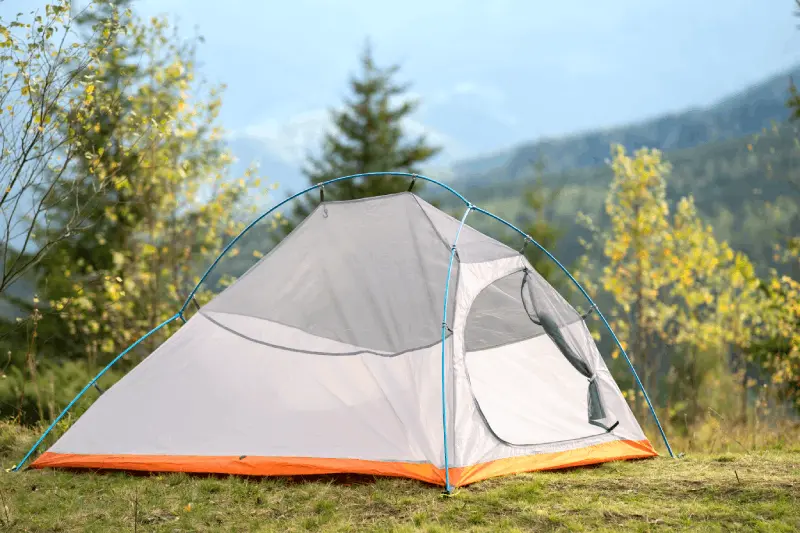
Double fly tents consist of a waterproof outer flysheet and an inner tent usually made of breathable fabric/netting. This system provides two major advantages in waterproofing:
The outer fly keeps water out, while the distance between it and the inner tent prevents potential leaks from reaching the camper directly.
The condensation droplets that form on the inner surface of the outer flysheet flow downwards due to gravity and go to the ground without touching the inner tent.
In single fly tents, condensation can drip directly onto you. Therefore, unless extreme lightness is required, double fly designs should always be preferred for waterproofing and comfort.
What Criteria Should You Focus on to Choose the Right Tent Fabric?
Ultimately, there is no such thing as the perfect tent fabric; there is only the fabric that best suits your needs. If your priority is lightness and extreme conditions, you should opt for Silicone-coated Nylon or DCF fabrics. If you are looking for general use, durability, and affordability, a quality PU-coated Polyester is ideal for you.
When making a selection, you should focus not only on the mm value but also on the quality of the seam tapes, whether the fabric is Ripstop, and the manufacturer's coating technology (PFC-free, UV protection, etc.). Remember that your tent is your home in nature; choosing the right fabric not only keeps you dry but also makes your connection with nature safer and more enjoyable.