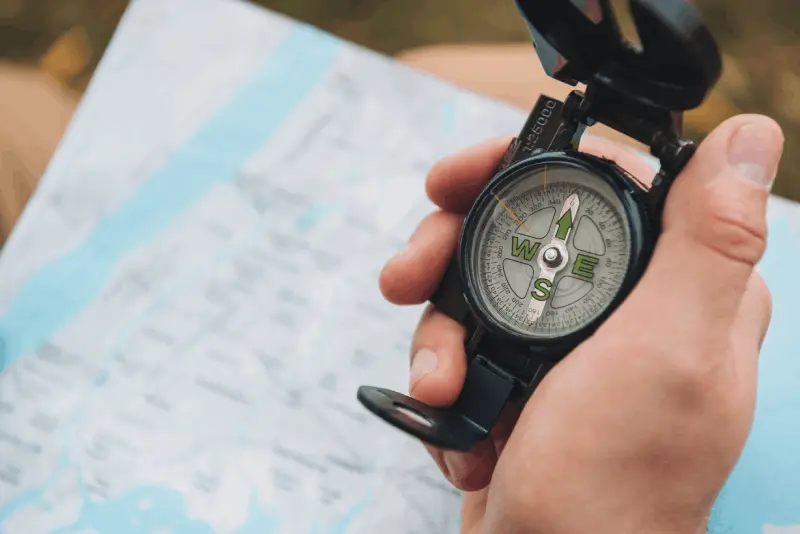
Why Should We Still Use Physical Maps and Compasses in the Modern Age?
While digital technology, smartphones, and GPS devices have made our lives easier, the limitations of these devices quickly become apparent in the challenging conditions of nature. Battery depletion, signal loss, screen freezes due to cold weather, or electronic malfunctions can leave you defenseless in an unfamiliar terrain. A physical map and a quality compass do not require batteries, do not need signal strength, and continue to work in all weather conditions as long as they are stored properly. The ability to use these traditional tools is not just a backup plan; it is also a fundamental survival discipline that develops your ability to read nature and connect with the terrain. Being able to chart your own course and know exactly where you are is the key to freedom and safety in the wild.
How to Read the Index of a Topographic Map Correctly?
Topographic maps are not just lines on paper; they are a three-dimensional projection of the terrain. When you pick up the map, the first place to look is the explanatory section on the edge of the map, known as the legend. Here, you will find the scale of the map, the interval of contour lines (isohyps), and the meanings of the symbols. For example, on a map with a scale of 1/25,000, every 1 centimeter on the map corresponds to 250 meters in reality. The year of the map's printing and the angle of magnetic declination are also critically important; because the magnetic field on Earth is constantly in motion. Navigating without understanding this technical data can lead to significant deviations and missing your target. Reading a map is like learning a language; the legend is the vocabulary of that language.
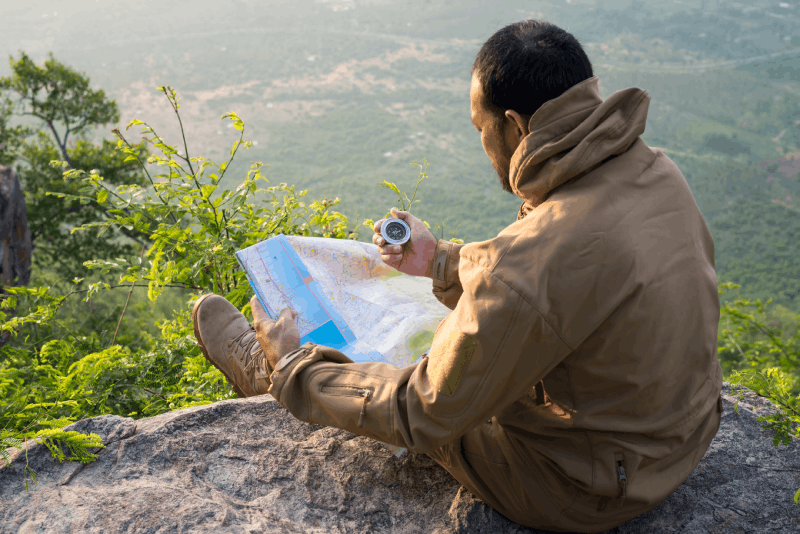
What is the Exact Function of the Rotating Capsule on a Compass?
A compass is not just an arrow pointing north; it is a precise calculation tool that works with angles. The rotating capsule on the compass, also known as the "degree bezel," represents angles from 0 to 360 degrees. The primary function of this capsule is to fix an angle taken from the map (bearing) onto the compass and to ensure progress while maintaining that angle in the terrain. The "north arrow" or "alignment arrow" inside the capsule is used to align the map's north with the compass needle. If you do not know how to use the rotating capsule correctly, you can only see general directions, but it becomes impossible to reach a specific target point, such as a distant rock outcrop or a hidden water source, accurately.
How Does the Difference Between Magnetic North and True North Affect Navigation?
There are two main north points on Earth: Geographic (True) North and Magnetic North. Maps are drawn according to geographic north, while the compass needle points to magnetic north. The angular difference between these two is called "declination" or magnetic deviation. This difference varies depending on your location and time. If you do not account for a 10-degree deviation, you will stray approximately 175 meters from your target for every kilometer you travel. In long-distance journeys, this margin of error can accumulate and lead you completely astray into a wrong valley or dangerous cliff edge. Before starting navigation, you must learn the current declination angle of your map and calibrate your compass accordingly or add/subtract this difference in your calculations.
What Methods Are Used to Orient a Map to the Terrain?
Map orientation is the process of aligning the north on the paper with the north in the terrain. The simplest method is to place the compass on the edge of the map and rotate the map until the compass needle is parallel to the north lines on the map. Another method is "visual orientation"; if you can recognize prominent hills, riverbeds, or roads in your surroundings, you can rotate the map to match these landforms. An un-oriented map can lead to mental confusion; it may cause you to think that the mountain you need to see is on your left when it is actually on your right. For a correct start, when you place the map in front of you, the direction you are looking at must perfectly align with what is represented on the map. This is the cornerstone of navigation.
How Do We Estimate the Slope of the Terrain Using Contour Lines?
Contour lines are imaginary lines that connect points at the same elevation above sea level. The proximity or distance between these lines directly indicates how steep the terrain is. If the lines are very close together, it means there is a steep slope or cliff; if the distance between the lines is widening, the terrain is flattening out. The "V" shape of contour lines indicates valleys or ridges. If the pointed end of the V shows high elevation, it indicates a valley; if it shows low elevation, it indicates a ridge. Being able to read these details helps you understand the difficulty level of the route you will be taking and allows you to use your energy efficiently. If you do not want to suddenly encounter a canyon on what appears to be a flat route, you must learn the language of contour lines.
How is Taking a Bearing and Following That Angle in the Terrain Applied?
Taking a bearing is determining the angle between your current location and the target you want to reach. You place the edge of the compass between your current position and your target on the map. Then, you rotate the compass capsule until the lines inside are parallel to the north-south lines of the map. By holding the compass in your hand and turning around, when you align the compass needle with the north reading in the capsule (the red end), the direction arrow on the compass shows you the exact direction you need to go. This technique is especially vital in forested areas where visibility is low or in foggy weather. Even if you cannot see your target directly, this mathematical angle will guide you to the correct point.
How to Avoid Getting Lost Using the Reverse Bearing Method?
Reverse bearing is the angle that is exactly opposite to the direction you are heading, which is 180 degrees. If you have moved away from a point and want to return or verify your location, you would use this method. Mathematically, if the angle you took is less than 180, you add 180; if it is greater than 180, you subtract 180. However, in modern mirror compasses, you can also see the reverse bearing line by placing the black (south) end of the needle on the north arrow. This method allows you to retreat to a safe point when you realize you have made a mistake. Additionally, when you draw your line on the map, you can confirm whether you are on that line by taking a reverse bearing from a prominent peak left behind.
How to Find Your Location on the Map Using the Triangulation Technique?
If you have a map and a compass but do not know exactly where you are, the "triangulation" method is your savior. For this, you should select at least two, preferably three, prominent landmarks in the terrain (a mountain peak, a tower, an edge of a lake) that you can recognize. You take a bearing to each point with the compass and transfer these angles as lines onto the map. The point where these lines intersect on the map is your exact location at that moment. The three lines may not intersect at a single point; the center of the small triangle formed (error triangle) is your location. This technique provides the most scientific and reliable answer to the question "Where am I?" and is the most powerful tool to prevent panic when lost.
Why is the Aiming Off Strategy Important?
Aiming off is a technique where you deliberately aim slightly to the right or left of a target (for example, a bridge or a trail junction) instead of going directly to it. If you are looking for a small cabin on the riverbank and you go directly to it, but cannot see the cabin when you arrive, you will not know which side of the river the cabin is on (whether upstream or downstream). However, if you deliberately aim 200 meters to the right, you will know that when you reach the river, the cabin will definitely be on your left. This strategy eliminates uncertainty in navigation and minimizes the risk of missing the target. It is a safety method frequently used by professional navigators, especially in night hikes or foggy terrains.
How Does the Handrailing Technique Facilitate Navigation?
Constantly looking at the compass while moving in nature can be tiring and slow. The "handrailing" technique involves following a prominent and long landform that runs parallel to your route. A river, a ridge line, a valley floor, a road, or a power line can serve as your "handrail." You proceed by keeping this line on your right or left until you reach your destination. This method reduces the need for constant angle checks and helps you maintain your general direction. The important thing is that this line you are following is clearly visible on the map and does not lead you into a dangerous area (like a cliff). It is a practical method that makes navigation more intuitive and fluid.
How Are Control Points and Attack Points Determined?
Breaking a complex navigation route into smaller pieces increases the success rate. "Control points" are prominent places where you will check yourself when you reach them on the route (for example, a trail junction or a large rock). An "attack point" is the last prominent point that is very close to your final destination and easy to find. It may be difficult to find your main target (like a small cave), but it is easy to find a huge solitary pine tree (attack point) 100 meters away from it. You first reach the attack point, then from there, you "attack" your main target with precise bearings. This tactical approach is the most effective way to find small targets in large terrains.
How to Estimate Distance Using Pacing?
Knowing how far a measured distance on the map translates to in the terrain helps you understand when to stop. "Pacing" is a method of counting a "pair of steps" every two steps (every time your left foot touches the ground). You should know in advance how many pairs of steps it takes to cover 100 meters on flat ground (for example, during training). This number is usually between 60-70. However, remember; steps shorten when going uphill, become shorter when tired, and vary with a heavy backpack. You can use a small "pacer bead" (step beads) that you attach to your backpack to track your distance. If you know you need to go 500 meters and you are measuring it with your steps, you will eliminate the risk of passing your target unnoticed.
What Should Be Considered When Using a Compass at Night?
Depth perception is lost at night, and landforms look completely different. In this case, your trust in the compass must be 100%. The needles and important markings of modern compasses are usually phosphorescent (tritium or luminescent). You should use the "short hop" method while moving at night. You should select the farthest prominent object (a tree, a rock) that your compass can illuminate in the direction it shows and go there to check again. Also, during night hikes, never forget that the compass needle can be affected by metal flashlights, batteries in headlamps, or smartwatches, causing deviations. In moments when visibility is close to zero, the compass is your only reliable guide.
What Tactics Are Used to Maintain a Straight Line in Forested Areas?
In dense forests where visibility is limited, walking in a straight line is nearly impossible; people unconsciously curve towards the side of their dominant foot. To avoid this, the "three-point rule" is applied. You progress by aligning a tree you left behind, a tree at your current location, and the tree you want to go to in front of you on the same line. This is a kind of "going forward by looking back" method. Additionally, you should keep the compass open and carry it at eye level, making adjustments every time you stray from your line. Forest navigation requires patience; making a directional adjustment every 10-20 meters is much better than walking for hours in the wrong direction and getting tired.

How Do Bad Weather Conditions Complicate Compass Reading?
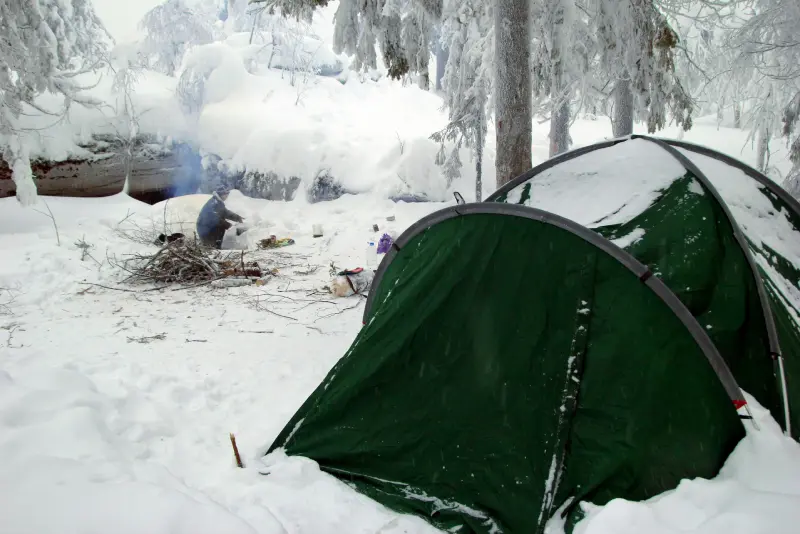
Heavy rain, snowstorms, or extreme winds can physically make using a map and compass very difficult. Wet paper maps can tear in the rain, so you must keep your map in a transparent, waterproof case. In extremely low temperatures, the liquid inside the compass can freeze or create an air bubble that prevents the needle from moving. In such cases, you should try to keep the compass warm with your body heat. Additionally, the effect of the wind blowing the map away is a real nightmare for many navigators; you should always secure your map with a string to your body or backpack. When nature challenges you, the durability of your tools and your composure are your greatest defenses.
What Metal and Electronic Items Affect the Compass?
The compass needle is sensitive to the Earth's magnetic field but is much more easily affected by local magnetic sources around it. This situation is called "deviation." The metal frame of your backpack, your knife, your cell phone, your radio, and even your glasses frame can deflect the compass needle. When taking a measurement, you should keep the compass at least 50-60 centimeters away from these objects. Especially near high-voltage lines or rocks rich in iron ore (like some volcanic areas), compasses can show completely wrong directions. If you notice the needle making strange movements or turning slowly, it is a vital safety rule to change your location and repeat your measurement.
How Are Coordinate Systems Used on Maps?
Maps usually have coordinate systems like UTM (Universal Transverse Mercator) or Latitude/Longitude. These systems allow you to express any point on Earth with numbers. If you need to call for help in an emergency, you cannot just say, "I am in a valley" over the radio or phone; however, if you provide your coordinates, rescue teams can pinpoint your location. To read coordinates on the map, the rule of "look right, then look up" is applied. First, you read the values of the vertical lines (east values), then the values of the horizontal lines (north values). These numbers represent 1-kilometer squares on the map and provide mathematical precision in determining your location.
What Does It Mean When the Compass Needle Wobbles or an Air Bubble Forms?
A quality compass is "liquid damped," meaning the needle floats in a liquid. This liquid ensures the needle settles quickly. If there is a large air bubble inside your compass, it usually indicates that the compass has been damaged or has leaked due to extreme altitude/cold. A small bubble usually does not cause problems, but if the bubble prevents the needle from moving freely, the compass is no longer reliable. Continuous wobbling of the needle indicates the presence of an electrical source or metal mass nearby. You should periodically check your compass and test the needle's speed in finding north. Remember, a compass that provides false information can be more dangerous than having no compass at all.
How to Create a "Route Card" When Preparing a Navigation Plan?
A professional hiker prepares a "route card" before heading out. This card breaks the route into stages and contains the following information for each stage: Bearing angle, distance to be traveled, elevation to be gained, and expected time. Additionally, "escape routes" are determined for each stage. For example, notes like "if a storm hits in stage 3, descend into the valley on the right and reach the village road" are taken. The route card is critical not only for you but also for informing those you leave behind about your route. A planned navigation reduces uncertainty and allows you to focus your mental energy solely on walking and observing the environment. Being prepared in nature is the first rule of survival.
What Advantages Do Maps with Relief Shading Provide?
Some modern topographic maps are printed with "relief shading" added over the contour lines. This method creates shadows as if the sun is shining on the map from a certain angle, visually highlighting the mountains and valleys. These types of maps are excellent for quickly understanding the general structure of the terrain. Instead of counting contour lines one by one, you can see at a glance which side is a deep canyon and which side is a high plateau. However, shading can sometimes obscure small details or the exact slope degree. Therefore, while relying on visual perception, you should always base your technical decisions on the mathematical contour lines and scale.
What is the Difference Between Mirror Compasses and Others?
Mirror compasses are high-level devices designed for precise navigation. The mirror on the lid of the compass allows you to see both the target (for example, a peak) and the compass needle at the same time. This way, you can hold the compass at eye level while taking aim and perfectly align the needle with the north reading. In non-mirror (baseplate) compasses, you must constantly separate your eyes from the target and look down at the compass, which increases the margin of error. Additionally, the mirror can also be used as a signaling device by reflecting sunlight in emergencies. If you are planning a serious expedition or search and rescue operation, investing in a mirror compass will greatly enhance your accuracy.
Is It Possible to Fix Magnetic Deviation (Declination) on the Compass?
Some high-quality compass models have a small adjustment screw under the capsule. With this screw, you can permanently set the magnetic declination angle for that area on the compass itself. This is called "declination adjustment." Once you make this adjustment, you no longer need to mentally add or subtract the angle in every measurement; your compass will align directly with the map's north. This feature is very valuable, especially for eliminating mathematical errors that can occur during moments of fatigue and stress. However, when traveling to a different geography, you must never forget to update this setting according to the current value of that area.
What Are the "Psychological Navigation Errors" Encountered While Reading a Map?
Navigation is not just a technical skill; it is also a psychological process. One of the most common mistakes is "forcing the map instead of adapting to the terrain." This occurs when a person becomes biased about where they want to be and tries to match the shapes they see in the terrain with incorrect places on the map. For example, they might convince themselves that a random hill they see is the famous peak on the map. Another mistake is "following fixation"; believing that just because there is a path, that path will lead you to the correct place. To avoid these traps, you should always be skeptical and verify your location with at least three different pieces of evidence (compass bearing, elevation, landform).
Why is Navigation More Difficult in Steep Cliffs and Canyons?
Deep canyons and very steep rocky areas limit both map reading and compass use. In canyons, your field of vision is so narrow that you cannot see distant landmarks; this makes triangulation impossible. Additionally, GPS devices lose satellite signals in such deep crevices. In this case, your only reliable methods are using "map-ground matching" and an "altimeter" (elevation meter). You must follow the curves of the valley, changes in the flow direction of the river, and small indentations in the contour lines. Navigating in such "closed" terrains requires as much attention and detailed analysis as solving a puzzle.
How Should We Integrate GPS and Smartphones into Navigation?
In the modern world, it is not logical to completely reject technology; smartphones and GPS devices are excellent auxiliary tools. However, your strategy should always be "map/compass first, then technology." Use GPS only to quickly confirm your location or obtain emergency coordinates. Constantly looking at the screen while walking can cause you to miss clues in your surroundings and leave you completely blind if the device fails. Use offline map applications on your phone (like Gaia GPS, AllTrails) as a backup, but keep your phone in airplane mode to conserve battery. Remember; technology speeds you up, but knowledge of maps and compasses keeps you alive.
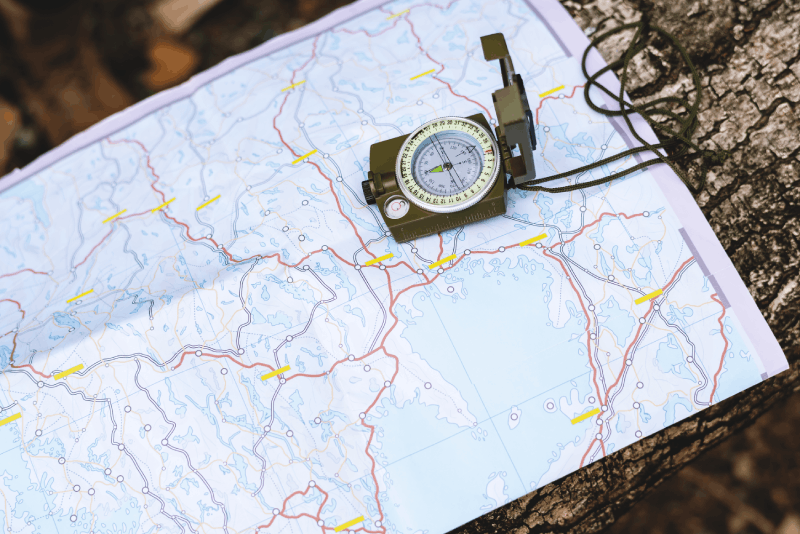
How to Train to Master Compass and Map Usage?
Navigation skills are gained not just by reading books but by practicing in the field. To start training, choose local parks or forests that you know and feel safe in. Target specific points on the map and try to reach them using only the compass. Then, practice short distances in foggy or dimly lit conditions. Exercises called "blind navigation," where a friend drops you off at an unknown point and asks you to return to the campsite, are very beneficial. In every hike, before touching technology, make a guess about "where I am right now according to the map" and then check how accurate you were with GPS. Success is the result of thousands of small corrections.
What is the "STOP" Rule You Should Apply When You Realize You Are Lost?
If the map and terrain do not match and you are not sure where you are, you should stop immediately. The "STOP" rule consists of the following steps: Stop, Think, Observe, and Plan. Panicking and rushing forward usually leads you deeper into confusion. Stop, calm down, and eat or drink something to stabilize your blood sugar. Then open your map and look for an answer to the question, "When was the last time I was absolutely sure?" Observe the prominent landforms around you and take a bearing with the compass. If you cannot find any solution, staying where you are or climbing to a high/prominent point to wait for help is the safest decision.
How to Prevent "Direction Drift" in Fog and Misty Weather?
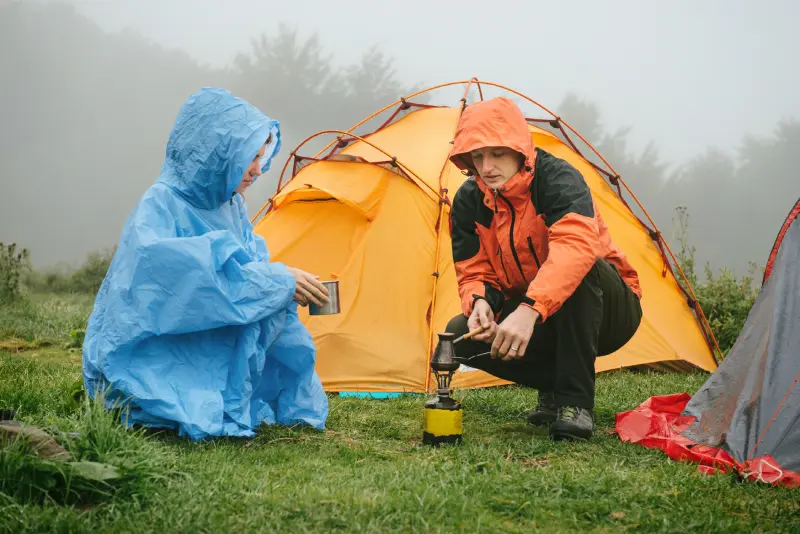
Fog is the biggest enemy of navigation as it can reduce visibility to just a few meters. In this case, you should check your compass angle much more frequently. If you are in a team, you can use the "rope line" method. The person in front holds the compass, while the person at the back checks whether the line is straight. If the person in front deviates from the compass line, the person at the back warns them. If you are alone, you can take slow but safe steps by looking at the compass angle over a marker (like a backpack) you left on the ground and walking towards a stone you throw ahead. In the fog, everything appears larger and farther away than it is; therefore, trust your compass, not your instincts.
How to Teach Navigation to Children and Beginners?
Teaching direction finding begins by making it a game. First, teach children the main directions (North, South, East, West) using the position of the sun. Then create a simple "treasure map"; for example, give tasks like "go 20 steps north from the big tree in the garden." The fact that the needle on the compass always points north is a magical event for them; use this interest to show them how to read degrees. Instead of complex topographic maps, start with simple sketches of familiar neighborhoods or campsites. Teaching them how to orient the map will be the most fundamental step in developing their spatial intelligence. The feeling of success will trigger their motivation to learn.
What Are the 5 Most Common Critical Mistakes in Map and Compass Usage?
Knowing the mistakes is the first step to avoiding them. 1) Forgetting magnetic deviation: This can be fatal, especially in areas with significant east-west differences. 2) Trying to read the map without orienting it: This is the shortest way to confuse left and right. 3) Keeping the compass close to metal objects: A deflected needle can ruin the entire route. 4) Miscalculating the scale on the map: Mistaking a 1-kilometer path for 100 meters can catch you unprepared. 5) Underestimating the weather: Navigation that is easy in clear visibility can become impossible in a storm. These mistakes can happen to even the most experienced navigators; therefore, one should always act according to the "double-check" principle.
What Are the Contributions of Navigation Skills in Nature to Personal Development?
Learning to use a map and compass is not just about getting from one place to another; this process deepens your self-confidence, problem-solving ability, and respect for nature. Finding your way in a wild terrain using your own decisions and mathematical data creates a great sense of satisfaction. This skill teaches you to be patient, pay attention to details, and remain calm under uncertainty. A person who finds their way in nature gains the will to chart their own course in the chaos of life. The steady and reliable oscillation of the compass needle becomes a reflection of your inner balance.
Why Should Everyone Have Basic Navigation Knowledge?
Finding direction in nature is one of humanity's oldest and most fundamental survival skills. No matter how perfect technology seems, the rules of nature always prevail. A person with a map and compass, who can speak the language of these tools, can never be considered completely "lost" even in the most remote corner of the world. The techniques described in this guide are not just information; they are the insurance of your life. On your next outdoor adventure, turn off your GPS, open your map, and wait for your compass to point north. The real adventure begins when you find your own way with your mind and tools. I wish you safe paths and accurate bearings.