How Should You Analyze the Direction and Intensity of the Wind Before Arriving at the Campsite?
A proper camping plan starts before you hit the road. You should examine the region's meteorological data not only based on temperature but also in terms of wind speed and gusts. Knowing whether the wind will change direction throughout the day determines which way you will set up your tent. Observing the wind's effect on trees based on the Beaufort scale will help you understand the local weather conditions. Especially, valley mouths or high ridges are areas that create a "venturi effect" where the wind accelerates. To avoid these areas, you should identify wind corridors in advance using topographic maps.
How Can You Identify Natural Windbreaks and Micro-Climate Areas?
When you arrive at the campsite, instead of immediately setting up your tent, you should look for areas where the wind has the least effect, known as "micro-climate" areas. Large rock formations, dense groups of trees, or areas that remain slightly depressed act as natural shields. However, setting up a tent under a solitary old tree is dangerous due to the risk of branch breakage in the wind. You can determine the wind's direction by tossing a piece of grass into the air or by wetting your finger to feel it. The ideal location is in sheltered areas just behind natural elevations that break the wind's intensity rather than facing the wind directly.
How Much Does the Aerodynamic Structure of the Tent Play a Role in Wind Resistance?
Not every tent design can withstand the same wind load. Dome-type tents distribute wind evenly from all directions, while tunnel-type tents show tremendous resistance when set up parallel to the wind. You should position the lowest profile and narrowest part of your tent facing the direction from which the wind is coming. Modern geodesic designs prevent breakage by distributing wind energy throughout the entire structure thanks to multiple intersection points where the poles support each other. If your tent has a tall structure, it will require more anchoring points to provide a larger surface area against the wind.
How Should You Choose the Most Suitable Tent Pegs According to the Ground Type?
Standard steel pegs are not suitable for every ground. In hard and stony grounds, thin but durable titanium "nail" type pegs are needed, while in soft soils, wider "V" or "Y" profile aluminum pegs provide better grip. In windy conditions, pegs should be driven into the ground at a 45-degree angle, opposite to the tent, to provide a mechanical advantage. If the ground is sandy or snowy, equipment known as "snow/sand stakes" with a wide surface area should be used instead of standard pegs. Choosing the wrong pegs can cause even the best tent to lift off the ground like a kite in the wind.
At What Angle and How Should You Tension the Guy Lines?
Guy lines are the unsung heroes that support the structure of the tent. These lines should be tensioned in such a way that they draw support from the junction points of the poles rather than directly outward from the tent's body. The angle at which the lines are anchored to the ground should be between 45-60 degrees to efficiently transfer the wind load to the ground. The lines should neither be too loose, allowing the tent to sway, nor so tight that they buckle the poles. Using "tensioners" to easily adjust the line tension according to the wind's intensity throughout the night is a critical move to maintain the tent's stability.
How Can You Increase the Flexibility and Breakage Resistance of Tent Poles?
Aluminum poles are much more durable against the wind compared to fiberglass because their bending capacities are higher. When the wind bends the poles, additional supports may be needed to share this load to prevent the pole from breaking. Some professional camping tents allow for double poling in the same pole channel, which can double the wind resistance. Ensuring that the pole joints fit perfectly eliminates weak points. If a pole starts to buckle, you can balance the load on the structure by tightening the tension lines on the side where the wind is coming from.
How Should Snow Skirts and Rock Pockets Be Used in Windy Conditions?
The fabric extensions found at the bottom of four-season or expedition-type tents are called "snow skirts." In windy conditions, you can prevent air from entering under the tent by placing heavy stones, dirt, or snow on top of these skirts. The wind entering under the tent tries to lift the entire structure upwards, creating a parachute effect. If your tent does not have a snow skirt, building a wall of stones (wind wall) around the tent (at a distance) can significantly reduce the wind's speed. This method especially helps the tent to almost anchor itself to the ground in open terrains.
How Does the Weight Distribution Inside the Tent Affect the Risk of Tipping Over?
The tent needs to be secured not only from the outside but also from the inside. You can stabilize the tent's base to the ground by placing your heavy backpacks, water bottles, or technical gear in the inner corners facing the direction the wind is hitting. This prevents the tent from being lifted off the ground by the wind. Instead of concentrating the weight in a single spot, spreading it along the wall facing the wind helps maintain the fabric's tension and reduces noise. Additionally, placing your sleeping bag and mat in the center can also serve as a balancing element for your own body weight to ensure stability. your setup.
How to Apply the "Deadman" Technique on Rocky or Sandy Grounds?
The "deadman" technique can save lives in hard-to-dig rocky areas or loose sand where digging is impossible. In this technique, a large stone or a bag filled with sand is tied to the end of a rope and buried to the depth of the ground or wrapped around a heavy rock block. The rope is pulled under this weight. This creates a horizontal resistance that transfers the force of the wind to a large mass instead of a vertical pulling force. This method is the most reliable professional technique that prevents the tent from being displaced even in the fiercest storms.
How Should the Windward and Leeward Tent Entrance Be Planned?
Setting the tent's entrance to face the direction of the wind (windward) can cause a massive air mass to fill the tent as soon as you open the door, leading to an explosion of the structure from the inside out. The entrance should always face away from the wind (leeward) or at a right angle to the wind. If your tent has double doors, you should use the door on the leeward side for entry and exit, while keeping the door on the windward side completely closed and taut. This strategy prevents dust and cold from entering while allowing ventilation without disrupting the tent's aerodynamics.
What Checks Should You Make Before Leaving Your Tent During Sudden Storms at Midnight?
Staying calm when you wake up in the middle of the night to a strong wind is the first rule. Immediately check the status of the poles and the tension of the fabric with the help of a flashlight. If there are loose stakes, reinforce them by placing larger stones on top. If the wind is stretching the poles too much, manually supporting the poles inside the tent can be effective for short-term actions. Ensure that the outer flysheet does not touch the inner tent; contact can lead to tearing of the fabric. Optimize all ventilation to minimize wind entry while preventing moisture buildup inside.
What Tips Are Available to Reduce Vibrations and Noise in Tent Fabric?
The biggest annoyance for campers on a windy night is the flapping sound of the fabric. This noise not only prevents you from sleeping but also indicates that the fabric is wearing out. To make the fabric tighter, gradually tighten the storm lines. If some areas are still flapping, you can reduce vibrations by placing a piece of clothing or a towel over the rope to add weight. Additionally, you must securely lock the Velcro fasteners around the poles to reduce gaps in the tent's pole channels and prevent the fabric from sliding around the poles.
How to Mitigate Wind Lift Forces in High Altitude and Open Area Camps?
At high altitudes, the wind blows much harder due to less resistance. Here, it is essential to set up the tent as close to the ground as possible and, if necessary, surround the tent with snow blocks. Ensure that the ground footprint does not extend beyond the tent to prevent the wind from passing underneath and creating lift like a "wing." If the ground footprint extends beyond the tent, it will catch the wind and collect rainwater under the tent. It is important to apply pressure along the entire perimeter to make the tent feel as if it is vacuumed to the ground.
What Materials Should Be in Your Tent Repair Kit for Wind Damage?
Even the best preparation can sometimes fall short against the forces of nature. You should always have a pole repair splint, strong duct tape, and a spare storm line on hand. When poles break, securing the broken area with a repair splint and taping it will keep the tent standing. A small tear in the fabric can turn into a massive hole in seconds due to the wind; therefore, self-adhesive fabric patches are lifesavers. Having these materials in an easily accessible bag allows for quick intervention in emergencies.
What Are the Structural Differences Between Seasonal Tents and Extreme Condition Tents?
Three-season tents are generally ventilation-focused and have thinner pole structures. In windy weather, these tents can stretch excessively and may sometimes become permanently deformed. Four-season or mountaineering tents are equipped with thicker aluminum poles, more tension points, and steeper fabric surfaces that deflect the wind. If you are camping in areas with strong winds, it is advisable to choose outer pitch models, which prevent the inner tent from getting wet and flying away in the wind during setup. The design of the structure is the most critical balance point between safety and weight.
How Does the Positioning of Tents Relative to Each Other in Group Camps Cut the Wind?
If camping with multiple tents, it is wise to arrange them in a formation that will block the wind rather than setting them up randomly. By positioning more durable and larger expedition tents like a wall against the direction of the wind, you can create a sheltered "courtyard" for smaller or lighter tents. However, care should be taken not to leave narrow corridors between the tents where the wind can squeeze and accelerate. If vehicle camping is involved, positioning the vehicles against the wind direction is the most effective artificial barrier. This collective defense strategy ensures that the entire group has a more peaceful night.
What Is the Effect of Ventilation Windows on Wind Circulation and Pressure Balance?
Many campers tend to close all windows in windy weather, but this can hinder the balance of air pressure inside the tent. Keeping the ventilation windows on the leeward side open allows the pressure inside to escape and prevents condensation. The windows on the windward side... To prevent the wind from entering, it should be kept closed. The chimneys on top of some tents create a vacuum effect that pulls the air inside as the wind passes. This circulation contributes to the tent's fabric being more resistant to the wind pressure coming from outside.
How to Prevent the Wind from Lifting the Tent Like a Kite During Tent Setup?
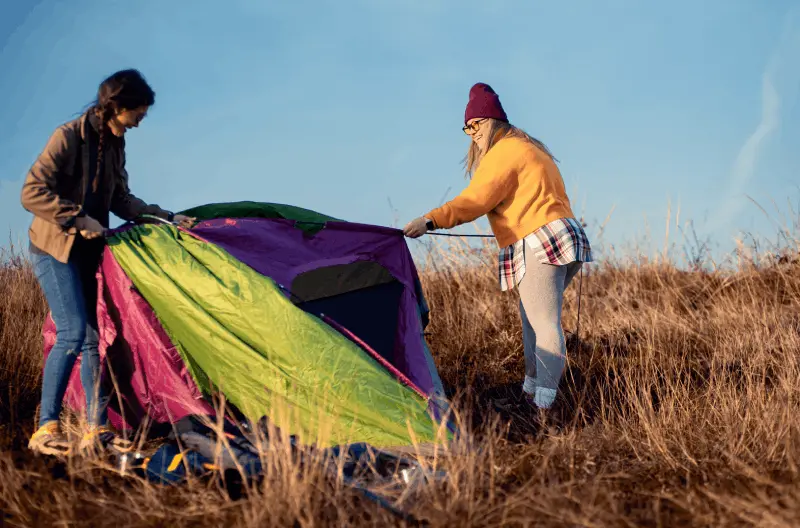
The setup phase is when the tent is most vulnerable. As soon as you take the tent out of the bag, tie one corner on the windward side to a heavy stake or secure it with a peg. While attaching the poles, press down on the fabric with your knees to prevent the tent from lifting off the ground. It is difficult to set up a tent alone in windy conditions; one person must hold the fabric at ground level while the other pushes the poles into the channels. Never try to attach the poles first and then stake them down; this can cause the tent to be uncontrollably blown away in the wind, leading to broken poles and potential injury to you.
What Are the Helpful Tying Methods to Prevent the Tent Stakes from Loosening?
The constant vibration from the wind can cause the stakes to loosen in the ground and eventually come out. To prevent this, you can use the "double staking" method; by driving a second stake behind the main stake and tying them together, you can increase resistance. Additionally, placing a large and heavy rock on top of the stake physically prevents it from being pulled upward. For the lines, using "tension relief" (shock absorber) straps can reduce the shock load on the stake by dampening sudden impacts from the wind. These small details are elements that help maintain the stability of the tent during prolonged storms.
How Should the Decision to Evacuate Be Made When the Wind's Intensity Exceeds Safety Limits?
No equipment can withstand unlimited force indefinitely. If the poles are continuously bending to the ground, if seams in the fabric start to tear, or if the sound of the wind indicates that nearby trees are at risk of falling, it is time to evacuate. Safety always comes before equipment. In such a situation, instead of wasting time packing up the tent, you should remove the poles and lay the tent flat on the ground, placing rocks on top to secure it in a safe location (such as a vehicle or a sturdy structure). Trying to pack up the tent at the peak of the storm can lead to facing uncontrollable forces.