
How Much Does Dust Accumulation on Caravan Solar Panels Reduce Energy Efficiency?
Energy means everything in caravan life. The operation of the refrigerator, lighting, and charging of digital devices entirely depends on the performance of those black-blue panels above your head. However, the fine layer of dust that accumulates on your panels while parked in the middle of nature or traveling miles on the road can actually be a much bigger energy thief than you might think.
How Much Do Dust Layers Reduce the Efficiency of Caravan Solar Panels?
The dust accumulation on caravan solar panels can reduce energy production capacity by an average of 10% to 25%, depending on the region and type of pollution. Field studies have shown that in particularly dry and windy areas, this loss can reach levels of 35-40%. Every micron of dust that accumulates on the panel's surface creates a physical barrier that prevents photons from the sun from reaching the silicon cells. For caravan owners, this means that the expected daily energy production of 100Ah drops to 75Ah, which means the refrigerator may shut down at midnight or the batteries may not fully charge. To protect your energy budget, you should treat dust accumulation not just as an aesthetic issue but as a technical malfunction.
How Do Microscopic Particles Block Photon Transmission?
The working principle of solar panels relies on photons striking a semi-conductive surface to create electron mobility. Dust particles create an irregular surface area on the panel glass, causing light to refract and reflect. Instead of entering the cell directly, light bounces back or is absorbed by dust particles. This situation is referred to as "optical loss" of the panel. The chemical composition of the dust is also important; for example, dark industrial dust retains heat, while light-colored mineral dust reflects more light. In both cases, the quantum efficiency beneath the cell decreases. This invisible barrier that accumulates on the caravan roof causes your system to experience "solar blindness" and makes it impossible to benefit from the panel's nominal power.
How Do the Caravan Roof Structure and Tilt Angle Affect Dust Accumulation?
While solar panels in homes are typically installed at angles of 30-45 degrees, in caravans, panels are usually mounted at an angle of 0-5 degrees to suit the flat roof structure. This horizontal placement is the most favorable environment for dust accumulation. Low tilt prevents dust from being self-cleaned by wind or light rain. Gravity ensures that dust particles adhere more tightly to the surface, and combined with the dew that forms at night, this dust essentially hardens on the panel by morning. If your caravan does not have a retractable or tiltable panel mechanism, dust accumulation occurs 50% faster compared to vertical systems. This structural disadvantage forces caravan owners to maintain more frequent cleaning intervals.
Does Salty Humidity and Sand on the Coastal Strip Increase Dust Accumulation?
For caravan owners who love camping by the sea, the biggest enemy is salty humidity. Aerosols from the sea, i.e., fine salt crystals, create a sticky and corrosive layer on the panel surface. This salt layer attracts sand and dust from the air like a magnet. The hygroscopic (moisture-attracting) property of salt creates a conductive mud layer on the panel by absorbing moisture from the air at night. This not only reduces light transmission but can also lead to corrosion of the panel frames and degradation of waterproofing elements. In a caravan parked in coastal areas, efficiency loss can exceed 20% in just a week. Therefore, the effect of dust mixed with sea salt is much more aggressive and harder to clean than dry dust in inland areas.

Do Bird Droppings and Tree Resins Leave Permanent Damage on Panels?
Not only fine dust but also regional "point pollutions" have a destructive effect on efficiency. Bird droppings and tree resins cause dangerous formations known as "hot spots" on the panels. When dust is evenly distributed, efficiency generally decreases, but a bird dropping can completely cover just one cell of the panel. This covered cell resists current flow and begins to overheat. In the long term, this overheating can lead to the burning of the cell or cracking of the panel glass. Additionally, tree resins, when dried, harden and trap dust, potentially damaging the protective coating of the panel with their acidic nature. These types of organic waste are elements that require much more urgent intervention than a simple dust layer and pose a direct threat to the system's lifespan.
Is Air Pollution During Winter Months a Threat to Efficiency?
The type of pollution encountered while traveling or staying in a caravan during winter varies. Especially in the winter months when fuel consumption increases, soot and ash particles that remain suspended in the air settle on the panels. These carbon-based pollutants have the capacity to absorb sunlight and cause the panel to overheat while preventing photons from entering. Dirty water stains left on the panel after snowfall also leave an opaque ring when dried. During this period when winter sunlight is already weak, a 15% loss of dust/soot can lead to the batteries not charging and the system shutting down (low voltage cut-off). Therefore, not only is the winter sun insufficient, but the additional barrier created by pollution can trigger an energy crisis.
How Does Dust Accumulation Shorten Battery Charging Cycles and Lifespan?
Dust accumulation is not just an instantaneous production loss; it affects the lifespan of your entire energy storage system. Dusty panels cannot fully charge the batteries during the day (incomplete bulk/absorption phases). This situation causes the batteries to remain in a constant "partially discharged" state. Especially in lead-acid or gel batteries, this accelerates sulfation and permanently reduces the battery's capacity. In lithium batteries, the BMS (Battery Management System) may have to continuously shut down and restart the system due to low voltage. Incomplete charging cycles can take years off the expected lifespan of your battery investment. Keeping the panels clean essentially means protecting your battery bank worth thousands of liras.
Can MPPT Charge Controllers Tolerate Partial Dust Effects?
MPPT (Maximum Power Point Tracking) devices are more adept at handling shading and dust conditions compared to PWM devices, but they are not a magic wand. MPPT continuously scans the voltage-current curve of the panel to try to extract the highest power. If the panel is uniformly dusty, the MPPT can compensate for some of the loss by reducing the voltage. However, if one corner of the panel is covered with a thicker layer of dust or a leaf, the "bypass diodes" in the panels come into play. This means that part of the panel is out of circuit. Even if the MPPT device tries to maximize efficiency in this situation, it cannot bring back a physically blocked photon flow. As a result, a quality charge controller can reduce losses by 5-10%, but it will never eliminate the need for cleaning.
Do Incorrect Chemicals Used in Panel Cleaning Damage Surface Structure?
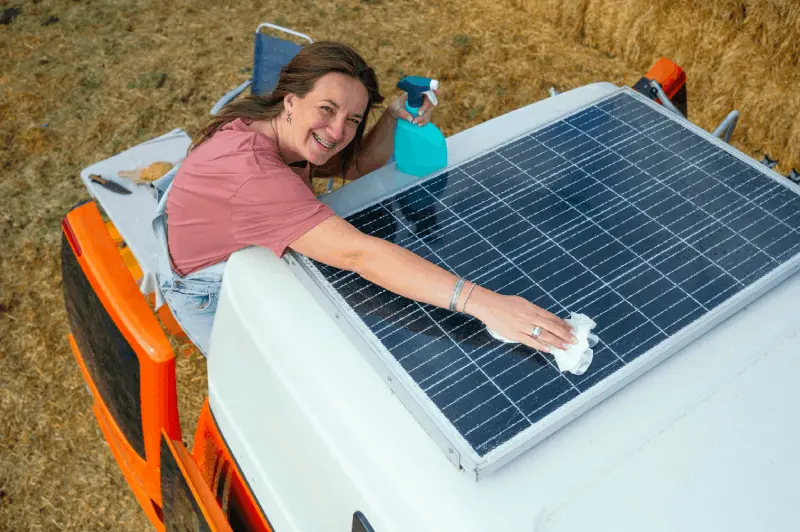
The biggest mistake made when trying to clean dusty panels is using household cleaning products or harsh chemicals. Solar panels have a special coating that prevents reflection (anti-reflective) and makes it difficult for dust to adhere. Dish soap, glass cleaner, or aggressive solvents can damage this fine layer. A panel with a damaged coating, even if it looks clean, transmits less light and begins to attract dust faster than before. Additionally, stiff brushes or abrasive cloths can create microscopic scratches on the panel glass. These scratches lead to a permanent reduction in efficiency by allowing light to escape. The safest cleaning method for caravan owners is to use pure water, a very soft microfiber cloth, and, if necessary, only special pH-neutral cleaners designed for solar panels.
Are Nano Coating Technologies a Real Solution for Caravan Panels?
In recent years, the increasingly popular "self-cleaning" nano coatings are quite a logical investment for caravans. These coatings make the panel surface hydrophobic (water-repellent), allowing water to flow off in droplets. As the water flows, it carries away the dust particles on it. Some advanced technology coatings also exhibit photocatalytic properties, breaking down organic dirt (pollen, resin) with the help of sunlight. In systems where low-tilt panels like caravans exist, these coatings can reduce dust accumulation by up to 70% and keep efficiency high for a long time. However, it should be noted that these coatings are not permanent and generally need to be renewed within 1-2 years. Still, they are a technology that simplifies caravan life by reducing the frequency of cleaning.
What Smart Monitoring Systems Should Be Used to Track Dust Accumulation?
The best way to understand efficiency loss is to monitor your system digitally. Modern solar energy systems have smart shunts and monitoring units that operate via Bluetooth or Wi-Fi. If on a clear and sunny day, even at the hour when the sun is at its peak, your panel is producing energy well below its nominal power (for example, 250W from a 400W panel), this is a sign of dust accumulation or a malfunction. You can see the "dust trend" by comparing past data through applications from brands like Victron and Renogy. If production gradually decreases every day, it means the panels are signaling a cleaning alarm. Visual inspection can be misleading; even if the panel looks clean, a fine layer of pollen on it may be undermining efficiency, so data does not lie.
Is Rainwater Really Sufficient to Clean Panels?
A common belief among caravan owners is that "since it rains, the panels will be cleaned." However, this is not always the case and can sometimes have the opposite effect. Light rains (drizzle) can deposit suspended dust onto the panel and leave a stained layer when dried. This is referred to as the "mud rain" effect. For a complete cleaning, a heavy downpour is needed, and the panel should be tilted at least 10-15 degrees. Since caravan panels are generally flat, rainwater tends to accumulate on the panel, and when it evaporates, the minerals in the water and the collected dust form thick layers at the edges of the panel. Therefore, instead of relying on rain, it is critical for efficiency to wipe the panels with a squeegee after each rain and clean any remaining stains.
What Role Does Dust Play in the Formation of "Hot Spots" on Panel Surfaces?
When dust accumulation is not uniform, it creates serious technical risks on the panel. If one part of the panel is covered with thick dust, mud, or leaves while other parts are clean, the clean parts try to operate at full capacity. The dusty part cannot conduct this current and shows resistance. This situation leads to overheating in that area of the panel, resulting in the formation of a "hot spot." Thermal cameras show that these points can reach up to 100 degrees. Prolonged hot spots can cause the protective layer (backsheet) behind the panel to melt and irreversibly damage the cells. The potential for a simple dust accumulation to burn the panel demonstrates why cleaning is not only an energy efficiency issue but also a system safety concern.
Does Wind Effect While Moving Help Clean Dust Off a Caravan?
Many caravan owners think that the wind created while driving at 90-100 km/h on the highway will blow the dust off the panels. While partially true, the wind only removes loose dust from the surface. Oil particles from exhaust smoke, road tar, and moist dust suspended in the air can adhere more tightly to the panel surface when blown by the wind. Additionally, the turbulence created by the wind while moving can create eddies that cause dust to accumulate at the edges of the panel frames. More than the cleaning effect of the wind, the risk of dust from the roads sticking to the panels is higher. Checking the panels when you take a break after a long journey or when you arrive at the campsite is vital for your evening energy needs.
Does Good Night and Morning Dew Create a Mud Layer on Panels?
The biggest phenomenon encountered in nature during mornings is dew. The panel glass cools at night and condenses moisture from the air in the early hours of the morning. If there is dust left on the panel from the previous day, this moisture moistens the dust, turning it into a fine mud layer. As the sun rises, this mud quickly dries and hardens on the glass surface. When this cycle repeats every day, the dust layer thickens, making it very difficult to clean. For this reason, experienced caravan owners perform a light wiping just before the sun hits the panel or while the dew is still wet. This simple habit can directly increase the efficiency gained from the sun throughout the day by 10-15%.
Do Different Panel Types (Monocrystalline vs. Polycrystalline) React Differently to Dust?
The response of panel technology to dust is related to the cell structure. Monocrystalline panels have higher efficiency, so even a small loss in efficiency means a greater absolute energy loss. Additionally, monocrystalline cells are more sensitive under low light conditions, so the dust layer on them reduces production efficiency more sharply. Polycrystalline panels may seem a bit more tolerant, but their overall efficiencies are already lower. Recently emerging Shingled panels, which have no gaps between cells, are more affected by uniform dust accumulation, while Half-Cut panels allow the other half to operate at full capacity even if part of the panel is covered with dust, thus mitigating the risk. So regardless of your panel type, dust is an enemy, but modern designs help minimize loss.
Should the Frequency of Cleaning Solar Panels Change Based on the Caravan's Location?
The cleaning schedule is entirely dependent on geography. In steppe or desert climates (for example, Central Anatolia or Southeast), weekly or sometimes even daily cleaning may be necessary. In forested areas, caution should be exercised during seasonal transitions (spring) due to tree pollen and resins. In coastal areas, daily cleaning from sea salt is required, while in humid regions like Europe, monthly cleaning may suffice. Caravan owners should create their own "pollution index." If you leave a noticeable mark when you run your finger over the panel, it means that cleaning time has long arrived. Instead of a fixed schedule, a flexible and observation-focused cleaning strategy based on the conditions of the location is the most accurate approach.
What Does the Financial Dimension of Efficiency Loss Due to Dust Accumulation Mean for Caravan Owners?
The energy lost due to dust accumulation creates an indirect cost. A 20% efficiency loss means that 100W from a 500W panel set is going to waste. If you cannot fully charge your batteries due to this loss and have to draw electricity (shore power) from outside at the campsite, the daily electricity bill you pay is the cost of this loss. Worse, if you damage your batteries early due to low voltage, you may face a renewal cost of thousands of liras. Additionally, adding more panels to the caravan's roof to compensate for the loss adds both weight and cost. A cleaning that can be done with just a bucket of water and a soft cloth can save you from heavy costs like system upgrades or part replacements.
What Are Practical and Safe Panel Cleaning Equipment for Travelers?
Climbing onto the roof of the caravan is not always safe or feasible. Therefore, practical equipment is lifesaving. Telescopic (extendable) handle microfiber mops allow you to reach the panels without leaving the side of the caravan. Tools with one end as a soft sponge and the other end as a rubber squeegee are ideal. Always have pure water (or demineralized water) on hand; because tap water can leave lime stains, reducing efficiency. Battery-operated small water sprayers (pressure sprayers) are effective in softening dust. Never use high-pressure washing machines (car wash guns); these devices can burst the panel's waterproof seals or flex the glass, damaging the cells. A ladder, a telescopic brush, and clean water are your best friends for your caravan energy system.
What Technologies Are Expected in the Future to Combat Dust Accumulation in Caravan Solar Energy Systems?
The technology world is moving towards the "set and forget" philosophy. Some innovations that will be accessible for caravans in the future include "electrostatic dust-repellent" surfaces. These systems provide a very low electric current to the panel surface, allowing dust to lift into the air and be blown away by the wind. Additionally, there are ongoing developments on micro-wiper systems integrated into the panel glass that are invisible to the naked eye. Some new generation flexible panels come with ultra-hydrophobic surfaces that create a lotus flower effect. However, until these technologies become widespread, the most effective and economical method will continue to be manual cleaning. The future is bright, but today you need to take that cloth in your hand to protect your energy.
The dust accumulation on the caravan's solar panels is not to be underestimated as an energy thief. With regular maintenance and proper monitoring, you can gain up to 25% more efficiency from your system, extend the lifespan of your batteries, and overcome the fear of running out of energy in the middle of nature. Remember, a clean panel means more freedom.