Why Has Hammock Camping Become So Popular?
Hammock camping has gained revolutionary popularity among outdoor enthusiasts in recent years due to the advantages of lightness, portability, and sleeping off the ground compared to traditional tent camping. Hammocks eliminate the necessity of camping on uneven terrain, rocky ground, or wet soil, allowing campers to set up a nest wherever there are trees. However, to enjoy this comfort without a cost, technical knowledge is required. While many people see hammocks merely as a temporary relaxation tool, with the right equipment and knowledge, a hammock can transform into the most ergonomic bed in the world. If proper techniques are not applied, a pleasant camping night can set the stage for serious back and neck pains that restrict your mobility the next day.
What Are the Main Reasons for Developing Back Pain While Sleeping in a Hammock?
The primary source of back pain experienced in a hammock is the unnatural bending of the body in a "banana" shape. When lying in a hammock parallel to its length, the center of gravity, which is the pelvis area, sinks down, and the spine takes on a C-shape curve. This position exerts excessive pressure on the discs in the lower back, leading to nerve compressions or muscle spasms. Additionally, the fabric of the hammock squeezing the shoulders and pelvis from the sides slows down blood circulation, causing the muscles to remain tense throughout the night. If the hammock is set up too tight or too loose, the body continuously makes micro-adjustments to balance itself. This situation can leave you feeling tired and sore upon waking, as if you had been exercising all night instead of feeling rested.
How Important Is Proper Hammock Selection for Back Health?
Not every hammock available on the market is suitable for sleeping through the night. If you want to protect your back health, you should first pay attention to the dimensions of the hammock. Hammocks that are too short or narrow do not allow the body to lie diagonally and inevitably force you into a cramped position. The ideal length for a hammock intended for camping use should be at least 3 meters (approximately 11 feet) or more. The width should allow the body to move comfortably without being trapped in the fabric. Models referred to as double provide more fabric area for a single person, helping to create a flatter sleeping surface. The stretch of the fabric is also a critical factor; overly stretchy nylon fabrics can cause you to sink more during the night, disrupting the lumbar curve.

Why Is Sleeping in a "Banana Shape" Harmful for the Back?
If you lie parallel to the line between the trees when you get into the hammock, your body follows the natural curve of the hammock. This creates a condition known in medical terms as "spinal flexion," where the spine is excessively bent forward. The human spine is naturally slightly S-shaped, and maintaining this shape is essential for disc health. Sleeping in a banana position puts stress on the facet joints in the lower back and causes excessive tension in the back muscles. Staying in this position for an extended period can not only cause immediate pain but also trigger risks of chronic lumbar disc herniation. Therefore, the biggest rule in hammock camping is to learn to make the hammock a platform where your body can lie flat instead of surrendering to the shape of the hammock.
What Is the Diagonal Sleeping Technique and How Is It Applied?
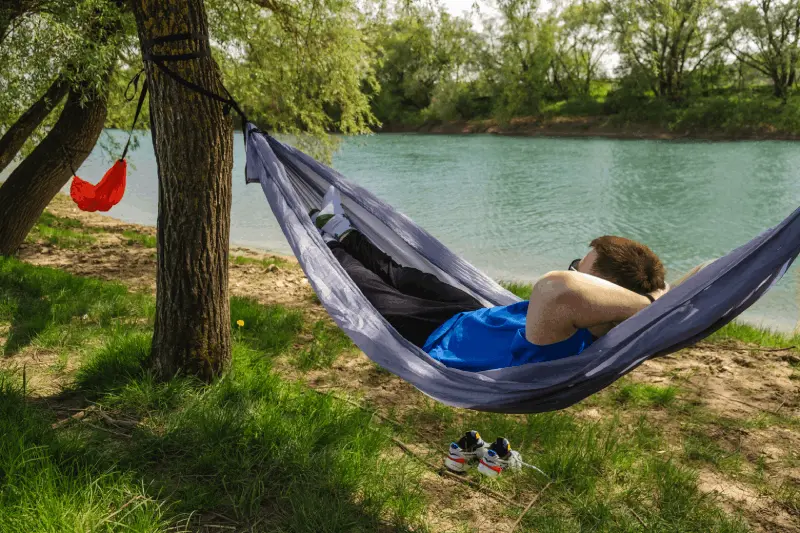
The most effective and golden rule for preventing back pain is the "diagonal sleeping" technique. In this technique, instead of lying parallel to the centerline of the hammock, you slide your body at an angle of about 30 to 45 degrees. When you position your feet in one corner and your head in the opposite corner, the fabric of the hammock stretches beneath you and creates a flat surface. This position prevents your body from sinking down and ensures that your spine aligns as if you were lying on a bed. The diagonal sleeping technique prevents your shoulders from being squeezed by the fabric and allows your rib cage to open up more comfortably. Although this technique may feel unfamiliar at first, you will immediately notice the relief in your back after a few tries.
How Does Hammock Setup Angle (30 Degree Rule) Affect Back Comfort?
It is a common misconception that the tighter you set up your hammock between two trees, the flatter the surface you will achieve. In fact, a very tight hammock creates a "guitar string" effect, starting to compress your body from the sides and making diagonal sleeping impossible. For ideal setup, the angle between the point where the hammock is attached to the tree and the end of the hammock should be approximately 30 degrees. This angle allows the fabric to sag at an optimum level when you get into the hammock. This sagging creates the necessary "working area" for you to achieve a flat line within the fabric. If the angle is much steeper than 30 degrees or much flatter, the weight distribution becomes uneven, increasing the pressure on your lower back and reducing your sleep quality.
Why Is It Necessary to Use a Structural Ridgeline?
Many campers struggle to maintain a 30-degree angle with each setup. This is where the "structural ridgeline" comes into play. This is a device made of a non-stretchable rope (like Amsteel) that is pulled between the two ends of the hammock. When this rope is adjusted to about 83% of the total length of the hammock, the hammock will always remain at the same sag angle, regardless of the distance between the trees. This setup standardizes the ideal sleeping geometry that is vital for your back health every night. Without using a ridgeline, you will encounter different setups at each campsite, and your back... The risk of experiencing pain increases due to the openings that do not have a permit. Additionally, this rope provides a perfect area to hang items such as a flashlight or water that you may need overnight.
Does Placing a Pillow Under the Knees in a Hammock Prevent Lower Back Pain?
One of the simplest and most effective ways to reduce tension in the lower back area is to place a small support under the knees. Even if you lie diagonally, in some hammocks, when the legs are completely straight, the ligaments behind the knees can stretch, and this tension can reflect on the lower back area. Placing a light pillow, a rolled-up jacket, or spare clothes under the knees helps to slightly bend the legs. This small adjustment aids in completely relaxing the lower back muscles (lumbar region) and helps the spine sit better on the surface of the hammock. This method is especially a trick that doubles the comfort of the hammock for those who use knee support while sleeping on their bed at home.
Does Cold Weather Trigger Lower Back Pain and Why is Under Insulation Necessary?
Lower back pain does not always stem from a mechanical posture; sometimes the cause is cold. While sleeping in a hammock, a constant airflow passes underneath your body. This situation can lead to a rapid loss of body heat and cause you to experience "cold butt syndrome." The back and lower back muscles exposed to cold contract to protect themselves. These involuntary contractions can lead to ongoing tension throughout the night and result in stiffness in the lower back when you wake up in the morning. Therefore, even if the weather is not very cold, it is essential to place an "underquilt" or a suitable mat inside the hammock. Keeping the lower back warm supports blood circulation by ensuring that the muscles remain relaxed and protects lower back health regardless of the position.
How Do the Length and Width of a Hammock Affect Sleep Quality?
When choosing a hammock for lower back health, dimensions should never be overlooked. Short hammocks (usually between 2.5 - 2.7 meters) restrict your maneuverability because they trap your body inside the fabric. If you are a tall individual, you can never achieve a completely straight line in a short hammock. Hammocks that are 11 feet (3.35 meters) long are considered the "gold standard" in the modern camping world. Width allows your body to spread out sideways. However, very wide hammocks can also experience the problem of excess fabric closing in on you (flop). What is important for lower comfort is the distribution of fabric tension. A quality camping hammock should be designed to distribute your weight over a wide surface to prevent pressure buildup at a single point (usually the lower back and hips).
Are Bridge Hammocks More Comfortable Than Traditional Hammocks?
If you cannot find comfort in classic "gathered end" hammocks no matter what you do, you may need to try "bridge" type hammocks. These hammocks offer a completely rectangular sleeping surface thanks to the tension rods at both ends. This structure, resembling a stretcher, does not allow your body to curl up at all and lays you flat on a surface. Especially for side-sleeping campers, bridge hammocks are the most guaranteed solution to prevent lower back pain. However, these models are heavier, more complicated to set up, and require a special insulation system. For those with serious chronic issues like herniated discs, bridge hammocks can be an excellent alternative treatment tool to continue hammock camping.
What Should the Distance Between Trees Be When Setting Up a Hammock for Lower Back Comfort?
The distance between the two trees where you will hang the hammock determines the geometry of your suspension system and thus your sleeping angle. The ideal distance is usually between 4 to 5 meters. If the trees are too close together, the hammock will take on a very deep curve, increasing the pressure on your lower back. If the trees are too far apart, you will need to attach the suspension straps from a very high point, which can lead to excessive tension in the suspension system and trigger the "guitar string" effect. When you find the correct distance, the hammock should be positioned approximately at knee height (about 45-50 cm) from the ground and should not touch the ground when you sit on it. Proper distance and height adjustment facilitate getting in and out of the hammock while ensuring that your body is supported evenly throughout the night.
Can People with Herniated Discs Sleep in a Hammock?
The answer to this question depends on the severity of the herniation and the individual's sleeping habits, but many patients with herniated discs report feeling much more comfortable in a hammock than in a tent. The pressure points that occur while lying on a mat in a tent can exert pressure on the herniated area. However, a hammock distributes your body weight evenly and eliminates contact with any hard surface. When using the diagonal sleeping technique and knee support, the decompression effect in the lower back area can alleviate herniated disc pain. However, individuals with advanced herniation should definitely consult their doctor and are advised to test their bodies' reactions with short trials before camping. When used correctly, a hammock can be a rehabilitation tool, but improper setup can worsen the situation.

Is Turning in a Hammock Safe for Lower Back Health?
Many people think that you can only lie on your back in a hammock, but it is possible to lie on your side and even turn slightly in a hammock of the correct size. Staying still throughout the night can lead to joint stiffness and trigger lower back pain. Therefore, slightly changing positions is actually healthy. Taking a fetal position while lying on your side can help maintain the curve of your lower back; however, it is important to place a small pillow between your knees to maintain hip alignment. Avoiding sudden and uncontrolled movements inside the hammock is necessary for both your safety and the balance of the suspension system. Keeping your body tensioned against the fabric... Using the liğini to slowly turn helps keep your back muscles dynamic and prevents morning stiffness.
Is a Sleeping Bag or Blanket Better Support in a Hammock?
Using a sleeping bag in hammock camping can sometimes restrict your mobility and strain your back. Being cramped inside the bag can force you into a diagonal position. Therefore, professional hammock campers often prefer what is called a "top quilt," which are open-backed camping quilts. These quilts allow you to move much more freely inside the hammock and help you find the position that is most comfortable for your back. If you are going to use a standard sleeping bag, spreading the bag over you like a blanket instead of fully zipping it up will make it easier to adjust your body position. Being able to move comfortably offers critical flexibility to prevent back pain; because when your body is uncomfortable, it will naturally want to shift to the most comfortable point.
How Should Hammock Tension Be Adjusted?
The tension of the hammock is one of the most critical stages of setup. Ideal tension is when the hammock has a slight smile shape when no one is sitting on it. Stretching the hammock tight like a string between two trees eliminates the fabric's elasticity and causes the fabric you sit on to become as hard as a rock. On the other hand, a hammock that is too loose can trap you inside and create a "cocoon effect," bending your shoulders inward. For the ideal adjustment, you should feel enough resistance to bend the structural ridgeline (ridge line) rope with your fingers at a 90-degree angle. This level of resistance indicates that the hammock is tight enough to support your weight but flexible enough to conform to your body's shape.
Is Practicing Hammock Setup at Home Before Camping Beneficial?
If you are going to sleep in a hammock for the first time, you should definitely practice before heading out into the wild. Setting up the hammock in your yard or home and spending a few hours in it will help you understand how your back reacts to the fabric. By trying different sleeping positions, you can discover the "sweet spot" where your body feels most comfortable. Additionally, you can optimize how high you need to attach your suspension system and the thickness of your underquilt during these trials. Back pain is often the result of an unfamiliar position; acclimating your body to hammock dynamics in advance will help prevent potential muscle spasms that could occur on camping night. A prepared camper is one who minimizes the risk of pain.
How Does Having Your Feet Higher Than Your Head Protect Your Back?
One of the cleverest tricks in hammock setup is to hang the foot end about 15-20 cm higher than the head end. This small difference prevents your body from sliding to the deepest point of the hammock (the center) due to gravity throughout the night. If the hammock is set up completely horizontally, you will gradually slide down due to your weight, and your back will end up at the point where the fabric folds. Having the foot end elevated keeps your body in the widest and most supportive area of the hammock. This position also supports blood circulation and lymphatic drainage in the legs, reducing swelling caused by prolonged sitting and relieving pressure on the vessels in the lower back.
How Should You Use a Proper Pillow in a Hammock?
Bringing your thick pillows from home to hammock camping may not be a good idea for your back and neck health. Since the hammock fabric already provides some support for your head, using a very thick pillow can cause your neck to bend excessively forward, thus straining your entire spine. The ideal pillow for a hammock is usually a low-profile inflatable pillow or a thin neck pillow. The main function of the pillow is not to elevate your head but to fill the gap in your neck, maintaining the natural alignment of your upper spine. Some campers prefer to use just a folded towel or fleece instead of a pillow. Back health is a whole; tension in your neck can cause a chain reaction leading to pain in your back muscles as well.
Does Long-Term Hammock Camping Damage Your Spine?
Many people think that hammocks are just a temporary solution and that prolonged use will harm the spine. However, a hammock set up with the correct technique and laid diagonally actually provides a healthy environment for the spine, as it does not allow pressure to build up at any point in the body. In many cultures around the world, people have been using hammocks instead of beds for thousands of years. Sleeping in a hammock allows the body to align itself with micro-movements throughout the night, unlike a static surface. If you follow the setup rules and do not feel any pain in your back, hammock camping can actually enhance the flexibility of your back muscles rather than harm your spinal structure. The important thing is to listen to the signals your body gives and always prioritize ergonomics.
How Should You Protect Your Back When Getting Out of the Hammock?
Not only your sleeping position but also how you get out of the hammock is important for your back health. If you suddenly spring from the edge of the hammock while your muscles are not fully warmed up in the morning, you can injure your back. The safest way to get out is to first let your legs dangle over the edge of the hammock, then slowly roll your torso to come into a seated position. After waiting in this position for a few seconds and stretching your back, you should use your hands to support yourself on the hammock fabric as you stand up. The unstable structure of the hammock can cause sudden pressure on your abdominal and back muscles while getting up. Therefore, controlled... and moving slowly is the final step to maintaining your waist that has rested throughout the night.
How Do Foot and Head Adjustments Affect Lumbar Ergonomics?
Although the distance and height of both ends of the hammock may seem equal, small nuances can create significant differences. A longer hanging column at the foot end may cause that side to flex more. For lumbar comfort, you need to feel exactly where your body is positioned within the hammock. If you feel pressure in your lower back, you might try lowering your head end a few centimeters or stretching the foot end a bit more. A hammock is like an instrument; when it is out of tune, it does not provide the correct sound (comfort). Optimizing these adjustments according to your center of gravity helps create a personalized sleeping surface and prevents chronic pain.
Is Sleeping Alone in Double Hammocks Better for Your Back?
"Double" hammocks are generally a better choice even if you are camping alone. The reason is that more fabric area gives you a wider angle to lie diagonally. The wider the fabric, the greater the angle of your body’s alignment. In narrow hammocks (single), the edges of the fabric squeeze your shoulders and hips inward, trapping your spine in a channel. In a wider hammock, you can spread your body like lying on a bed by utilizing the excess fabric. The "area" for back health is everything; the more free and spread out you feel, the less micro-pressure there will be on your spine.

Does the Material of the Hammock Fabric Affect Back Health?
The type of fabric and the weave density of the hammocks directly affect the support they provide to your body throughout the night. "Ripstop" nylon fabrics are generally known for being strong and lightweight, but very thin models may experience excessive stretch issues. For your back health, you should prefer fabrics that have a "tighter" texture that does not sag too much when you sit or lie on them. If the fabric stretches too much, it will loosen even more with your body heat throughout the night and cause your hips to sink. Thicker and more durable fabrics like 70D (denier) provide more stable support to the lumbar region, helping to keep your spine aligned.
Should a Mat Be Placed Inside the Hammock for Lumbar Support?
If you prefer to use a mat instead of an underquilt, the type of mat you choose will directly affect your lumbar comfort. Classic foam mats can slide inside the hammock and force a diagonal position. However, inflatable mats (especially when inflated to low pressure) can serve as a skeleton inside the hammock, further flattening the surface. When you inflate an inflatable mat to about 70-80% of its full capacity and place it inside the hammock, it provides additional firmness and support to your lumbar region. This method is a great solution for campers who cannot get comfortable on "soft" beds and are looking for a firmer surface to prevent back pain.
How to Prevent Your Knees from Locking While Sleeping in a Hammock?
In prolonged back-lying positions, the gravitational effect can cause the knee joints to "lock" (hyperextend) backward. This can lead to tension in the nerves of the legs and cause that tension to directly impact the lower back. To prevent back pain, your knees should remain slightly bent (flexed). You can largely prevent this locking by lying diagonally, but if you still feel tension, you should frequently change the position of your legs. Changing the position of your hips by pressing your feet against different points of the fabric distributes the load on your back muscles to different areas. Remember, the best position is always the next position; do not allow your body to remain static.
Does the Weight Balance of the Hammock Bag and Accessories Disturb Your Back?
Many campers hang storage bags on the edge of the hammock or place heavy items on the ridgeline. If these weights are too much on one side of the hammock, it can disrupt the symmetry of the hammock. In a hammock with disrupted symmetry, your body will involuntarily tilt to one side, causing the muscles on one side of your back to work harder throughout the night. Always place your items in a balanced manner. Be especially careful to hang heavy water bottles or large equipment in a way that does not disturb the structural balance of the hammock. A balanced hammock means a balanced spine; even millimeter deviations can create significant differences in an eight-hour sleep.
What Lumbar Exercises Should You Do When You Wake Up in the Morning?
No matter how comfortably you sleep throughout the night, warming up your body in the morning is critical for your back health. The light "cat-cow" stretch (standing or on your knees) and gentle torso rotations to the sides that you do after getting out of the hammock will accelerate circulation between the vertebrae that have rested throughout the night. Slowly stretching your hamstrings by bending towards your toes will reduce the pulling force on your lower back. This short routine takes only a minute but ensures that your back is much more resilient during the camping activities that will last throughout the day (hiking, wood gathering, etc.). Do not put heavy loads on your muscles without waking them up.
What Are the Best Lumbar Health Tips for Hammock Camping?
Preventing back pain is a combination of equipment, setup, and technical knowledge. In summary; choose a quality hammock that is 11 feet long, adhere to the 30-degree rule and use a structural ridgeline, always lie diagonally, and do not neglect knee support. Make sure your under insulation is complete to protect your back from the cold. When you follow these rules, the hammock will not only be a...
It is not just a sleep tool, but will also turn into the most comfortable healing area you can find in nature. A properly set up hammock will provide you with the deep sleep your body needs and spinal relaxation for the long nature walks you will take the next day.How Does Sleeping Securely All Night in a Hammock Camp Relieve Your Back?
When you do not feel safe psychologically, your body tenses its muscles as a defense mechanism. Sleeping with the worry of "Will I fall?" or "Will a wild animal come?" causes your back and lumbar muscles to become tense throughout the night. Therefore, you need to have complete confidence in the suspension system (straps) of your hammock and the stability of the trees. Know the carrying capacity of your straps and test the safety by sitting firmly on the hammock once after setup. When you completely let yourself go into the safe embrace of the hammock, your lumbar muscles will genuinely relax and minimize the risk of pain. Mental relaxation is the key to physical relaxation.
Where is the Future of Hammock Camping Going for Back Health?
The outdoor industry is developing hammock designs that increasingly highlight lumbar ergonomics every day. Asymmetrically cut hammocks offer great convenience to campers with their structures that naturally provide diagonal lying. Additionally, hybrid models supported by lightweight carbon fiber frames aim to completely solve the problem of back pain by combining the flatness of the tent with the height of the hammock from the ground. In the future, lumbar comfort may become fully automated thanks to intelligent suspension systems that can be adjusted according to your body type and weight. However, independent of technology, knowing the basic biomechanical rules will always be your most valuable tool. With the right information, back pain will remain just a distant memory for you.
Is Back Pain in Hammock Camping Inevitable?
Absolutely not. The back pain experienced in hammock camping is often a result of incorrect equipment selection or faulty techniques. By applying the steps mentioned in this guide, you can preserve the natural structure of your spine and wake up completely rested in the mornings with the chirping of birds. A hammock is like a cradle swaying at the heart of nature; if you respect it and apply the laws of physics, it will grant you the most peaceful sleeps in the world. Remember, comfort is not a luxury, but the foundation of a healthy outdoor life. Don't forget to lie diagonally, keep your feet elevated, and keep your back warm on your next camping trip. Wishing you enjoyable and pain-free camping!