Does Heavy Snowfall at Midnight Cause the Poles of 3-Season Tents to Break Under the Weight of Accumulated Snow?
The weakest point of 3-season tents is their limited vertical pole carrying capacity. Your biggest fear while winter camping should be the bending and eventual breaking of the poles due to the weight of the snow accumulating on the tent while you sleep. While 4-season tents have more pole intersections to distribute the weight of snow, 3-season tents are generally simple structures where two poles intersect at the center. If you do not clear the accumulating snow outside throughout the night, the massive weight of wet snow can crush the poles in an irreversible way or tear the fabric. This situation not only endangers your comfort but also your life safety in that harsh geography.
Does Wind Blowing Through the Mesh Parts of the Tent Bring Me to the Hypothermia Limit?
3-season tents have wide mesh panels to provide ventilation in summer heat. In winter, these meshes can cause freezing winds sneaking under the outer tarp to hit directly into your sleeping bag. When the outside air temperature is below zero, this uncontrolled airflow inside the tent creates a "wind-chill" effect, making you feel 5-10 degrees colder than the actual temperature. If your sleeping bag's extreme limit cannot cope with this drop, you may find yourself shivering awake throughout the night and at risk of hypothermia in the early morning light. This is one of the most frustrating and dangerous details of using a 3-season tent in winter.
Does the Outer Tarp Not Reaching the Snow Level Cause Snow to Fill the Inside?
The outer tarps (flysheet) of 3-season tents usually end a few centimeters above the ground to ensure air circulation. This gap, which provides comfort in summer, can turn into a disaster scenario in winter. Snow falling in a blizzard can filter through this gap and fill the area between the inner tent and the outer tarp. If the wind is very strong, snowflakes can reach directly into your inner tent from the mesh parts above your sleeping area. If you do not want to see a layer of snow on your boots or sleeping bag when you wake up in the morning, you may need to manually cover the distance between the outer tarp and the ground with snow, which brings ventilation issues.
Does Intense Condensation Inside the Tent Soak My Sleeping Bag and Freeze Me?
The most insidious enemy of winter camping is not the snow outside, but your own breath. 3-season tents cannot provide enough airflow to let the humid air inside escape when completely sealed in winter. The moisture escaping from your breath condenses when it hits the freezing outer tarp surface, turning into water droplets and then ice crystals. Every time you touch the tent or when the wind blows, these ice crystals rain down on you. A wet sleeping bag loses its insulation properties completely. This situation can lead to you being trapped inside a wet and freezing bag as the night progresses.
Do Standard Tent Stakes Hold in Frozen Ground or Soft Snow?
The thin, aluminum "shepherd hook" type stakes that come with your 3-season tent may become completely ineffective in winter conditions. Frozen ground is as hard as concrete, causing these stakes to bend while you try to hammer them in. Conversely, if you are setting up on fresh snow, these stakes can pull out without any resistance. If one of your tent stakes fails on a windy winter night, it can lead to the outer tarp collapsing into the inner tent and soaking you, or even cause the tent to balloon and tear apart like a sail. If you are going to use a 3-season tent in winter, you must allocate budget for additional logistical solutions like "snow stakes" or deadman techniques.
Does the Tent Floor Fabric Start to Leak While Waiting on Top of the Snow?
Most 3-season tent floors are made of thin nylons like 20D or 30D and have lower hydrostatic head resistance compared to 4-season tents. When camping on snow, your body heat starts to melt the snow beneath you through the floor fabric. If you do not have a very thick mat underneath you, the melting snow can seep into the fabric through its pores under high pressure (when pressed with your knee or elbow). Spending the entire night on a surface that does not guarantee "staying dry" risks both your health and the lifespan of your gear. Using an extra footprint or tarp becomes a necessary cost at this point.
What Happens If I Can't Get Out When the Zippers Freeze and Get Stuck?
The most overlooked technical detail of winter 3-season tents is the zippers. The zippers of these tents usually do not have protective flaps or ice-breaking tooth designs to prevent snow and ice entry. If condensation freezes between the zipper teeth overnight, you may find yourself trapped inside the tent when you need to go to the bathroom in the morning or want to get out in an emergency. Forcing the zipper can lead to tearing the fabric or breaking the teeth. This means you completely lose the protection of the tent in a freezing mountain environment, which is a logistical disaster.
Do the Tent's Guy Lines Break When Wind Strength Increases?
3-season tents are generally designed to withstand winds of 40-50 km/h. However, winter storms can suddenly reach speeds of 80-90 km/h. At this point, the stitching points where the tension lines (guy-lines) are attached to the tent come under significant load. While these points are reinforced in 4-season tents, in 3-season models, it is not uncommon for the seams to burst under stress. If a tension point breaks, the load on the poles becomes unbalanced, and the entire structure can collapse within seconds. This risk should be the biggest source of fear for tourists who will camp in open terrain.
Does a Narrow Vestibule Make Cooking in the Snow Impossible?
The vestibules of 3-season tents are generally designed to hold shoes and a small bag. However, in winter, you may have to use the vestibule to melt snow and cook while a storm rages outside. Lighting a stove in a narrow vestibule can cause the flames to be dangerously close to the outer tarp, leading to the nylon melting in seconds or even causing a fire. Additionally, a vestibule that cannot accommodate winter boots and large wet bags will force you to bring all wet gear inside the tent. This creates a logistical error that increases the humidity and cold inside, completely ruining comfort.
Does the Color of the Tent Reduce Visibility in a Snowstorm and Cause Me to Get Lost?
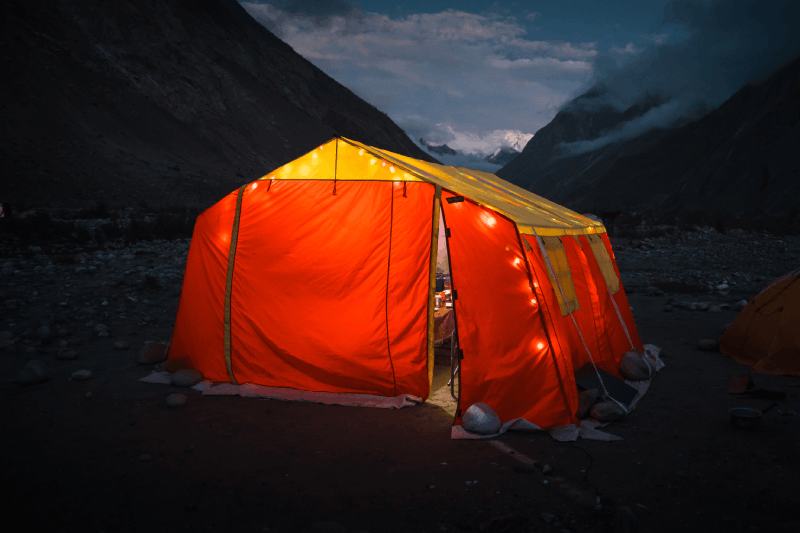
Many 3-season tents are produced in green, gray, or brown tones to blend in with nature. While this is an advantage in summer, in winter, these colors can completely disappear in the midst of a white blanket. If you stray just a few meters from the tent during a severe blizzard, you may have difficulty finding your way back. Additionally, it becomes impossible for search and rescue teams to spot you from the air in an emergency. Once you understand why 4-season tents are usually bright orange or yellow, you also realize how important the color of your survival strategy is.
Can I Set Up the Tent If the Poles' Elastic Cords Freeze from the Cold?
The shock cords running through the tent poles can lose their elasticity or freeze completely in extreme cold. The standard cords used in 3-season tents are generally not tested for temperatures below -10 degrees. If you notice that the cord inside does not stretch or has broken while trying to set up the poles when you arrive at the campsite, it will make it impossible to raise the tent. Being forced to spend the night in the open air, just inside a sleeping bag, can be one of the most painful experiences of winter camping.
Does the UV Resistance of the Outer Tarp Break Down Quickly in High Reflection on Snowy Days?
Snow reflects 80% of sunlight, which doubles the amount of UV exposure that the outer tarp of a 3-season tent is subjected to. The fabrics of 3-season tents are generally thinner, making them more susceptible to UV degradation over prolonged winter use. The fabric becoming brittle can lead to tearing like paper in even the slightest breeze or when snow accumulates on it. If you are planning a long winter expedition, you should be aware that the lifespan of your tent's fabric will quickly diminish due to this reflection, and this is a hidden cost (early equipment replacement).
Is the Fabric Weight of the Inner Tent Enough to Retain Heat Inside?
The inner layer of 3-season tents is usually made of very thin nylon or mesh. This material does not provide insulation; it only protects against insects and regulates airflow. In winter, what you need is for the warm air heated by your body to be trapped inside the tent. In a 3-season tent, the warm air inside escapes immediately, and the freezing air outside enters. This is like a thermal leak; no matter how good a mat you use, that cold airflow passing over your head will ruin your sleep. Your comfort level will be nearly equal to the outside air temperature.
Is the Setup Speed of the Tent Vital in Freezing Cold?
When you arrive at the campsite on a stormy winter day, your hands will start to go numb within minutes. Some 3-season tents have complex pole structures and small clips. These small parts, which are difficult to handle with gloves, extend the setup time. Every passing second means your hands are freezing more and your body temperature is dropping. If your tent does not have a "fast pitch" feature and is not designed to be set up with gloves, that 10-minute setup process can turn into torture. Logistically, the simplest and quickest setup structures always save lives in winter.
Does the Warranty of a 3-Season Tent Torn in the Sixth Month Get Voided for Winter Use?
Most tent manufacturers cover their products under warranty based on "fitness for purpose." If a tent labeled as a 3-season has its pole broken or fabric torn under heavy winter snow, the brand may classify this as "user error" or "usage beyond limits." In this case, your several thousand lira tent could become trash, and the repair costs would be entirely on you. As a hidden cost, using a 3-season tent in winter could mean you are effectively voiding the insurance on your equipment.
Does Using a Candle or Heater Inside the Tent Lead to Carbon Monoxide Poisoning?
A camper overwhelmed by the cold may be tempted to light a small candle lantern or gas heater inside the tent. However, in winter, when you cover the outer tarp with snow and minimize ventilation, the oxygen inside the tent quickly depletes. 3-season tents can turn into "air-tight" boxes when covered with snow in winter conditions. The silent killer carbon monoxide can enter your bloodstream without any odor and cause you to lose your life in your sleep. This is one of the biggest health risks of winter camping, and the uncontrolled ventilation structure of 3-season tents complicates this risk even further.
Does Leaving Shoes Inside the Tent Cause a Logistical Nightmare?
If you are staying in a 3-season tent, leaving your boots in the vestibule can cause them to turn into blocks of ice by morning. However, bringing the boots inside the tent also brings in snow and mud. Sleeping with wet boots in a narrow 3-season tent not only reduces space but also leads to hygiene issues. Trying to put on a frozen boot in the morning is not only painful but can also lead to frostbite in your toes. Not having enough space to keep your boots inside your sleeping bag is a practical challenge created by the choice of a 3-season tent.
Does Static Electricity on the Tent Floor Damage My Electronic Devices?
In dry winter air, serious static electricity can build up between synthetic tent floors and mats due to friction. The thin fabrics of 3-season tents may be insufficient to dissipate this charge. The static discharges that occur while moving inside the tent can damage your sensitive electronic devices (phone, GPS, headlamp) or at least cause the batteries to drain much faster. Considering that batteries are already inefficient due to the cold in winter, this static charge buildup can present a logistical problem and leave you without navigation when you need it most.
Will I Panic If the Sleeping Bag's Zipper Gets Stuck in the Tent Fabric?
In the cramped space of a winter 3-season tent, moving with a thick and bulky sleeping bag is quite difficult. The walls of the tent can lose tension due to the cold and moisture, causing them to sag inward. When you urgently need to get out of the bag in the middle of the night, the zipper of the bag can get caught in the sagging tent fabric or mesh panels. Trying to free this zipper in freezing cold, darkness, and limited space can lead to serious panic attacks. While this may seem like a simple comfort issue, it is a serious safety risk that restricts your mobility in emergencies.
Do the Tent Pole Connection Points (Hubs) Freeze in the Cold?
Some modern 3-season tents have plastic or lightweight alloy hubs that connect the poles together. These points carry the entire tension of the tent. In extreme cold, these materials can become brittle. If one of these hubs breaks while setting up the tent or under wind load, the entire structure of the tent collapses. While 4-season tents usually avoid such "single point of failure" designs, 3-season tents take this risk for the sake of lightness. This risk of collapse can turn your winter camping into a search for shelter.
Does the Water Repellency (DWR) Feature of the Outer Tarp Wear Off in a Day of Winter?
The snow that falls in winter stays on the tent for a long time and melts slightly with your body heat before refreezing. This constant cycle of wetting and freezing quickly wears off the water-repellent coating (DWR) on the outer surface of 3-season tents. Once the fabric starts to "hold water," the weight of the tent doubles and becomes impossible to dry. A heavy tent fabric increases the load on the poles and completely cuts off ventilation. This technical deformation can cause your tent to lose its performance in just a week of winter.
Does Using a Rock Instead of Tent Stakes Lead to Fabric Cuts?
In situations where stakes do not hold in the ground, tying the tent's tension lines to heavy rocks may seem like a logical solution. However, on a windy night, these rocks can rub against the fabric as the tent moves. The low-denier (thin) fabrics of 3-season tents are not resistant to such abrasive contacts. A sharp edge of a rock can tear your outer tarp in seconds. In winter, such "makeshift" solutions can lead to larger damages and safety gaps as you push the limits of your equipment.
Is It Possible to Dry Towels and Wet Clothes Inside the Tent?
Trying to dry a wet sock or towel inside a 3-season tent during winter camping is a complete fantasy. Due to the low temperatures and high humidity inside, these items become even more damp instead of drying, increasing the overall humidity inside the tent. This situation not only creates a hygienic discomfort but also means more icing on the inner surface of the tent. Having to sleep with wet clothes or stuff them inside your sleeping bag is a logistical error that undermines your efforts to keep your body heat and is exacerbated by the insufficient volume of a 3-season tent.
Can Small Items Lost Inside the Tent Be Found Again in the Snow?
The inner pockets of 3-season tents are usually minimalist and insufficient to carry heavy winter gear (spare batteries, large headlamps, thick gloves). If these small items scattered inside the tent somehow fall out of the door into the snow, your chances of finding them are nearly zero. A gray battery cap or a transparent medicine box that falls in white snow means a logistical loss. Equipment management requires much more diligence in winter, and the organizational shortcomings of 3-season tents facilitate this loss.
Can I Remove the Poles If the Pole Sleeves Freeze?
In 3-season tents set up by passing poles through sleeves in the fabric, water can freeze inside these sleeves in winter. When you want to pack up the camp in the morning, the poles may be stuck in the fabric. Forcing the poles out can tear the fabric, and trying to heat them can cause the nylon to melt. If you cannot remove the poles, you cannot fold the tent and put it in your bag. This leads to a tragicomic but real logistical challenge of being stuck with a tent that is set up and has frozen poles at the top of a mountain.
Do the "Cold Spots" on the Tent Floor Threaten My Kidney Health?
If your mat does not completely cover the tent floor, the thin floor fabric of a 3-season tent creates "cold spots" that come into direct contact with the snow. When an arm or leg hanging out of your sleeping bag touches this cold spot, heat loss accelerates locally. Prolonged exposure to this cold can lead to freezing your kidneys or joints. The health risks in winter are not only related to general cold but also to such local contacts, and the inadequate floor insulation of 3-season tents always keeps this risk alive.
Can a Single Zipper on the Tent Door Prevent Snow Entry?
Some 3-season tents have doors with simple zippers that only open in one direction. In winter, you may want to slightly open the door from the top to check outside or provide ventilation. As soon as you open a single-zippered door, it completely drops down, and all the snow on the ground enters. While double zippers found in 4-season tents solve this logistical detail, any attempt to look outside in a 3-season tent means inviting snow inside. This not only disrupts comfort but also increases the humidity inside.
Does the Light Permeability of the Tent Trigger Winter Depression?
Winter days are short, and the weather is often overcast. The dark fabrics of 3-season tents can make the inside pitch black even in the middle of the day. When you are trapped inside the tent for long hours due to a storm, this darkness and confined space can trigger claustrophobia or low morale. Psychological resilience is part of winter camping. While the bright inner colors of 4-season tents are designed to keep morale high, spending a winter day in a 3-season tent can be much more exhausting mentally.
Is the Packing Volume of the Tent a Problem in a Winter Backpack?
In winter camping, your sleeping bag, mat, and clothes are already massive. Although 3-season tents are generally compact, the extra pole repair kit, snow stakes, and footprint you need to bring in winter increase the volume. If your tent does not fit neatly into your winter backpack (85L+) or hangs outside, it can throw off your balance while climbing or get caught on branches and tear. Logistically, the compatibility of the tent with the backpack is a factor that directly affects your mobility on winter routes.
Do I Have a Plan If I Need to Leave the Tent in a Severe Storm at Night?
The most important practical need when pushing the limits of a 3-season tent is a "Plan B." If the poles break or the outer tarp tears at night, can you gather all your gear and reach a shelter or your vehicle within seconds? Camping with a 3-season tent in winter always requires an "evacuation plan." Relying on these tents while heading into the heart of the cold without a way back can be logistical suicide. Safety comes not just from the strength of the equipment but from anticipating when it will fail.
Is It Economically Logical to Use a 3-Season Tent Throughout Winter?
Finally, you should conduct a cost analysis. Using a 3-season tent in winter conditions can accelerate its lifespan by 3-4 times. The repair costs for frequently torn fabrics, broken poles, and damaged zippers can eventually exceed the price of a quality 4-season tent. As a content strategist, my recommendation is that if winter camping is not a one-time adventure, investing in the right equipment instead of taking risks with a 3-season tent is more profitable and much safer in the long run.