Why Should You Stay Away from City Lights for Milky Way Photography and Star Exposure?
City lights create a massive glare that overwhelms the faint starlight in the sky, referred to as "light pollution" in the modern world. For a photographer wanting to do star exposure, this glare is an obstacle that interferes with the photons the sensor is trying to capture. The yellow and white lights of the city reflect off dust and moisture molecules in the atmosphere, causing the sky to appear orange or gray instead of black. A truly dark background is essential for capturing the Milky Way; only then can the deep contrast between stars and the colors of nebulas emerge. Therefore, professional astrophotographers aim to choose a shooting location at least 50-100 kilometers away from civilization.
How is the Bortle Scale Used to Determine Star Exposure Quality?
The Bortle Scale is a scientific standard that rates the darkness of a region's night sky from 1 (the darkest) to 9 (the brightest). For campers wanting to do star exposure, areas rated Bortle 1 and Bortle 2 are considered the "holy grail." At these levels, the Milky Way is so bright that it can cast shadows on the ground, and the horizon line is completely black. In areas above Bortle 4, light pollution begins to swallow details. Checking the Bortle rating of your camping area in advance through light pollution maps directly determines the quality of the photograph you will take and how much difficulty you will face in the editing phase. For the best results, always prefer the least polluted, dark plateaus or valleys.
Is Melikler Plateau the Darkest Sky Point in Turkey?
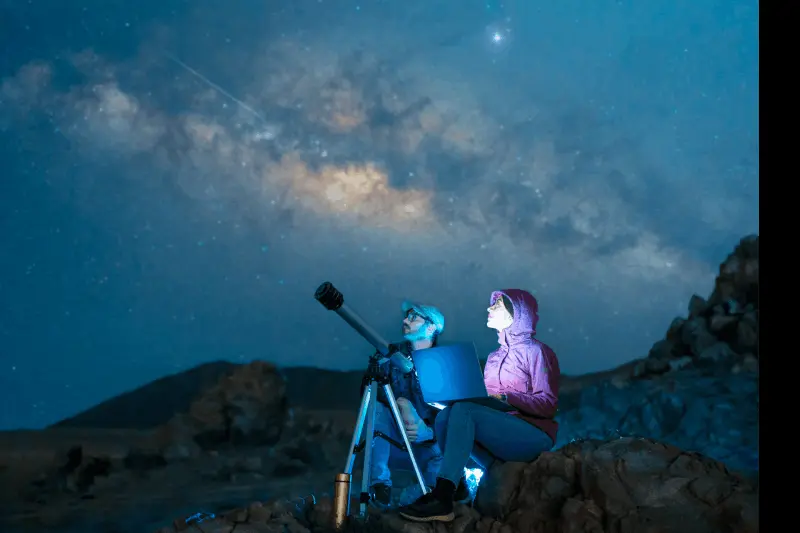
Located in the Yenişarbademli district of Isparta, Melikler Plateau is the first and most important route that comes to mind when talking about astrophotography in Turkey. According to measurements made, it has been certified as one of the darkest areas in Turkey and hosts international sky observation events every year. The plateau, located at approximately 1700 meters above sea level, is completely protected from the light spill of surrounding districts thanks to the steep mountains around it. While camping here, you can see the magnificent structure of the Milky Way in its arc shape with all its details when you look up. Melikler Plateau is an indispensable natural studio for star exposure enthusiasts due to its accessibility and the incredible darkness it offers.
How Suitable are the Peaks of the Taurus Mountains for Milky Way Photography?
The Taurus Mountain range offers unparalleled opportunities for photographers seeking to escape the humid air of the Mediterranean and reach a high-altitude dry atmosphere. Especially the high plateaus of Antalya and Mersin are among the points where atmospheric distortion is minimal due to their elevation thousands of meters above sea level. This high altitude allows stars to appear clearer and sharper. Camping in the unpolluted parts of the Taurus not only provides darkness but also presents sharp rocky formations and ancient cedar trees that will add aesthetics to your photographs. However, it should be noted that the night temperatures can drop suddenly here, and wildlife is active, so a well-prepared camping plan should be made.
Is There Light Pollution in the Depths of Yenice Forests?
Located within the borders of Karabük province, Yenice Forests are considered one of the most pristine natural areas in Turkey. When you dive into the depths of this vast forest ecosystem, you are completely isolated from the lights of settlements thanks to the dense tree cover and rugged terrain. While camping in Yenice, it is possible to capture stars filtered through the massive beech and fir trees that envelop the sky like a dome. In this valley, where light pollution is almost negligible, the ground color of the sky remains deep black even during long exposure times. This ensures that colors appear much more natural and vibrant in the post-production phase.
Why Should the Eastern Anatolian Plateaus be Preferred for Winter Star Exposure?
The high-altitude plateaus and plateaus of Eastern Anatolia achieve incredible transparency with the freezing of moisture during the winter months. Cold weather minimizes the water vapor in the atmosphere, ensuring that the sky is "crystal clear." The high plateaus between Erzurum, Erzincan, and Kars create a pure white ground that reflects the faint light from the stars when covered with snow during winter. This situation is unique for astrophotographers who want to capture the texture of snow in the foreground and the star rain in the sky in the same frame. Despite the challenging winter conditions, the clarity of the sky in these regions is far superior to many points in western Turkey.
How Do Stars Look in the Unpolluted Bays of Gökçeada and Bozcaada?
These islands in the middle of the Aegean Sea are incredibly dark spots as they are isolated from the lights of major cities on the mainland by sea. Especially areas like the Hidden Harbor or Star Bay at the western tip of Gökçeada, where there are no settlements, offer a vast dark area where the sea meets the horizon line. In star exposures taken on the islands, capturing the reflections of stars on the still waters of the sea during calm nights creates wonderful compositions. However, the wind factor on the islands is very strong; therefore, using a heavy and sturdy tripod is critical for obtaining sharp images. Cleaning after shooting should not be neglected to prevent sea salt from damaging the equipment.
Is Atacama Desert the Best Star Exposure Point in the World?
The Atacama Desert in Chile is considered one of the driest places on earth and is referred to as the "sky on earth" due to its high altitude. It is no coincidence that some of the world's largest telescopes are set up here; because the year-round
More than 300 days of the year, the sky is completely cloudless. Camping in Atacama is the ultimate experience a photographer can have in their lifetime. The Milky Way photographs taken here are so sharp and detailed that they cannot be seen anywhere else, thanks to the thinness and clarity of the atmosphere. Capturing the different star formations of the southern hemisphere sky and the Magellanic Clouds puts this journey on every astrophotographer's bucket list before they die.Why is the Sky So Clear in Namibia's Namib Desert?
Namibia has one of the lowest population densities in the world, which means artificial light pollution is almost nonexistent. The Sossusvlei area within the Namib Desert is famous for its gigantic red sand dunes, and at night, it transforms into a complete star paradise. A camp set up on top of the dunes offers you an unobstructed horizon line of 360 degrees. The extremely dry air prevents dust and humidity from interfering with the starlight. Namibia's internationally recognized "Dark Sky Reserve" parks provide an enchanting atmosphere not only for professionals but also for every camper who wants to sleep under the stars. The sky here is so crowded that sometimes you may even have difficulty selecting the constellations you know.
What Are the Challenges of Camping Under Iceland's Northern Lights?
Iceland is the most popular destination in the world for capturing not only star exposures but also the dance of the Aurora Borealis (Northern Lights). However, camping in Iceland is a significant challenge due to constantly changing weather conditions and strong winds. While the long nights in winter increase the exposure time, freezing temperatures can cause camera batteries to drain very quickly. To photograph the Northern Lights along with the stars, you need to choose a location where the sky is dark and track solar activities. Iceland's volcanic black beaches add dramatic depth to star photographs as a foreground element.
How to Capture Star Images Resembling Mars Atmosphere in Wadi Rum Desert?
Wadi Rum in Jordan, known for its red sands and massive sandstone mountains, is also referred to as the "Valley of the Moon." Camping here gives you the feeling of being on another planet. In the desert's isolation, photographs taken without any artificial light source allow the star density in the sky to gently fall on the red rocks, providing natural illumination. When doing star exposures in Wadi Rum, using the massive rock arches or Bedouin tents as a foreground helps you create powerful images with a story. The silence and darkness of the desert prepare a perfect scene for you to capture the core region of the Milky Way in all its glory.
What Are the Best Camera Settings for Astrophotography?
Star exposure is a technical discipline, and the basic settings must be done correctly. Lenses with the widest aperture (f/2.8 or lower) are generally preferred. The ISO value should be kept between 1600 and 6400, depending on your camera's sensor performance; however, it should be noted that very high ISO can lead to "noise". The most critical setting is the "500 Rule"; this rule helps you calculate the maximum exposure time needed to prevent stars from appearing as streaks due to movement. For example, with a 20mm lens, an ideal exposure would be 500/20=25 seconds. Focusing should be done manually and adjusted precisely to the "infinity" point.
Why Are Wide-Angle Lenses Important in Star Exposure?
To capture the vastness of the sky and the curve of the Milky Way in a single frame, wide-angle lenses between 14mm and 24mm are typically used. A wide aperture not only captures the sky but also allows you to include your camping tent, a tree, or a mountain peak as a foreground. A star photograph without a foreground element often lacks depth perception and creates a feeling of "emptiness" in the viewer. Additionally, wide-angle lenses allow for longer exposures according to the 500 rule, letting more light enter the sensor. This results in brighter and more detailed star images.
Is It Necessary to Use Star Tracker Devices?
If you want to capture very professional, deep-sky objects (nebulae, galaxies) or very low-grain images, you need to use a star tracker device. These devices synchronize your camera with the stars by rotating in the opposite direction of the Earth's rotation speed. This allows you to expose for much longer periods, such as 3-5 minutes instead of 30 seconds, while keeping the stars as points. When using a tracker, the ISO value can be reduced, which significantly increases the dynamic range and sharpness of the photograph. However, setting up these devices requires precise alignment with a polar star, so it requires patience and practice.
How to Use Light Pollution Maps in Choosing a Campsite?
Interactive maps like "Light Pollution Map" or "Dark Site Finder" on the internet are the biggest helpers for star enthusiasts. These maps use satellite data to show the light intensity in every part of the world with color codes. Black and dark blue areas are the most ideal places for shooting, while red and white areas should be avoided. Finding a "dark island" on these maps before determining your camping route prevents you from going on a wild goose chase. Additionally, by examining the terrain and transportation routes on these maps, you can identify a location that is both safe and rich in photographic opportunities.
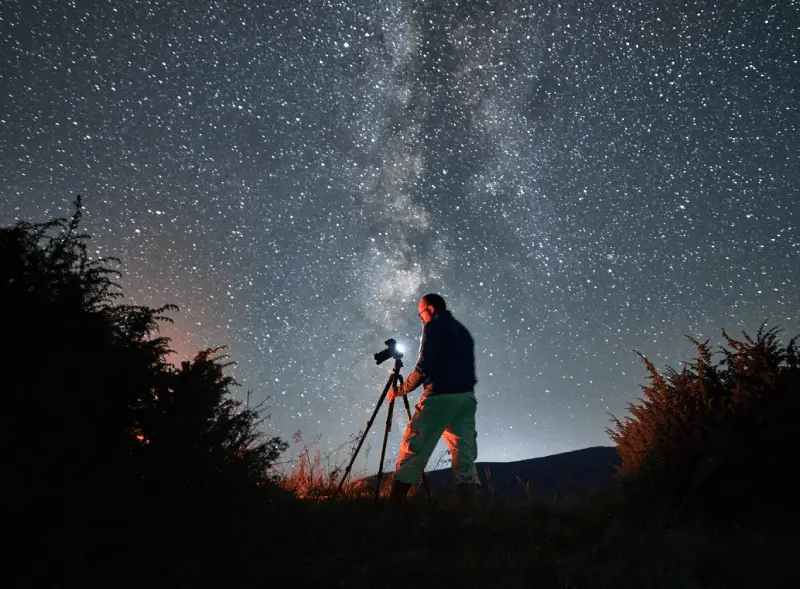
New Moon Phase Star P
Why Is It The Best Time For Long Exposure?
The moon is the brightest natural light source in the sky and can completely obscure the Milky Way during the full moon phase. The moonlight illuminates the atmosphere so much that it feels like you are shooting during the day, causing stars to disappear. Therefore, for a successful star exposure session, you should choose the "New Moon" phase, meaning the days when the moon is either not visible in the sky or is just a very small crescent. If the moon is in the sky, you need to wait for sunset or finish your shoot before the moon rises. In some cases, a crescent of 10-15% can be advantageous for slightly illuminating the foreground, but the general rule is always "the darker it is, the more stars you see."
How To Prevent Camera Shake During Long Exposure?
In star exposure, the camera must not move even a millimeter for durations of 20-30 seconds. The slightest vibration can ruin the clarity of the stars. To prevent this, you should use a very sturdy tripod that does not shake in the wind. Even pressing the shutter button with your hand can create shake, so a remote control (intervelometer) or the camera's 2-10 second timer should be used. If you are in a windy area, hanging your bag from the tripod to lower the center of gravity will increase stability. Additionally, the "Image Stabilization" (IS or VR) feature on the lens should be turned off while on the tripod; because this system can sometimes create vibrations on its own.
What Are "Dark Frame" And "Flat Frame" In Astrophotography?
Those who process photographs at a professional level do not just settle for capturing the sky during shooting. A "Dark Frame" is a shot taken with the same settings and with the lens cap on; this frame is used to determine the thermal noise in the sensor. A "Flat Frame" is taken to detect vignetting and dust spots on the sensor. When these auxiliary frames are combined with the original photograph in a computer environment (stacking), the resulting image is much cleaner, purer, and flawless. This process, which requires patience, is the element that creates the difference between an ordinary photograph and a work of art that can be exhibited.
Why Is Using Red Light Important In Night Shoots?
The human eye needs about 20-30 minutes to adapt to the dark. If you look at a bright white light or a phone screen during shooting, your pupils immediately constrict, and you lose the ability to see the faint details in the sky. However, red light does not disturb the night vision of the eye. Therefore, it is essential to use a red light headlamp while setting up your camera and in the campsite. Avoiding the use of white light for the comfort of both you and other photographers nearby is one of the fundamental rules of astrophotography ethics.
How Should Camping Equipment Be Selected For Star Exposure?
Not only camera equipment but also a comfortable camping experience is key to a successful shoot. Regardless of the season, wearing layered and thermal clothing is vital for staying outside all night; because staying still quickly lowers body temperature. A comfortable camping chair, a warm thermos of tea or coffee, and energy-boosting snacks keep your motivation high. Additionally, since you will be camping in remote areas, you should also have safety equipment like power banks, maps, and a first aid kit with you. A well-rested and alert photographer can capture much more creative frames.
Is It Possible To Do Star Exposure With A Phone?
Thanks to advancing technology, new generation smartphones can perform basic level star exposure with "Night Mode" or "Pro Mode" options. By increasing the ISO in manual settings and setting the exposure time to 30 seconds, and placing the phone on a stable surface (or tripod), it is possible to capture the outlines of the Milky Way. Of course, they do not provide as much detail as a professional DSLR or mirrorless camera, but they can produce quite impressive results for social media sharing. Choosing RAW format while shooting on the phone gives you more flexibility when adjusting colors and contrast later.
What Software Is Used To Edit Sky Photos?
Star photos often appear dull and raw in their unedited forms. Adobe Lightroom and Photoshop are the most commonly used tools to reveal the true potential of these photos. Especially the "Dehaze" and "Clarity" settings make the stars more distinct. Additionally, special software like "Sequator" (Windows) or "Starry Landscape Stacker" (Mac) is used to reduce noise by stacking multiple frames on top of each other. During the editing phase, correctly adjusting the color balance (usually around 3500-4000 Kelvin) is very important to preserve the natural depth and cosmic colors of the sky.
What Are The Tips For Camping During Meteor Showers?
Meteor showers like Perseid or Geminid are natural events that add excitement to star exposure. When camping during these periods, orienting your camera towards the center where the meteors radiate (the radiant point) increases your chances. Taking hundreds of frames in continuous shooting mode using an intervelometer ensures that you capture at least a few frames with a bright meteor. Since meteors are momentary events, high ISO and shorter exposures can sometimes yield better results. You should avoid lighting a campfire during meteor showers; because the light from the fire tires your eyes and negatively affects your camera's sensor.
What Are the Advantages and Disadvantages of Star Photography at High Altitude?
High altitude means that the atmosphere is thinner and contains fewer air molecules. This results in less distortion of starlight and clearer photographs. However, at high elevations, the oxygen level is lower, which can lead to quicker fatigue or headaches. Additionally, weather conditions at high altitudes can change much more rapidly, and storms can be more severe. When camping in these areas, you should ensure that your equipment is extra protected against the wind and allow yourself time to acclimatize to the altitude. The advantage is that you may have the chance to see a clear sky even when the lower atmosphere is cloudy.
How to Capture Star Trails Photographs?
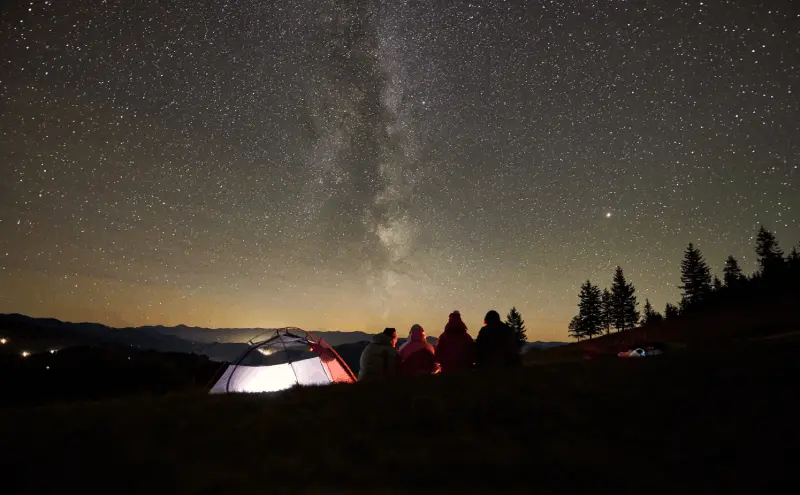
Star trail photographs, which visualize the rotation of the Earth, are the result of hours of patience. There are two methods: You can either expose a single frame for 30-60 minutes (which can cause overheating and noise in digital sensors) or take hundreds of 30-second photographs and combine them with software. The second method is much safer. If you center on the North Star (Polaris) in these photographs, you will see that the stars trace a complete circle. Leaving a soft light inside your tent creates a fairy-tale atmosphere by giving a glowing feeling to the photograph.
How to Prevent the Effect of Humidity and Dew on the Lens?
When the night temperature drops, humidity in the atmosphere can condense on the lens glass, creating