Does a Lumbar Support Chair Really Reduce the Risk of Back Pain?
The most neglected topic in camping life is body ergonomics. Many users do not realize the load on their spine when they sit "buried" in standard fabric chairs. Professional camping chairs with lumbar support aim to maintain the natural "S" curve of the spine. If you have a history of back pain or feel discomfort in your lower back after sitting for a long time, this support is crucial. However, not every product labeled as "lumbar support" offers the same performance. Real support should have an adjustable mechanism that fills the lumbar gap or a firm curved structure. Otherwise, supports that consist only of a soft cushion can increase muscle fatigue in the long run, chronicling your pain.
Do Connection Points Crack When a User Over 100 Kilos Sits?
Weight capacity is one of the most manipulated technical details when purchasing a camping chair. A chair labeled as "120 kg capacity" does not always mean it will remain comfortable and safe at that weight. Models with plastic connection points tend to flex under high weight and over time, these points show signs of "fatigue" and crack. If you weigh 100 kilos or more, you should focus on models with reinforced steel connection points and aviation-grade aluminum frames. Cracking sounds are the first sign that the frame is approaching its load limit. This not only compromises your comfort but also poses serious injury risks due to the chair suddenly collapsing.

How to Avoid Models That Cause Numbness in the Legs After Long Sitting?
The front edge of many camping chairs ends with a hard pipe. During prolonged sitting, this hard edge cuts off blood flow under your thigh bone, causing a "tingling" or "numbness" sensation. This is referred to in literature as a pressure similar to "sciatic paralysis." When choosing a comfortable camp chair, you should ensure that the front part of the seating area has a "waterfall edge" design, which is sloped downwards and extra padded. If the fabric is too tight and presses on the lower part of your legs, you may feel weakness in your legs after standing up 30 minutes later. This is a critical comfort parameter, especially for those who will spend hours by the campfire.
Do Chair Legs Sinking into Wet and Muddy Ground Create a Risk of Tipping Over?
Camping areas are not always flat and concrete. Standard chairs with thin legs lose balance when one side sinks more into soft soil or sand. Losing balance on a chair with lumbar support can lead to your back being suddenly bent at an incorrect angle. You should prefer models with wide bases known as "duckfoot" or mud plates. These features help distribute weight across the surface, preventing the chair from sinking into the ground. If the legs of the chair you choose are very thin, trying to solve this problem with small wooden pieces you will carry next to you will become a logistical burden; therefore, it is most logical to turn to brands that have solved this issue in the design phase.
Does Fabric Cause Sweating and Create Rashes on the Back?
When camping in the summer, durable but non-breathable materials like 600D Oxford fabric can create a greenhouse effect on your back. If the chair fits your waist perfectly, airflow in that area is completely cut off. The result is a sweaty shirt and rashes the next day. An ideal long-term seating chair should have a "mesh" structure in the middle panel or lumbar area. This mesh allows for structural durability while ensuring that body heat is expelled. Additionally, having antibacterial properties in the fabric prevents sweat odor from permeating the chair. "Comfort" is not just about softness, but also about balancing body heat.
Is the Carrying Bag Thin Enough to Tear After Two Uses?
The chair may be great, but as long as you can't carry it, it's no different from a burden. Many manufacturers make carrying bags from paper-thin fabrics to reduce costs. The metal legs of the chair can create holes in the bottom of the bag in a short time. As a strategy, you should check the stitching quality and fabric thickness (denier value) of the bag before purchasing the chair. Having a padded shoulder strap and designing the bag to be slightly wider than the chair eliminates the "squeezing" stress experienced during packing. Remember, a torn carrying bag can cause damage to your chair's other belongings in the trunk or lead to the mechanism breaking when dropped while carrying.
Do Adjustable Armrests Really Reduce Arm Fatigue?
Armrests are often seen as mere accessories, but an armrest that is not at the correct height can cause your shoulder muscles (trapezius) to remain tense continuously. If your arms are too low, you will lean forward, and the lumbar support will lose its meaning; if they are too high, your shoulders will come close to your ears, leading to neck pain. The best camping chairs are those where the armrest height can be adjusted according to the fabric tension. Additionally, having soft-textured pads instead of hard plastic on the armrests prevents stiffness and pain that may occur in your elbows. If you will be reading a book or drinking something for a long time, the armrest design is as critical as the back support.
Does Salty Sea Air Cause Rust on Metal Parts in One Season?
If your camping route is usually along the coast, the enemy of your chair is corrosion. Cheap steel tubes begin to rust at the joints when combined with the humid and salty air from the sea. This rust is not just an aesthetic issue; it locks the chair's folding mechanism and can lead to breakage by compromising the metal's resistance. For beach camping, anodized aluminum frames or models painted with powder coating should be preferred. Wiping the metal parts with a cloth moistened with fresh water after each camping trip extends their lifespan, but if there is no quality coating, rust is an inevitable end and means your money is going to waste.
Can It Be Set Up Alone in Less Than 30 Seconds?
After a tiring journey, the last thing you want to deal with is a complicated puzzle when you arrive at the campsite. Some lumbar-supported models can become very complicated to set up due to extra support rods. "Accordion" type mechanisms that open in one motion are the standard. If you need to connect 3-4 different parts to set up the chair, this process can turn into torture in the dark or under the rain. You should watch the setup video before purchasing or try it in the store. The smooth operation of the mechanism is also an indicator of production quality; a chair that opens by being attached is a sign of poor quality metal caps or workmanship inside.
Is the Cup Holder Wide Enough to Hold a Standard Thermos?
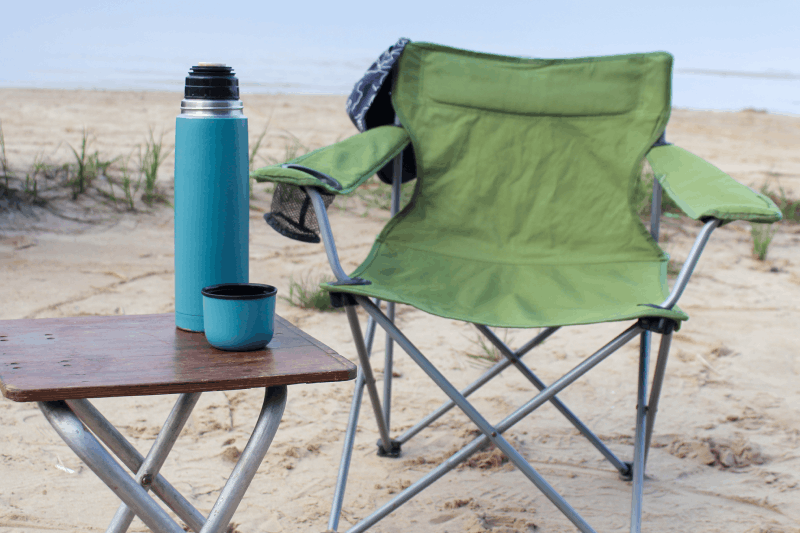
This may seem like a small detail, but a cup holder that cannot hold a standard 500 ml steel thermos significantly undermines your camping comfort. Many cheap models have cup holders designed only for paper cups. When you lean back against your lumbar support, having to place the thermos on the ground every time causes you to lean forward and strain your back. In an ideal chair, the inner diameter of the cup holder should be wide and supported by a strong stitch so that the base does not sag under the weight of the thermos. Insulated (cooler) pockets found in some models provide a significant advantage in keeping your drink warm during long sitting sessions.
Does Head and Neck Support Allow for Napping?
Sitting for long periods sometimes involves napping as well. Even if the lumbar support is excellent, if you cannot find a place to rest your head, your neck muscles will fight against gravity. High-backed chairs usually come with a headrest. But can the height of this pillow be adjusted according to your height? If the pillow aligns with the back of your head instead of your neck curve, it will push your head forward and disrupt your posture. Removable or adjustable pillows with Velcro offer personalized comfort for users of all heights. Designs with side wings that prevent your head from falling sideways while napping are a feature you should look for in the luxury segment.
Is There an Insulating Fabric Option That Prevents Cold from Coming Up in Winter Camping?
Most chairs with lumbar support are designed with a summer focus. However, the cold air coming from the ground in winter can penetrate from underneath and behind the chair, chilling your kidneys and lower back. Cold weather can cause muscle contractions and trigger your back pain. If you camp in all four seasons, you should choose models with double layers and filled with fiber or foam in between. This filling not only provides softness but also offers excellent thermal insulation. Alternatively, you should ask if there is a winter cover suitable for your chair. In a chair without thermal insulation, even the best lumbar support in the world cannot keep your body comfortable due to the cold.
Do Side Pockets Sag with the Weight of Phones and Books, Disturbing Balance?
The pockets on the side of the camping chair protect your valuable items from dirt and moisture. However, these pockets are sometimes sewn so weakly that when you put a heavy phone or power bank inside, the fabric stretches downwards, adding extra weight to one side of the chair and causing the fabric to sag. This sagging can disrupt the tension in the seating area, leading to asymmetry in the lumbar support. The pockets should be supported by connection points to the main frame and made of thick canvas fabric instead of mesh. Additionally, having a zippered pocket is an important safety detail that prevents your phone from falling out when you accidentally fall asleep in the chair.
Is It Stable Enough Not to Tip Over When Children or Pets Jump on It?
Static balance is not only about the person sitting on the chair but also about resisting external impacts. The back of lumbar-supported chairs is generally higher and heavier, which raises the center of gravity. If the base width is not wide enough, the chair can easily tip over with an external intervention. For families with children or those camping with dogs, an "anti-tip" leg design is essential. Having the chair's legs spread out at a flared angle increases stability. Safety should always come before comfort; because a tipped-over chair invites back injuries.
Does the Chemical Smell of the Fabric Cause Discomfort When Stored in an Enclosed Area?
Many newly purchased camping gear has a sharp plastic or paint smell. This odor is the release of chemicals known as "VOCs" (volatile organic compounds). When you keep your chair at home, close to the bedroom or inside the car, this smell can lead to headaches. Additionally, there is a risk of allergic reactions from these fabrics that come into contact with the skin. Quality brands use fabrics with certifications like OEKO-TEX. If you smell a strong petroleum odor when you take the chair out of the box, you should air it out for a few days in the open air. If you have sensitive skin or respiratory issues, the quality of the fabric should be your primary concern for health.
Do Hard Plastic Connection Points Flex and Stretch Under the Sun?
Plastic parts can degrade and "become brittle" when exposed to the sun's UV rays for long periods. A chair that has been under the sun for a season may suddenly break when you sit on it the next season. Brands that use "UV stabilized" plastic components minimize this risk. If the joints of your chair look very shiny and thin, it is likely that low-quality plastic has been used. Matte, textured, and thick plastic parts are generally more durable. Do not underestimate the sun's damaging effects; when that small plastic piece holding the lumbar support breaks, the chair becomes completely unusable.
Does the Warranty Coverage Reject Fabric Tears as User Error?
Camping chairs are prone to misuse; however, a seam coming undone or fabric tearing at the connection point is often a manufacturing defect. You should review the brand's "warranty policy" before purchasing. Brands that offer a "lifetime frame warranty" generally have high confidence in their products. However, fabric tearing is usually seen as user error. Some premium brands offer "no-questions-asked replacement" within a certain period. Investing large sums in a product without after-sales support is akin to gambling. For products with mechanical parts like lumbar support, you should also inquire whether these parts can be obtained as spares.
Do These Large Chairs Fit in Cars with Small Trunks?
Chairs with lumbar support and comfort are generally "bulky" products. Even when folded, they can reach a length of 120 cm and a diameter of 25 cm. If you have a hatchback or a small city car, it may be impossible to fit these chairs in the trunk, and they will take up space in the back seat. Logistically, you should compare the folded dimensions of the chair with the narrowest part of your trunk. Some advanced models have "ultra-compact" designs where both the frame and fabric can be separated or folded in half. Having a comfortable chair is great, but if you can't take it to the campsite, it has no value.
Is the Seat Height Suitable for Those with Knee Problems?
Very low chairs (low-riders) are great on sand or the beach, but for those with knee issues, getting up can be a real torture. The seat height of a chair with lumbar support should be at least 45-50 cm above the ground. This height allows you to keep your knees at a 90-degree angle and makes it easier to use your leg muscles for support when getting up. If the chair is too deep and leans too far back, you may have to ask someone for help to get up. For elderly users or those suffering from joint pain, models with "high seating" and armrests that provide enough support are a strategic choice.
Do Footrests Require Constant Cleaning When Used on Sand?
Sand is the silent killer of camping gear. Sand grains that get into the folding mechanisms of the chair can cause metal to grind against each other, leading to wear and the mechanism seizing up. If you have rail systems that adjust the lumbar support, sand getting in can disrupt the system. It is important for footrests to be enclosed and to have a "plug" system that prevents sand from entering the tubes. Additionally, cleaning the joints with a brush before closing the chair at the end of the camping trip can extend the life of your chair for years. There is no maintenance-free material, but there are poorly designed ones that make maintenance difficult.
Does the Fabric Sag Over Time, Leaving the Lumbar Support Ineffective?
The quality of the fabric (in denier) determines its stretchability. Low-quality polyester fabrics stretch under your body weight after a few camping trips, and the chair begins to "hammock." In this case, the lumbar support moves away from your body and no longer supports your lower back. Fabrics with "ripstop" (tear-resistant) weave and high denier (at least 600D) retain their shape for a long time. Having extra support columns (webbing) underneath the chair is a professional solution that prevents the fabric from sagging. If the fabric stretches immediately when you sit on it, that chair will only provide comfort for the first few sessions.
Does the Thickness of the Frame's Pipe Provide Assurance?
From the outside, all metal pipes look the same. However, the "wall thickness" of the pipe is what determines the chair's actual strength. There is a world of difference between a pipe with a thickness of 0.8 mm and one with a thickness of 1.2 mm. Thinner pipes provide lightness but carry the risk of breaking under heavy sitting (dynamic load). The lumbar support mechanism usually places a load on these pipes. If the chair feels "paper-like" light when you pick it up, this is not an advantage but a sign of material deficiency. The fine line between durability and lightness is determined by quality alloys (like 7075 aluminum).
Are Rivets or Screws Safer in the Mechanism?
Camping chairs use either rivets or screw nuts at their joints. Rivets are factory-installed and generally more stable; however, they are difficult to repair with home tools when they loosen. Screws can also loosen over time but can be tightened with a wrench. In models with lumbar support, the number of moving parts is high, so the quality of these joints is critical. Rivets should be made of "stainless steel" and their heads should be smooth. If there are signs of rust or play in the rivets, that chair is ready to "break down" at any moment.
Does Incorrect Sitting Angle Trigger Neck Pain?
Even if the lumbar support is excellent, if the chair's back recline angle is too far back and you are trying to eat or drink something, you will have to constantly strain your neck forward. This posture increases the load on the neck vertebrae by five times. An ideal camping chair should offer a back angle that is compatible with the lumbar support. Some models have adjustable back angles (3-4 levels), allowing you to sit upright to eat and lean back to watch the stars. To avoid neck pain, you should ensure that your line of sight is naturally focused in front of you while sitting.
Is There a Risk of Finger Pinching During Setup?
Some camping chairs' folding mechanisms work like a "guillotine." Especially the extra arms that tension the lumbar support can pinch your hand or finger during setup. If it is a product that children will also use, this poses a serious safety issue. You should prefer models with a "safety lock" and joint areas covered with plastic guards. A camping product should not pose a risk of physical harm to the user. The smoothness of the mechanism's movement is the clearest evidence of whether the design is user-centered.
Does the Fabric Color Fade Under the Sun in One Season?
While it may seem like an aesthetic concern, color fading is actually an indicator that the "dye" and fibers of the fabric are weakening. Dark-colored (black, navy blue) chairs absorb more sunlight and both heat up more and fade faster. Fabrics produced with UV protective paints (solution-dyed) retain their color longer. If your chair starts to turn gray by the end of summer, it means the fabric's strength has decreased by 30-40%. This can lead to tearing at the weakest point of the fabric (usually at the seams) in the next season.
Does Uneven Ground Cause the Feet to Buckle the Frame?
On uneven ground, if one leg of the chair is left in the air, all the weight is transferred to the other three legs and the cross-connected frame rods. Chairs with lumbar support are more sensitive to such asymmetric loads because their frame structures are more complex. Models with adjustable foot lengths (telescopic legs) solve this problem at its root; you can level the chair by adjusting each leg according to the ground. If you are buying a model with fixed legs, you should ensure that the frame is made of a flexible but sturdy alloy that can withstand such "twisting" forces.
Is the Integrated Opener on the Armrest Really Necessary or Just a Marketing Tactic?
Manufacturers sometimes add dozens of small attachments to the chair to appear "multi-functional." Details like a bottle opener or phone pocket on the armrest are sometimes used to disguise the poor quality of the main material. Strategically, remember that you are paying for the "main body" of the chair, not these types of attachments. If the lumbar support is weak but there are five pockets and an opener on it, that chair will likely be trash after one season. Functionality is important, but it should not take precedence over ergonomics. First think about your back, then your drink.
Is Packing Up the Chair a Chore When Returning from Camp Late at Night?
In the dark, trying to fit the chair into its bag under the limited light of a headlamp is a test of patience. Some bags are sewn so tightly that it is impossible to get the fabric in without fully deflating it. "Roll-top" bags or bags that open completely from the side allow you to finish packing in seconds. Since the fabrics of lumbar-supported chairs are stiffer, they are harder to fold. Therefore, the volume and opening width of the bag is a hidden logistical detail that determines your peace of mind at the last moment of camping.
Is It Logical to Choose a Brand with Second-Hand Value?
Camping gear can be expensive, and sometimes you realize that the chair you bought does not suit you (your height or weight) only after 2-3 camping trips. If you bought an anonymous, very cheap model, you cannot sell it; your money is wasted. However, products from global and well-known brands (like Helinox, Coleman, Kelty) retain their value in the second-hand market. Quality chairs with specific features like lumbar support are always products that have buyers. When viewed as an "investment," paying a little more for a quality brand can be more economical in the long run.
How Many Minutes Should You Test the Chair in the Store Before Buying?
Sitting on the chair for 10 seconds in the store will not provide you with any real data. It takes at least 5-10 minutes for your body to adjust to a chair and for pressure points to become apparent. If possible, sit in the chair in the store, pretend to read something, place your arms on the armrests, and feel the pressure the lumbar support exerts on your spine. If you feel discomfort in your back or hips after 5 minutes, it will be impossible to spend a weekend camping in that chair. Be patient and listen to your body; it will tell you which chair is right for you.
Comfort is Not a Luxury, but a Necessity for Sustainable Camping
Camping means being in harmony with nature; however, this does not mean you have to suffer. Choosing a chair with lumbar support that is suitable for long sitting can save you from the costs of going to the hospital or a masseur during your camping trip. Each of the 31 questions above is a strategic filter designed to protect your comfort, safety, and budget at your campsite. When you choose the right chair, you are not just acquiring an item, but your "throne" in nature. Remember, the most expensive chair is not necessarily the best; it is the one that fits your body type, your vehicle's capacity, and your camping habits the best.